Politics & Government
A Hard Line Drawn In The Sand
Part two of a three-part series "Ocean, Man, and Policy: The Struggle to Save Matunuck," addressing the host of issues haunting the Matunuck shoreline.


“The Council favors non-structural methods for controlling erosion such as stabilization with vegetation and beach nourishment... When structural shoreline protection is proposed, the council shall require that the owner exhaust all reasonable and practical alternatives including, but not limited to, the relocation of the structure and nonstructural shoreline protection methods.”
-Section 300.7 of the Coastal Resources Management Program, Construction of Shoreline Protection Facilities, Heading B. Policies
“Last year alone I spent $70,000 on soft structures,” said Ocean Mist owner Kevin Finnegan. “That works for a one to three day storm. Every year I’ve been there I’ve spent between $5,000 and $70,000 on soft structures.”
Find out what's happening in Narragansett-South Kingstownfor free with the latest updates from Patch.
Such are the woes of the coastal property owner. But questions coming from Matunuck hint at no clear definition of what point all reasonable and practicable alternatives will be exhausted. As an echo of property owners’ concerns, the South Kingstown Town Council’s January 24 Resolution rhetorically states they certainly have been.
“Our Program has always taken the viewpoint of managing a natural process in the most unobtrusive way, so putting in temporary soft structures,” said Laura Ricketson-Dwyer, Public Educator and Information Coordinator for the CRMC. “Now… they’ve done it in California, a managed retreat.”
Find out what's happening in Narragansett-South Kingstownfor free with the latest updates from Patch.
Such a consideration is not really an option in this case, according to Vincent Murray, Director of the South Kingstown Planning Department.
“I think a managed retreat implies that you move the road, it certainly implies the loss of some of those properties, and I don’t think that’s best… It’s complicated, it’s costly, you’ve got private property interests not just on the seaward side of the road, but also the landward side,” said Murray.
Ricketson-Dwyer acknowledged the Town’s point of view.
“We’ve tried to listen to what the town has to say and give them some information and provide the assurance we are happy to work with them,” offered Ricketson-Dwyer. “We’re amenable to a solution. We’re not looking at removing houses, bars, and businesses and letting nature take its course because that’s just not practical right now.”
After receiving their violations, many property owners responded to the CRMC explaining that they were not only unaware of regulations governing actions on their property, but also intended to leave the structures in place on their property until a viable long term solution has been arranged.
“I’ve been [in Matunuck] my whole life, and had the Ocean Mist for twenty five years, and [CRMC] hasn’t done a thing about it,” Finnegan lamented over his efforts with soft structures. “They’ve been giving me that advice for twenty four years. Within three years I expected a better solution.”
“He’s kind of the guinea pig of everything,” Matunuck property owner Mark Melnick said of Finnegan and the Ocean Mist. “He’s so sick of it. Look at the video of what was happening to his property. You see the water coming up to his front door. It took out half his parking lot. [CRMC] tie[s] your hands. They don’t let you do anything. If you’re not going to do anything yourself, at least let us try to protect our property.”
Representatives at Tara’s Joyce Family Pub also reported dismay upon being issued a violation for placing sandbags around the foundation of the building to prevent water damage.
“I know my other neighbors have tried to go [to the CRMC] and said ‘I want to implement some kind of a hard structure.’ and they absolutely say, ‘No hard structure. No hard structure, no nothing, the only thing you can do is sandbag’,” Melnick offered.
Many of those interviewed expressed concern over a lack of outreach on behalf of the CRMC to make coastal property owners aware of the Coastal Resources Management Program and its policies.
“There’s no dedicated outreach program when people move into a coastal area to say hi, we’re CRMC, you need to check out our program … because this applies to you,” responded Ricketson-Dwyer to such concerns. “I think most people when they move into a coastal area know that you can’t just do whatever you want wherever you live, you have to get approval.”
When asked if the CRMC might consider taking a more aggressive approach to outreach, Ricketson-Dwyer responded, “I think we’d certainly be open to outreach. If the message from [the people] is not that of ‘we don’t think you’re being fair,’ it’s of ‘we didn’t know’… if there is a demand for more information aside from what we have on our website, aside from the everyday, and something that maybe we send to all new property owners when they buy a house… absolutely.”
In an April 23, 2010 letter to the CRMC in response to his violation, Matunuck homeowner James Dring wrote, “With regards to the ‘structural shoreline protection' that you have stated is a violation. It is our intention to remove this as soon as there is a comprehensive long term solution from the town of South Kingstown or State of Rhode Island to permanently solve the problem of erosion that is plaguing our beach and threatening our property and permanent structure.”
In his April 23, 2010 fax to the CRMC, Melnick wrote, “The bottom line as that four of my neighbors were issued letters for protecting their property. From talking to them, the sentiment seems united: no one helped us, and we needed to do something. It is my understanding that all are going to comply at some point when we know we are protected.”
“CRMC should work with the Town and property owners,” said Finnegan. “I’ve been here my whole life. I know just as much as they do about the area in layman’s knowledge."
“Through the whole bad winter last year the only thing CRMC did was come by with a camera and take pictures,” Melnick accounted of the entire Matunuck area’s efforts. His statements correspond to the consensus among violators that such proves a sour introduction to the Coastal Resources Management Policy. “That’s all they did. Come by, take pictures, document what everybody was doing, not help out, not do anything.”
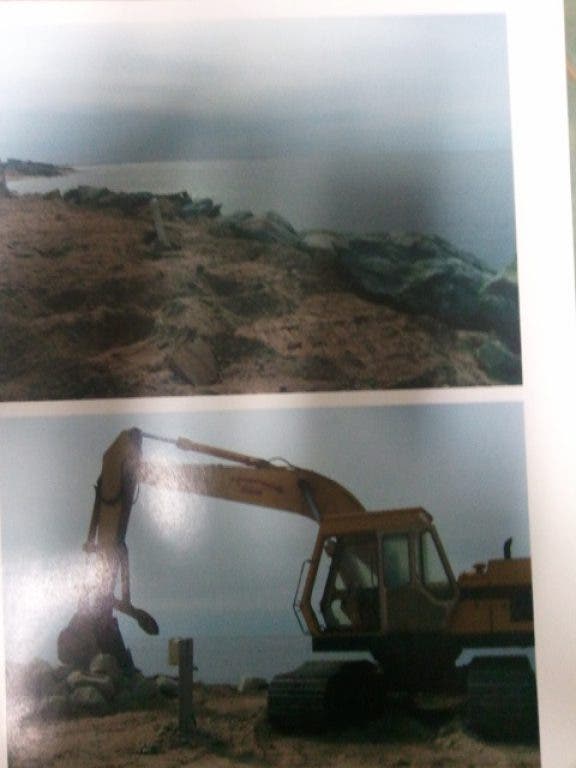
Melnick and Dring aren’t the only ones who share that sentiment, either. Among the slew of April 2010 violations were those issued to both the Matunuck Beach Trailer Association, and George Sherman Sand and Gravel. Both Violations were pertaining to the re-grading of a lot, and the incidental repair of a rip rap revetment on the Trailer Association property. George Sherman provided the following account.
“I had a machine there and a person going back and forth. [CRMC] put a little business card in the machine. He didn’t see it at first and was finishing the job and realized the little card was there that said cease and desist so we stopped. But they took pictures of before and after and said we did not cease and desist when we were supposed to.”
As a courtesy, the Matunuck Beach Trailer Association handled litigation and subsequent fines for George Sherman Sand and Gravel. The repairs to the revetment were never finished, but the Trailer Association now has a permit to carry out the work and it will be completed once the weather turns, according to Sherman.
Stay tuned to the South Kingstown Patch, as Friday Frank Mastrobuono will present the final chapter discussing the town's role in working towards a long-term solution in Matunuck.