Neighbor News
Save Our Seas
A brief explanation in regards to the effects of Ocean Acidification, and how to make a difference.
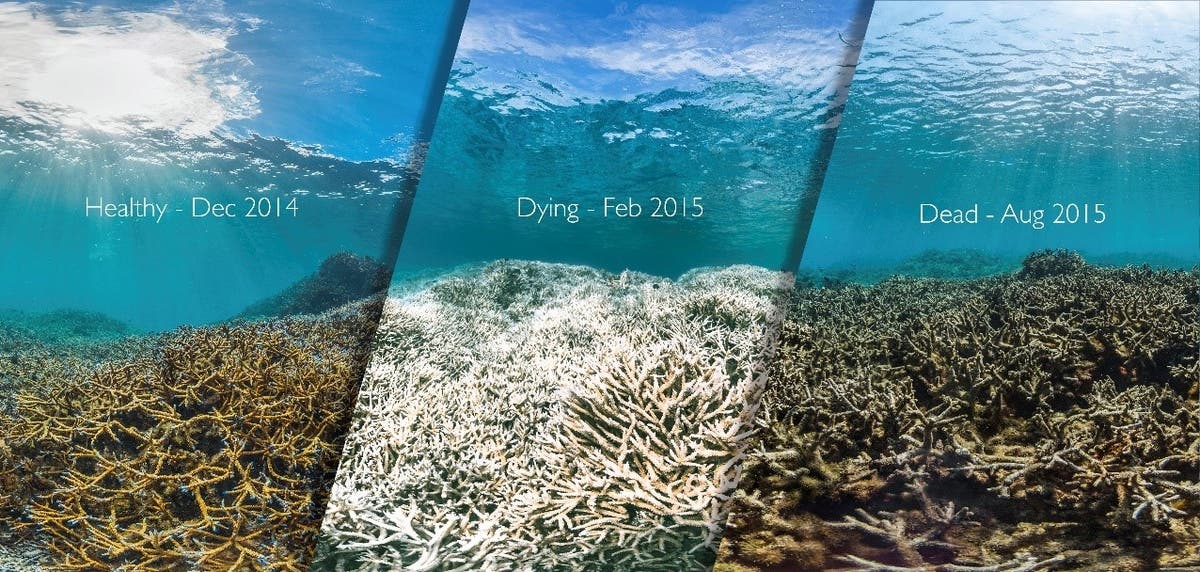
Life was born in the ocean. It is the origin of biodiversity, and arguably the greatest resource available to humankind. Yet people continue to do it harm. Plastic overwhelms its wildlife, an oil spill kills everything in its path, and the excessive burning of fossil fuels is changing its delicate chemistry. The picture above was taken at the American Samoa Airport reef, documenting the horrible reality of coral reefs in the modern age. The phenomenon that causes this is known as ocean acidification.
Ocean acidification is essentially the massive amount of carbon dioxide being absorbed by the oceans. This is slowing a greenhouse effect, but destroying the oceans and reefs at alarming rates. Acidity is calculated using the PH scale; the measure of concentrated hydrogen ions. As carbon dioxide is excessively pumped into the atmosphere by humans, more than a third of it gets absorbed into our oceans and seas. All of this CO2 becomes harmful when reacting with H2O, the chemical make-up of water. Through a chain of chemical reactions, the ocean becomes overpopulated with hydrogen. Hydrogen ions are increasing the acidity of the water, and it’s happening rapidly. The problem isn’t necessarily the excessive hydrogen, but the lack of calcium carbonate. The overly active hydrogen reacts with available carbonate ions, the chemical needed for calcium carbonate. Simply put the increase in hydrogen decreases the amount of calcium carbonate in the water. This may not seem like too big of a deal, until you realize how important it is to aquatic life at every level of the food chain. The concept is abstract in the chemical sense, but the effects it has on the planet are clearly evident.
The question is, why is calcium carbonate so integral to marine life? Calcium carbonate is needed for shells and coral to grow and repair themselves. A shortage will disrupt almost every living organism in the water. Coral reefs, mollusks, crabs, and a slew of other organisms no longer have the calcium carbonate they need to survive. More importantly certain single celled organisms no longer have what they need to make their little shells. Foraminifera is a single celled planktonic animal that is often found on the ocean floor, and uses calcium carbonate to cover itself in a shell. They’re food to small animals such as sand dollars or snails. Coccolithophores also need shells, and are major phytoplankton producers. Coccolithophores and foraminifera are some of the most important things in the whole ocean, because of how they can create their own energy and feed lower level animals in their ecosystems. Due to the effects calcium carbonate has at the base of marine ecosystems, even the biggest of fish will eventually be affected. With nothing to eat, species will die out or shrink in size. This means humans will have a lot less food, with billions of us starving already.
Find out what's happening in Narragansett-South Kingstownfor free with the latest updates from Patch.
Coccolithophores have always been a major part of our oceans, and massive deposits of their fossils have been found on beaches across the globe. Their fossil deposits lead us to believe they have played a major role on earth for a very long time. Not only are coccolithophores essential to life in the water, but could possibly be key to all life on earth. Coccolithophores release a chemical that is a huge factor in cloud creation. If there is a reduction of these coccolithophores, cloud cover and UV-ray deflection could diminish; leading to rising temperatures across the globe.
Biodiversity is threatened by ocean acidification because it can decrease immune system productivity and eliminate entire ecosystems. Coral reefs create the most abundant and diverse ecosystems on the planet, and they are dying across the world due to the acidity of the water. To lose such beautiful parts of our world is crime enough, not to mention how greatly the extinction of coral reefs would affect all marine life. With increasing PH levels in the water, coral doesn’t have enough calcium carbonate to repair itself, let alone grow. Coral reefs are the most important and abundant places in the oceans, and without them life in the water would decline expeditiously.
Find out what's happening in Narragansett-South Kingstownfor free with the latest updates from Patch.
Humans have caused a lot of problems recently, but with enough desire to fix our problems there is no reason why we can’t overcome. The first thing to do is raise awareness to the dire problem at hand. Fortunately, people are aware of global warming and its harmful effects. What people don’t know is how it is affecting the ocean and all the animals in it. Educating people is the first and hardest challenge facing organizations such as ours.
Ocean notion’s main goal is to protect our waters for future generations to enjoy. The ocean is such a fantastic resource to mankind, and cannot be ignored in its time of need. The more people know about the struggles their environment is facing, the more they’re willing to help. Ocean Notion spreads awareness about the current dangers facing our oceans and natural waters. Through proper promotion we can help reduce our communities carbon footprint, and take a big first step in the right direction. Even though ocean acidification is very serious, it isn’t the only problem we face. Every piece of plastic cleaned off the beach, and every wetland cleaned of waste helps a plethora of local marine life. Cleaning up our oceans is a multifaceted effort; and due to our past mistakes our efforts need to encompass multiple forms of operation. Cleaning up beaches of trash and harmful waste may seem like it’s not enough when compared to the big picture. But together we are the big picture, and if enough hardworking people put their best efforts before them, we can achieve any goal. While we fight to fix ocean acidification; we need to continue our efforts to clean up plastic, agricultural waste, as well as industrial ocean dumps. As an organization, it is our goal to spearhead the mission of cleaning our oceans. Join in the fight to save our planet, so future generations can enjoy it as well.
Sources
Gattuso, Jean-pierre, and Lina Hansson. "Ocean Acidification." Google Books. Oxford, n.d. Web. 28 Feb. 2017.
Photo composite of before, during, and after bleaching at Airport Reef, Tutuila, American Samoa (image courtesy of R. Vevers, XL Catlin Seaview Survey).
Bennet, Jennifer. "Ocean Acidification." Ocean Portal. N.p., n.d. Web. 2 Mar. 2017.