Politics & Government
A Night with a Newport Noise Officer
Patch takes a ride with Zoning Officer Dan Titus.
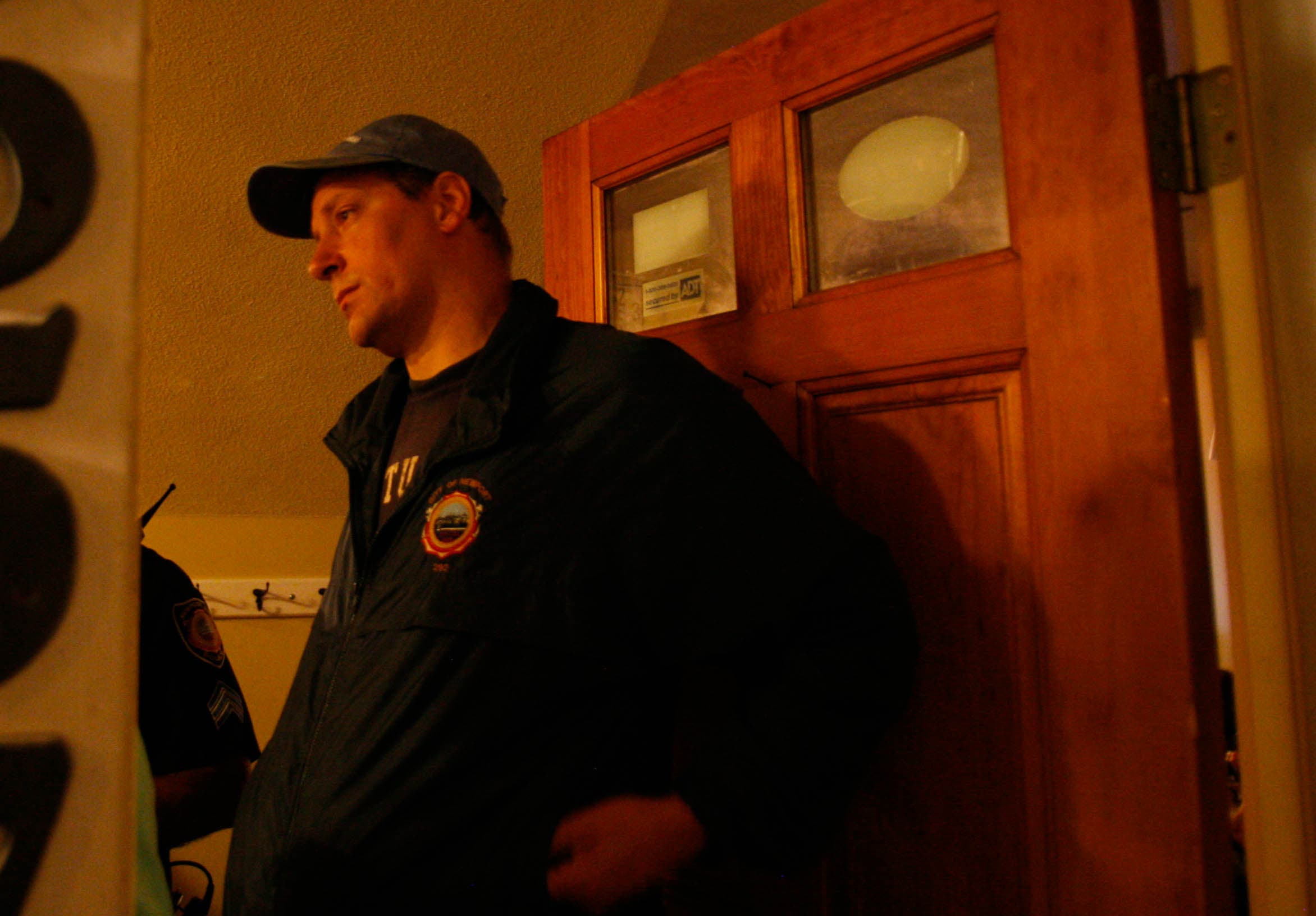


Around 11 p.m. on a recent Saturday night, Dan Titus, one of Newport's two deputy zoning officers, leaned his large frame against a giant Plane tree and bobbed his head to a Run DMC song blaring from a courtyard several houses down.
"Not a bad song, actually," he said, "but way too loud."
He'd just taken two noise meter readings from a spot on a street directly across from the party. At the tree, using both thumbs, he typed details into his Blackberry and e-mailed them to himself.
The party was in violation of Newport's noise ordinance, meaning the music measured over 55 decibels from where Titus took the reading. He was waiting for the police to arrive, trying to stay out of plain sight. When they came, he accompanied the two officers as they told the host to take the party inside. The crowd of 18 murmured disapproval. The music was turned off. Titus remained quiet.
Walking back to their cars, one of the officers turned to Titus.
"We'll be back," he said.
"Oh yeah," said Titus. "We'll be back."
As a part-time deputy zoning officer, Titus describes his primary objective as "proactively keeping nuisances down." He works from 8 p.m. to 3 a.m. on Thursdays, Fridays, and Saturdays, responding to noise complaints from residents, looking for parking, garbage and other zoning violations, and trying to find noisy places before they become complaints. Often Titus will drive up to addresses known for parties, shut off his engine, and coast by, head cocked, listening.
"Summer is by far the busiest," he said, "because it's the ever-changing crowd."
The city has made many efforts in recent years to combat the noise problem in Newport, and has had notable successes. The city implemented a "Zero Tolerance" policy during the summer of 2000 to aggressively enforce its existing ordinances relating to noise, garbage, parking, overcrowding and illegal rentals. Then in 2002 it created the "Party House and Nuisance Mitigation Plan," which recommended a series of amendments to those ordinances, policies and programs to mitigate the problems further. Planning and Zoning Director Paige Bronk said officials revisited this plan a couple of years ago and found that they had successfully implemented most of the 21 recommendations. One of those recommendations was to hire a full-time deputy zoning officer who would more proactively track illegal rentals, overcrowding, parking problems, minimum housing code violations and surveillance. That position is held by Titus' long-time friend and work partner, Dennis Sullivan.
But even with these many improvements, the issue of noise is still on the minds of residents. At the August forum of the Alliance for a Livable Newport, about two dozen residents showed up to hear city leaders talk about the work that's being done today to combat motorcycle noise, fireworks and party houses.
Find out what's happening in Newportfor free with the latest updates from Patch.
"People have said to me that they think we're doing an excellent job on noise," Bronk said. "It'll never go away, but we're working on it."
For zoning officers like Titus, a night's work can vary depending on the calls, of which they typically receive between 15 and 20 a night. Right now, their work is in transition with the season, as tourists leave Newport and university students settle back into town. Salve Regina Associate Dean Gerry Willis has worked closely with Police COP Kevin Parsonage on the issue in recent years, and noted at the ALN meeting that they have reduced the rate of recidivism regarding student housing noise complaints.
Find out what's happening in Newportfor free with the latest updates from Patch.
"There's definitely a spike in the fall," Titus said, referring to the return of students. "But we'll issue three or four citations, and hopefully word gets around."
Titus said that issuing a citation will usually cause houses to quiet down. A citation means a summons to municipal court. Short-term visitors don't tend to know this, or don't tend to care, making summer far busier than the other seasons.
If there is a violation—after 10 p.m., residences are allowed up to 55 decibels, and businesses are allowed up to 75 decibels until 1 a.m., after which time 55 decibels becomes a violation—it is up to either the police to cite on scene or to Titus's boss, Zoning Officer Guy Weston, to issue a citation based on what Titus tells him. Titus only gathers evidence.
Around midnight, Titus drove by a tavern on Marlborough Street, and noticed the door was propped open.
"That's a violation," he said, taking out his Blackberry. "We'll come back."
Upon returning, about a half-hour later, he saw the door ajar and shook his head.
"We have very few problems with bars, because 75 decibels is so loud," he said, "but those doors and windows need to remain closed."
He said the majority of problems come from residences. By 1 a.m., Titus pointed out no fewer than 15 residences that he'd responded to recently, as well as entire streets, like Ann and Brewer streets, which he finds himself visiting on a regular basis.
Titus said part of his job is to meet with businesses to explain how to limit noise complaints. He also meets with neighbors, explaining that sometimes, while there may be noise, it doesn't necessarily mean a violation.
Around 2 a.m., Titus accompanied police into a house that had registered less than one decibel over the limit. One of the residents revealed that they were renting the unit for five days. Titus took over questioning from the police officers, suspecting a zoning violation. The lease was produced on an iPhone.
"They should know better," said Titus later of the building's owner. "You need a permit for short-term leases."
Walking back to his car, a woman addressed him by name, introducing herself as an attendee of that ALN forum on noise.
"It was eye-opening, seeing how much work you guys do," she said. "The noise can really wear on you."