Arts & Entertainment
Hard Work and Puppet Play
The children's puppet theater production of Cinderella is being held today at Newport Library.
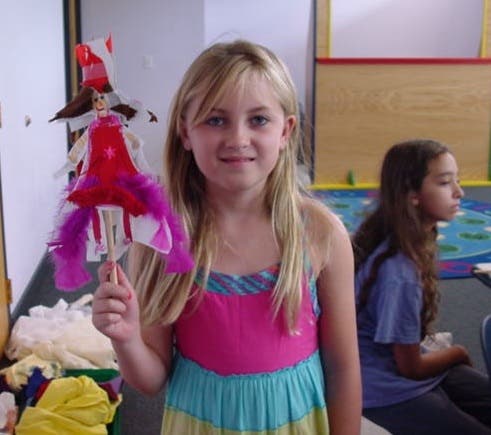


Puppet camp at the Newport Library is not all child's play. It's a week packed heavily with focused creativity that starts by developing a storyline.
This year the story is Cinderella, and on the first day, Camp Director Sue Klau encouraged children to compare many versions of the Cinderella tale in order to discuss the dramatic issues and decide how their version of the story would go. The discussion included why the stepsisters might be so mean to Cinderella when she comes into their house.
"The kids said maybe they were jealous and things like that," Klau said.
Klau, a Sarah Lawrence alumna who winters in Puerto Rico, has appeared for 45 years using puppets to teach English on Puerto Rican television (Canal 6). And while summering in Newport, she regularly holds short, Tuesday evening puppet workshops for younger kids. But this is the first year she has tried the week-long camp, an instantly popular library program that ended up having to turn seven children away.
"I'm learning that we took on an awful lot in a short time," said Klau as the camp headed into midweek and only about half the necessary puppets had been completed.
She also found this group of children opting for realism in their story. "For some reason they wanted to get away from the magic and have it like it really could happen," Klau mused. "But they voted on that."
So the fairy godmother who once waved her wand to turn Cinderella's rags into a ball gown has morphed into a helpful relative.
Klau recounted the children's version of events: "Her aunt, her godmother, not her fairy godmother, goes by on the horse and hears her crying and goes in and switches dresses with her. And so we're getting away from some of the magic that the kids objected to a bit."
As the week continued into mid-week, it became a maelstrom of falling ribbon, sticking glue, faux fur, and ubiquitous plastic googly eyes, used for making puppet eyes. These sticky-backed eyes, the children found, also made excellent fashion statements. The proverbial "third eye" and "eyes in the back of your head" started cropping up on children all over the room. Anyone looking down might have spotted the occasional Cyclops eye stuck to the floor.
"You've got to stop taking all the eyes and gluing them onto your body!" called a voice barely heard above so much industry going on in the room. Klau instructed and worked with the children assisted by ever-patient Cindy Mahood. Other library personnel regularly came through to help cut outlines or tape severed limbs back in place. Most of the children at camp were in the 8-1o year range.
Apart from creative diversions, like half-made-puppet combat, the children became engrossed in the task at hand. Puppet characters were drawn on paper and then cut out. Pieces of fur were cut into mustaches. Colors were matched. The children looked at the fabrics, yarns, ribbons—supplied by the library, Mahood and some parents—and came up with creative ideas for coordinating and building outfits.
"Don't make the arms or legs too thin; it won't look good for a puppet," Klau instructed the children.
Building a puppet is full of small engineering and logistical puzzles. For example, in the rod puppet's life, wardrobe is not a selection of clothes; it's a series of clones.
"You have to have two different princesses," Klau explained to the group, holding up a sample puppet, "one with a ball gown [for the ball scenes]. So try to make them look the same." The children didn't always want to draw the second puppet to look like the first one.
Hiding the doweling rod glued to the backside of the decorated puppet offered another challenge. It involved tracing the frontal puppet onto a second sheet, cutting out the body, and taping it to the back of the puppet so it had a front and a back with the doweling hidden between. Anyone who misunderstood (or rejected) this principal ended up with a two-faced puppet, or with a frontal view overrun with protuberances from the mismatched backing.
Each time a child finished constructing a puppet, Klau held it up and announced, "Ladies and Gentlemen, we have a puppet."
In the final two days, the children had to make scenery, learn a song (in Klau's best case scenario), rehearse the improvised script, and, without stage manager, keep track of the many puppets and their clones, the step-sisters and mothers, the horses, mouse and cat, the prince, king, queen, and Cinderella. Serious business indeed.
The finished production, to be enacted behind a real puppet stage at 4:30 p.m. on Friday afternoon, is a 3-act puppet show open to the public.