Arts & Entertainment
'Japan Craze' Has Special Meaning for Some Newporters
The exhibit, at the Newport Art Museum through Oct. 17, highlight's Rhode Island's connection to the Far East.
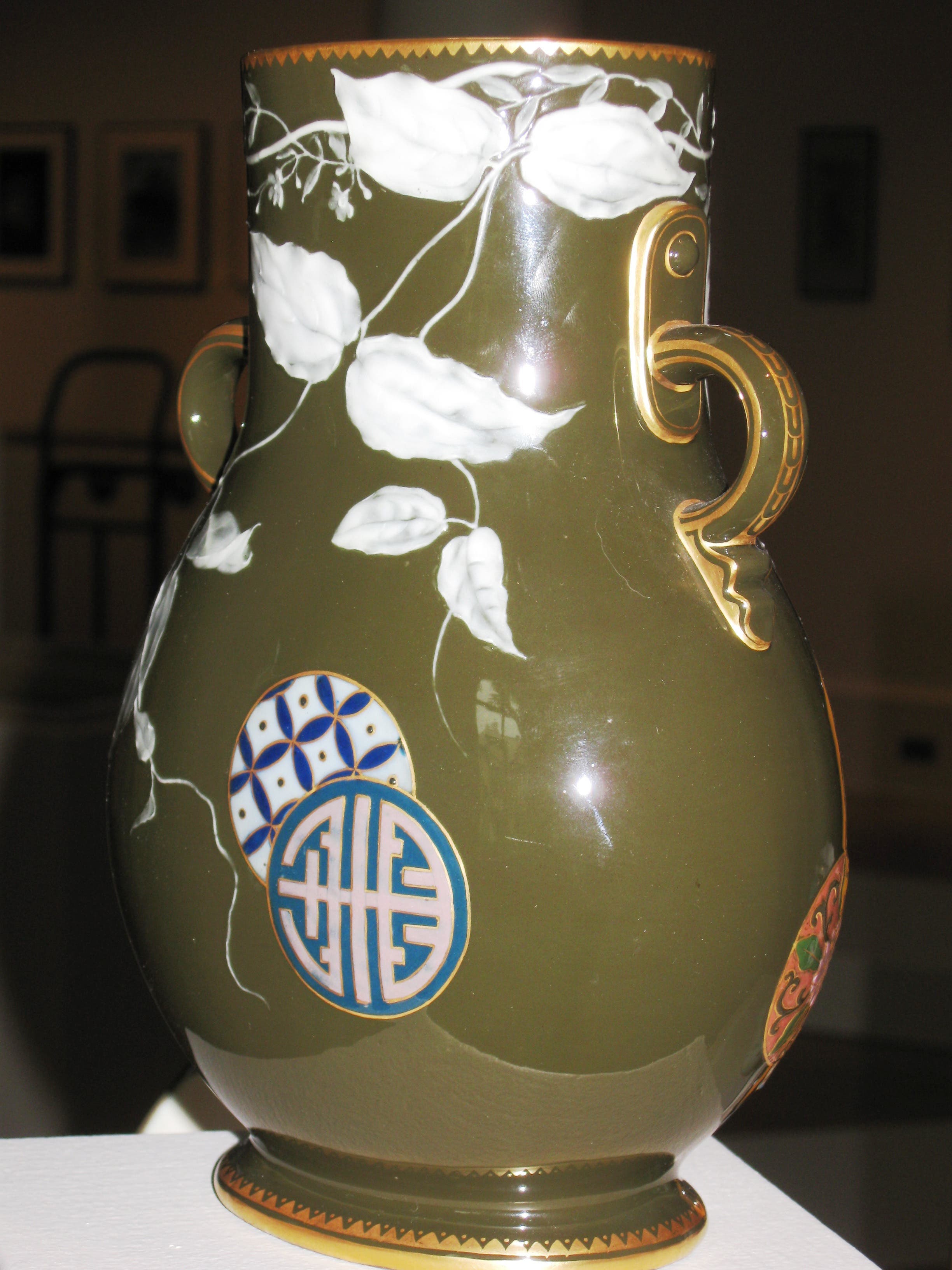

On the surface, the paintings and decorative art objects of "Japan Craze," an exhibit currently at the Newport Art Museum, document the artistic melting pot that roiled in Newport during the Gilded age. Newport artists like John LaFarge were on fire, excited by the Japanese aesthetic and by his travels to Japan. Moguls like William Henry King, of Kingscote mansion, traveled to the Far East and brought back Oriental art, furnishings and wares. Commodore Matthew Calbraith Perry secured the famous trade treaty with Japan, which pressed that closed society to open its cultural gates to the West.
A generation or two later when the Newport trendsetters traveled to Europe to shop, vacation, and hunt for titled husbands, they, too, brought back "Oriental treasures." But these, according to Newport Preservation Society curator Paul Miller, were not, in fact, from the Orient. They were from the Near East.
"They brought back, for example, paintings that were so Moroccan—Bedouins camping in a desert," he said.
Find out what's happening in Newportfor free with the latest updates from Patch.
In European art, Japanese, French, and Middle Eastern elements could end up side-by-side and be called Oriental. The same synthesis made its way into American art and art collections. The Japan Craze exhibit (curated by Nancy Whipple Grinell) sweeps us through this whole historical panorama.
But a closer look at the name tags of people who have loaned these artifacts, the pairs of shoes, the folding fans, the kimonos, cigarette lighters, paintings, vases, all on loan to the exhibit, enlivens the objects with a present-day story where they are not so much documents of an era as parts of someone's family and personal history. For these lenders, there's a hint of trepidation in letting the works out, and perhaps empty spaces while they're away.
Find out what's happening in Newportfor free with the latest updates from Patch.
Frederick A. Cushing, grandson of the well-respected American painter Howard Gardiner Cushing, loaned "Ethel in Kimono" (c. 1909) to the exhibit, Ethel being the painter's wife.
"The museum asked if I had anything that might fit this particular exhibition, and since I had the picture of my grandmother in her kimono…," he stated.
Frederick Cushing remembers his grandmother well, though he never knew the painter.
"He died when my father was 12," Cushing recounts.
He also lent paintings on glass (garasu-e) depicting Japanese harbor scenes, possibly dating back to the late 18th century.
"I've had them since my mother and father died," he said. "They used to hang in the main house and I really rather liked them."
Cushing admits that "of course" he misses the loaned paintings, "but it's for a good cause, so I can tolerate that."
For Miller at the Preservation Society, which oversees the Kingscote and Chateau-sur-Mer mansions, choosing works to loan the exhibit is a long, careful process of board meetings and consultations. It begins with Miller and the visionary curator of Japan Craze, Grinnell, going through the mansions and taking pictures.
In the mansions, the works hang or sit among many objets d'art; they blend with their surroundings; they showcase the mansion and its past owners. "The Lily Pond," hangs above a lady's dressing table, gracing the boudoir where it nestles against the rose-patterned wallpaper. The Tiffany Tea Caddy—Miller thinks it might be the earliest documented Tiffany Japonesque-styled Tea Caddy—is tucked under a mahogany sideboard.
Both are chosen for the exhibit, and Miller is happy to lend the works because at the museum, each artifact gets individual attention. Even if the pieces at Kingscote and Chateau-sur-Mer are not "family" for Miller, he speaks about them with genuine affection in his voice. After seeing the exhibit, he remarks, "I loved in the central rotunda the way the Emile Guilemen bronze Japanese maiden was displayed."
The elegant floor lamp, or "torchere," he's referring to, normally sits at the top of a grand staircase.
"The way it was lit [in the exhibit] you could see the contrast in the patinated bronze with the giltaccents, the plum blossoms of her dress," he said. "In Chateau-sur-Mer, it's a lighting fixture. You walk right by it."
In one Japan Craze exhibit room, a magnificent 18th century suit of Japanese armor confronts you boldly. It comes from Belcourt Castle. Though the suit looks fragile and worn, it still creates a daunting impression.
"Of course it was designed to frighten the enemy as well as protect the man that wore it," says Belcourt Castle owner Harle Tinney.
Like Cushing, she has a long, fond history with the artifact on loan. She's had it on display at the castle for over 30 years.
"The silk is very delicate right now," says Tinney, "and there's not much that anyone can do to revive silk once it's in that stage."
She notes that her late husband could have restored the armor to its glory. When asked if it's nerve-wracking to see the armor travel, she replies, "a little bit, yes."
But also like Cushing, Tinney feels strongly that the value of the exhibit outweighs the risks.
"The inter-museum connection," she says, "is very important, for every museum to work together."