Politics & Government
Continued Inaction On Rolling Greens Development
Discussion of deadlines and water issues eventually ends in agreement to further postpone action.
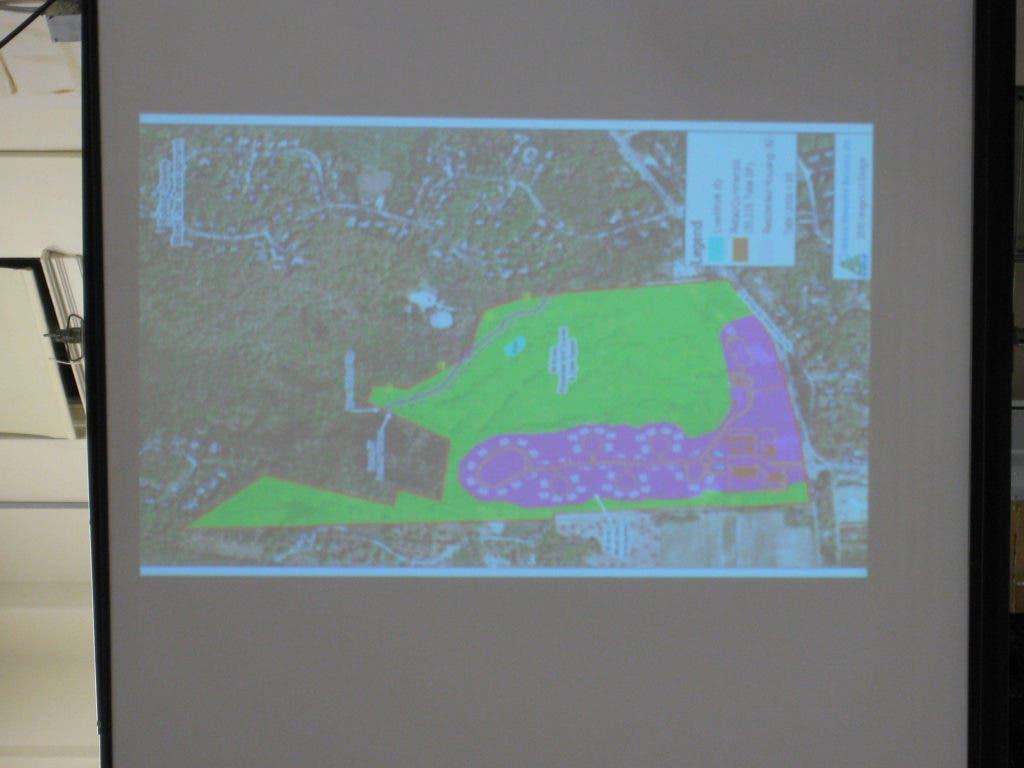


Last night’s meeting of the North Kingstown Planning Commission provided a public exposition of the master plan for the proposed Rolling Greens development, but again produced no recommendation.
On the agenda were a public hearing and a recommendation to the North Kingstown Town Council regarding an amendment to the town’s comprehensive plan and zoning changes that would accommodate the proposed development.
The commission voted unanimously to continue the two items to the March 24 meeting. Both were previously continued from the commission’s Oct. 19 and Dec. 7, 2010 meetings.
Find out what's happening in North Kingstownfor free with the latest updates from Patch.
At issue is a parcel of 132 acres including Rolling Greens Golf Course on Ten Rod Road near Route 2. The applicant, M.L. Hawk Realty, LLC, proposes the construction of a village-style development with a mix of housing and commercial units on the site similar to South County Commons in South Kingstown.
The area is currently zoned primarily for residential use with commercial patches. The proposal under consideration by the commission would designate the area a Mixed Use Planned Village Overlay Zone.
Find out what's happening in North Kingstownfor free with the latest updates from Patch.
Paul Attemann, a representative of Donald Powers Architects, and Scott Rabideau of Natural Resource Services, Inc. presented the master plan on behalf of the applicant.
The plan, filed with the town last Friday, calls for 88 units and a total of 35,000 square feet of retail space.
The plan was scaled down from the version previously discussed at commission meetings in October and December of last year. That plan featured 92 units and 47,000 square feet of retail, and itself represented a reduction in scale from an earlier draft, according to Attemann’s presentation.
As currently envisioned, the development would retain the golf course. A one-way street with a single entrance by the golf course would lead all traffic to the development, including golfers, through the retail and commercial section.
Age restricted two-bedroom houses built in clusters would form a retirement community, with communal gardens and a village green that Attemann said would help to foster community development.
Speaking of the environmental impact of the development, Rabideau said that under the proposal, 40 of the 132 acres would be developed, with the rest preserved in perpetuity.
“That’s a little over 90 acres of open space that will permanently be preserved. That’s going to be legal open space from now until eternity. That’s the balance here,” he said.
Adding to the complexity of the issue, the Rolling Greens area is in a groundwater overlay district, restricting the size of the possible development and creating concerns about the protection of the groundwater.
Most public comment and questions focused on this question of the town’s drinking water; how the development might affect the groundwater and whether it would receive town water. After some discussion, the commission determined that the application contained language that would require the town to supply public water.
Town Director of Water Supply Susan Licardi told the commission that the water department was not in favor of expanding water service in light of the , and commission member Jeffrey Michaelson called the language a “deal-breaker.”
Another issue at the meeting was whether the applicant would continue to waive the time limit for review or demand an immediate decision.
The Planning Commission originally had 45 days in which to consider the application and make a recommendation to the Town Council.
The applicant chose to waive that limit until Tuesday’s meeting on the understanding that they would be participating in the creation of a comprehensive vision for the area said William Landry, the applicant’s lawyer.
Landry said that this expectation had not been met, and urged the commission to send the application on to the Town Council.
“If the Town Council doesn’t want to proceed to consider the type of vision that we’ve identified, that’s fine. We’ll [withdraw] this proposal, submit another one,” Landry said.
Landry, on behalf of the applicant, eventually agreed to a further extension on the condition that the commission members and the applicant get together some time before the April meeting.
The commission subsequently passed a motion to continue the items in question to a new meeting to be held March 24 with a work session earlier that day.
In other related business, Nathan Kelly of the environmental science and engineering firm Horsley Witten Group presented the findings of a study evaluating eight sites considered for potential development.
The study, funded by a $70,000 state grant, identified areas that might be candidates as receiving areas for transfer of development rights, a process which involves the sale of one area’s development rights to another.
The firm judged eight areas based on potential for development versus constraining factors, and concluded that the Allenton, Hamilton, Wickford Junction, and Lafayette sites were all strong candidates for potential development. The Wickford Village, Davisville and Saunderstown sites were judged unsuitable for development,
Horsley Witten listed the Rolling Greens/Bald Hill Nursery area was listed as an equivocal “no.”
“Because of the lack of a cohesive vision associated with this area…it is not possible for us at this point to say if TDR is appropriate,” Kelly said.