Community Corner
DEM Says No Evidence to Support Brown's Claim of Carving Rune Stone
The Town Council on Monday will discuss the future of the Narragansett Rune Stone and if it should end up in Updike Park in Wickford.


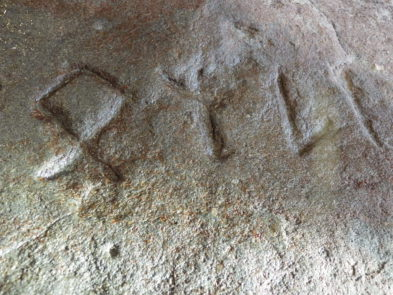
The Criminal Investigations Unit of the state Department of Environmental Management’s law enforcement division has concluded that Everett Brown, who claims to have carved the Narragansett Rune Stone in the 1960s when he was a 13-year-old boy, is likely lying.
“We cannot find any evidence to substantiate Mr. Brown’s claim,” a detective said in an e-mail message obtained by the Patch. “Our statement is based on our investigation, witness interviews, and likely skills and talents of a 13 year old child with a reasonable expectation of tide schedules for the year. ”
Brown did not respond to several requests from state officials asking for more information about his claims. He also did not submit a formal statement to law enforcement and “has not provided any concrete proof that he carved the stone,” the e-mail stated.
Find out what's happening in North Kingstownfor free with the latest updates from Patch.
But DEM officials did meet with a number of people who have signed sworn affidavits attesting to encountering the stone before Brown’s claim of carving the stone over the summer of 1963 with simple hand tools borrowed from his father and a book of runes as inspiration.
And the investigation suggests that the people who signed the affidavits, mostly longtime residents and former visitors to Pojac Point in North Kingstown, where the stone has been a source of mystery and intrigue for generations of locals, are telling the truth when they recount seeing it partially submerged under the tides and occasionally exposed during exceptionally low tides.
Find out what's happening in North Kingstownfor free with the latest updates from Patch.
In one account, Patricia Lindsay (formerly McMahon) recalled playing “Indian” on the rock as early as 1948.
“I spent summers there growing up,” she wrote. “I was 11-years-old and I remember playing ’Indian’ on the rock as we thought Indians made the markings. It was visible at low tide and large enough to climb on.”
McMahon’s family bought the property in 1948. A thorn of land jutting out into Narragansett Bay just south of the Potowomut River, they sold it just five years ago to billionaire Timothy Mellon, heir to the Mellon Bank empire, for $5.6 million. This is about when the stone’s mythic power started to reach far beyond the shores of Pojac Point.
The actual origins of the stone, discounting Brown’s story, are unclear. Some believe it is of Viking origin and was carved in the 1400s by voyagers. A compelling analysis by Valdimar Samuelsson of Iceland purports that the stone was the work of Icelandic explorers and settlers in medieval times. If true, the history of America would have to be re-written as the discovery would pre-date Columbus’ arrival to the New World by decades.
And then there’s Scott Wolter, who has raised a theory that the stone might be the work of the Knights Templar. His work on the stone was featured in an History Channel documentary that helped to make the Narragansett Rune Stone the focus of international scrutiny at the same time it riled other researchers who discredit him as a wannabe Indiana Jones.
Others believe the stone has much more modern origins, likely in the 18th or 19th century, by Icelandic immigrants or people with Nordic lineages who were paying homage to their ancestors and background.
Earlier this year, town officials were very welcome to the idea of installing the stone in Updike Park in Wickford after yet-another mysterious episode in which the stone was reportedly sunk out at sea by Mellon and then ordered back after the state caught wind of its disappearance.
State officials have refused to release any details about that ordeal, but they have been collaborating with town historian Tim Cranston in an effort to get it moved out of its current storage place at the University of Rhode Island’s Bay campus in Narragansett.
But when Brown came forward with his account, the plan for the stone to be erected in Wickford was put on hold as town officials decided to look into the claims.
Though it’s unclear what the council’s action will be on Monday night (stay tuned for an update), it is clear that many, regardless of what they believe are the stone’s origins, think it should go into Updike Park.
In an e-mail, Wolter said it’s clear that Brown is not being truthful and “this distraction should not deter the town. . .from embracing the stone and the controversy.”
“When the reasonable minds defer to the factual evidence, the amazing truth behind the creators of this stone will become realized and it’s profound importance will take its appropriate place in history,” Wolter said. “Until that day, the artifact needs to be protected and preserved by responsible people with vision.”
In more practical terms, the stone in Updike Park could be a major tourism draw and a focal point for the village’s efforts in launching an economic and social revival. For a small village in Rhode Island hoping to raise its profile, in the words of Cranston, “this is publicity money can’t buy.”
Get more local news delivered straight to your inbox. Sign up for free Patch newsletters and alerts.