Arts & Entertainment
How Deer Can Help Trim Shrubs & Other Insights
Pruning the dos and don'ts kick off a free lecture series presented by URI Master Gardeners at Smith's Castle.
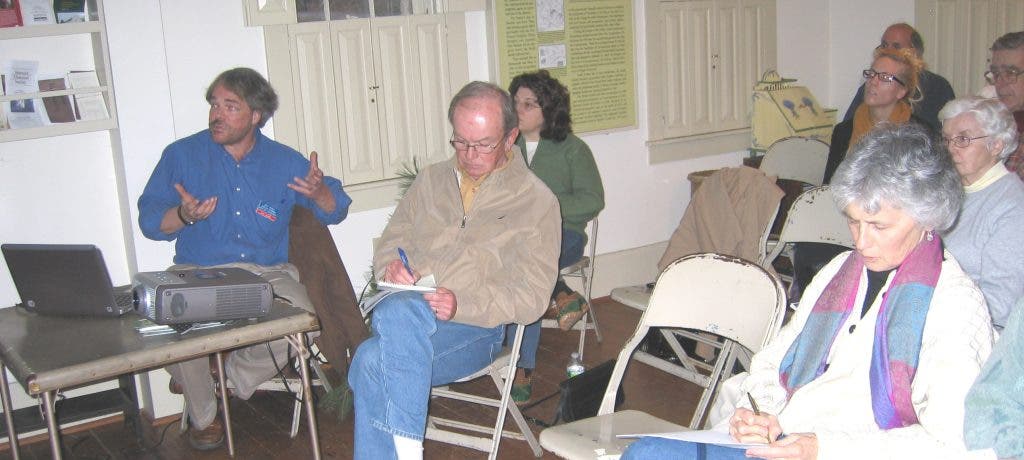


Master Gardener Jeff Rossi believes in keeping gardens in order, but he also believes plants will be plants, and there’s only so much even the most determined gardener should do if a plant ends up in a less than perfect spot.
For a formal hedge of holly or boxwood in a sunny, well-drained garden, he explained, standard advice works quite well: prune narrow at the top and wider at the bottom so the lower branches get needed sunlight.
A garden surrounded by hungry deer, like his northern Rhode Island yard, may
require less conventional treatment. Rossi has a group of hydrangea paniculata that
grow like small trees. Deer eat the foliage as high as they can reach,
maintaining a tree-like silhouette, he said, yet the shrubs produce a lovely
display of blooms.
Find out what's happening in North Kingstownfor free with the latest updates from Patch.
Yews, on the other hand “are deer candy,” he reported. After having yew bushes eaten down to the ground at his home, he’s learned to live without them.
Rossi entertained about 15 gardeners at “Correcting Winter Damage to Trees and Shrubs and Other Pruning Problems,” an hour-long presentation April 12 at Smith’s Castle. His was the first of three free lectures that the URI Master Gardeners will present there this month.
Find out what's happening in North Kingstownfor free with the latest updates from Patch.
Forsythias, which began blooming in mid-April, will quickly occupy adjacent territory without regular pruning, Rossi noted. He passed around examples of how forsythia branches that touch the ground quickly send down roots and start new plants. He advised removing one quarter to one third of old canes every year. If new shoots explode skyward, cut off half their length to encourage branching.
Gardeners are advised to remove one third of old lilac canes every year, too, to maintain a conventionally shaped bush. Rossi said he enjoys an old lilac next to his house that has grown so tall its branches carry scented flowers to a second-story window. He prunes that plant to remove deadwood and keep the tall growth healthy.
Slides and handouts showed examples of good and bad pruning of shrubs and trees. Rossi advised gardeners to carefully study a plant and see how it normally grows before the first cut. Removing lower branches of spruces and other evergreens, for example, can result in a top-heavy “lollipop” tree that easily topples in a heavy wind or snowstorm.
He also handled questions such as "Can an old, overgrown apple tree be pruned to restore its apple-producing vigor?"" Rossi said the answer is yes, but the job would require several years of gradual pruning.
For the next lecture, 6:30-7:30 p.m. Tuesday, April 19, Master Gardeners Claire Chenevert and Earle Perkins will discuss “Black Gold: Compost and Worms are Worth their Weight in Gold,” talk on backyard composting that everyone can adopt.
The third lecture, 6:30-7:30 p.m. April 26, will feature a team of Master Gardener volunteers at the Smith’s Castle outlining spring garden tasks and helpful hints for the rest of the
season.
Terri Melvin, project manager for the Master Gardeners, said the group plans additional lectures involving the Smith’s Castle garden and its colonial design beginning in May.