Politics & Government
Renewable Energy Planners Want to Hear From You
All Rhode Islanders are invited to Thursday's RESP meeting to pose critical questions about siting new alternative energy projects

Without checking Google, can you answer these questions about renewable energy?
a. Which U.S. state has the most wind installations?
b. What is the biggest human cause of bird mortality?
Find out what's happening in North Kingstownfor free with the latest updates from Patch.
c. Where in Rhode Island will a new energy project absolutely, positively not be built?
Questions sailed back and forth Oct. 6 at the second public stakeholders’ meeting of the Renewable Energy Siting Partnership. RESP is a publicly funded effort to develop model guidelines for where to place land-based renewable energy projects, including wind turbines like those proposed for North Kingstown, in Rhode Island.
Find out what's happening in North Kingstownfor free with the latest updates from Patch.
Anyone with questions or suggestions is invited to the next stakeholders meeting Thursday, November 3, 6 to 9 p.m. at the URI Bay Campus in the Hazards A & B Rooms. For more information, visit the website http://seagrant.gso.uri.edu/resp/ or contact Amber Neville at amber@crc.uri.edu, (401) 874-6106.
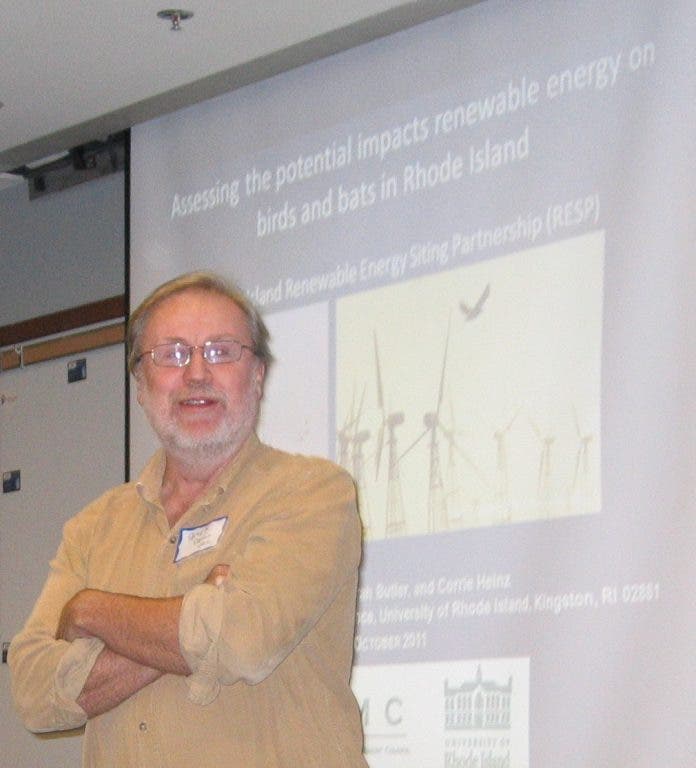
At the Oct. 6 meeting, Peter Paton, professor of wildlife ecology and department chair at the University of Rhode Island, raised some critical questions about renewable energy and wildlife and explained how he proposes to answer them.
URI has a grant from the state Office of Energy Resources to provide scientific answers to questions about the impact of emerging renewable energy technology, including wind, solar and hydropower, and the best practices for developing and maintaining it.
Paton is looking for reliable statistics on Rhode Island’s bird population, which fluctuates by the season, and various species’ nesting and migratory habits. The state has already collected data, for example, on bird night flights over the ocean around the proposed Block Island wind farm. Such statistics have not been collected over land, though doppler radar maps may reveal useful data, he said.
Paton is reviewing previous studies to identify other critical issues. For example, some studies indicate that bats are more affected by wind turbines moving at slower speeds than birds. He also explained how statistics on wind turbine bird and bat kills are collected: Someone must be assigned to go out every day, walk the area around a turbine, and look very closely for tiny carcasses.
After Paton’s presentations, some of the 40 audience members raised questions. A few had attended an RESP field trip to the Portsmouth wind turbine. Two attendees said they were surprised at how quiet the turbine was and how little impact it seemed to have on neighborhood life. “Kids were out playing soccer,” said one.
Yet a third person said the turbine is so noisy he suspects it is having mechanical problems.
Other questions focused on potential health hazards. One key question is whether flickering shadows from turbines represent an annoyance or true health hazard.
Another audience member asked the RESP group to study whether proposals to generate electricity from dams on the Blackstone River would stir up dangerously polluted sediment.
The URI group took note of all the questions and said they would follow up. The also asked the audience to rank priorities for further investigation. The researchers invited any Rhode Islander to contact them with issues they consider relevant to the siting process.
As facilitator Marion Gold said, “The RESP is up to you.”
And, to answer the questions, this is the information provided by Prof. Paton:
a. Texas has the most wind installations in the United States.
b. Tall buildings pose the biggest human threat to birds,that fly into them by the millions every year. (Power lines and pet cats are the next biggest killers.)
c. No alternative energy project will be placed where it would interfere
with the nests of piping plovers, or any other endangered species.