Politics & Government
EPA Scientists Told Not To Speak On Narragansett Bay Report Involving Climate Change
Autumn Oczkowski was supposed to give the keynote at an afternoon workshop session and Rose Martin was slated to speak on a panel.

PROVIDENCE, RI — Scientists planned Monday to talk about a report on the health of Narragansett Bay, New England's largest estuary. But the Narragansett Bay Estuary Program (NBEP), which published the report — which partly involves climate change — said the U.S. Environmental Protection Agency told three scientists not to appear at the event.
The EPA wouldn't elaborate on why the scientists were told not to appear.
"EPA supports the Narragansett Bay Estuary, and just this month provided the program a $600,000 grant," spokeswoman Nancy Grantham said in a statement Monday. "EPA scientists are attending, they simply are not presenting; it is not an EPA conference." (For more information on the event and other Providence stories, subscribe to Patch to receive daily newsletters and breaking news alerts. If you have an iPhone, click here to get the free Patch iPhone app.)
Find out what's happening in Providencefor free with the latest updates from Patch.
Thomas Borden, program director of the NBEP, told The Associated Press that Wayne Munns, director of the EPA's Atlantic Ecology Division, called him Friday to say two staffers who work out of its research lab in Narragansett were advised not not attend. Munns did not explain, but Borden said he understood the decision came from the EPA's headquarters in Washington.
Staffer Autumn Oczkowski was supposed to give the keynote at an afternoon workshop session and staffer Rose Martin was slated to speak on a panel.
Find out what's happening in Providencefor free with the latest updates from Patch.
"We've been working with more than five researchers in that lab who have contributed substantial elements to our report," Borden said.
He said after Munns' call, he checked with a third researcher who consults for the EPA, Emily Shumchenia, and who was scheduled to participate in Monday's event.
"I advised her, you should check with your folks and see if you should attend," he said. "She was advised by EPA Region 1 that she should not attend."
The report finds that climate change is affecting air and water temperatures, precipitation, sea level and fish.
Borden said scientists from a variety of agencies and institutions had been working for years on the 500-page technical document, the purpose of which is to examine the condition of the bay and the trends with data on 24 different environmental indicators. Those include stressors such as population, and also climate change, such as warming temperatures, increased precipitation and increased sea level rise.
"It's a comprehensive scientific update of the status of the bay," he said. "It's not a policy document. It's a scientific report. It doesn't propose policy changes."
All four members of Rhode Island's congressional delegation were scheduled to attend a news conference on the report Monday morning. Democratic Sen. Jack Reed criticized the EPA's move, which was first reported by The New York Times.
"Muzzling EPA scientists won't do anything to address climate change," he said. "While the Trump administration tries to suppress the facts, the American people are seeing and feeling the real world impacts. We need to work on a bipartisan basis to reduce pollution and emissions, and this type of hostility toward science inhibits rather than furthers discussion and action."
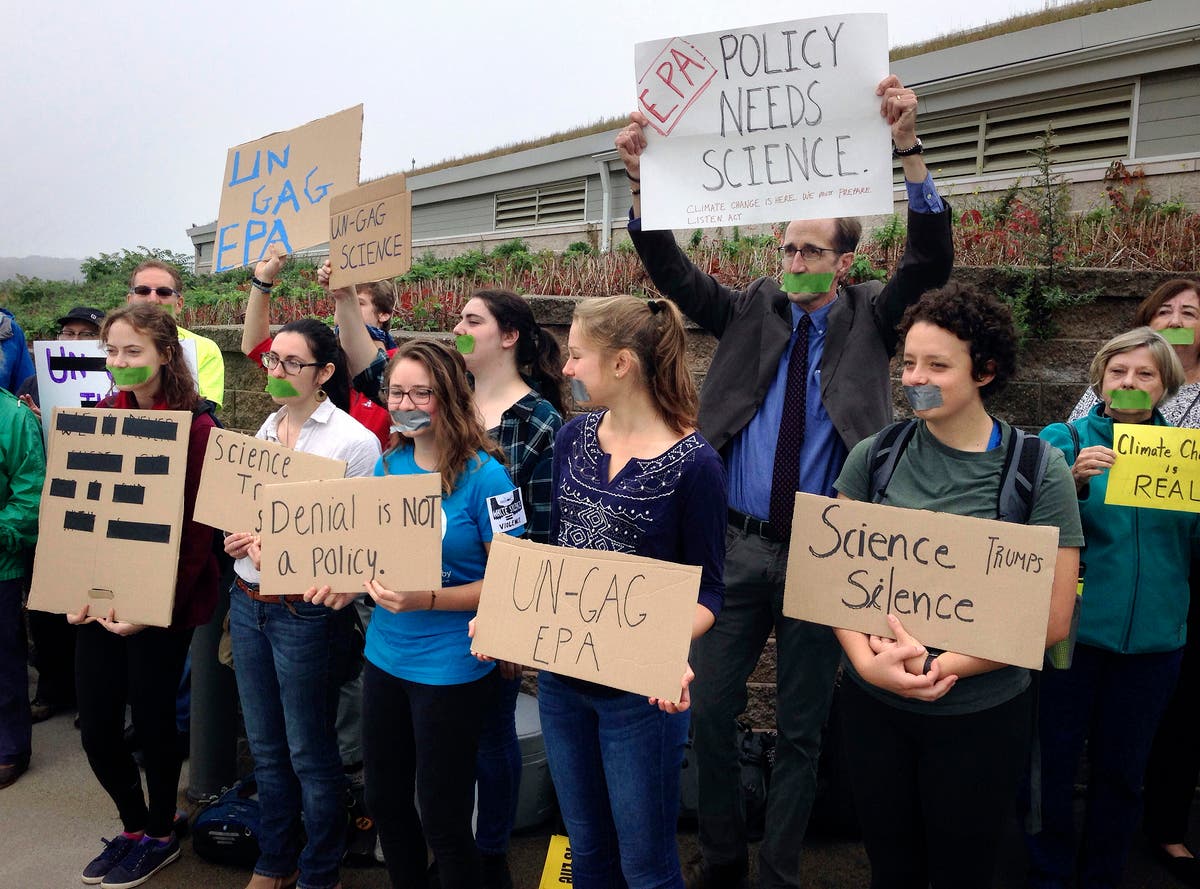
About 30 people outside the meeting Monday protested the EPA's actions. They carried signs including "Ungag the EPA" and "Science not silence."
The estuary program gets all its funding from the EPA.
By MICHELLE R. SMITH, Associated Press
Photo credit: Michelle R. Smith/Associated Press