On a fall day my mother and I headed for the estuary, searching along the rocky shore for sea glass – shards of green, brown and blue – polished smooth by surging tides. I filled the pockets of my sweatshirt with these colorful treasures and listened to the familiar rattle as I took each step.
Passing the breakwater, we sat for a few moments on a huge boulder watching seagulls circling overhead. An egret rose out of the salt marsh, its bright white plumage outlined against the vivid green of the marsh grass. With my back to the light wind, I rambled along, enjoying the warmth of the autumn sun on my exposed face and hands.
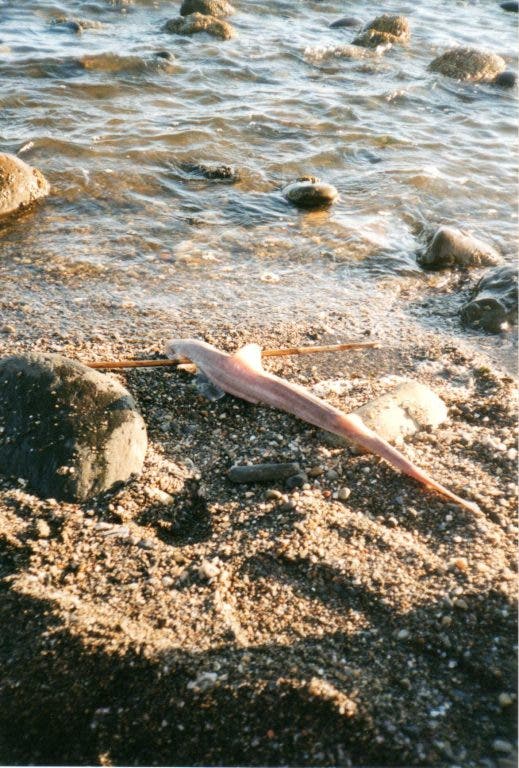
Nearing the mouth of the estuary, I stumbled upon an unusual find: a three-foot-long shark in still waters with a gaping hole beneath its gills.
Find out what's happening in Tiverton-Little Comptonfor free with the latest updates from Patch.
Disturbing a school of minnows that were nibbling on the flesh, I lifted the dull gray carcass from the muddy bottom and ran my hand over the erect dorsal fin.
Killed in deep ocean waters, the shark had been carried into the estuary by a flood tide. Ironically, one of the most deadly predators of the sea was slowly being devoured by tiny fish – already the eye sockets had been picked clean.
Find out what's happening in Tiverton-Little Comptonfor free with the latest updates from Patch.
As I stroked the shark, the soft gray body was pliable to my touch, the skin rough and sandpapery, studded with tiny, tooth-like scales.
Sharks exhibit great maneuverability in the depths but are different from other fish, since they have no swim bladder and cannot regulate their buoyancy. Consequently, they have to constantly swim or sink to the bottom. In fact, it is rare to find a shark’s skeleton, since its soft cartilaginous flesh is readily consumed by fish that feed on the ocean floor. Yet members of this shark’s family are carnivores at the top of the marine food chain.
This shark is called a smooth dogfish. Its habitat is ocean waters 60-feet deep or more, but it enters bays and river mouths to feed. A migratory predator, the species inhabit waters around Southern New England in the summertime.
Members of the Requiem shark family vary greatly in size from the three-foot smooth dogfish to the adult tiger shark, which spans about 25 feet in length.
“God created the great sea monsters,” says the Scripture verse in Genesis; and sharks are monstrous indeed.
Four shark species – the tiger, bull, oceanic whitetip and great white – are most responsible for fatal attacks on humans.
Last summer, there were sightings of great white sharks lured by the seal population off Chatham, MA, as well as shark sightings in nearby Westport, which closed Horseneck Beach.
In 2010, there were two reported fatal shark attacks in United States waters. A 19-year-old died 100 yards from shore when he was pulled off a surfboard by a great white shark in Santa Barbara, CA; and multiple bull sharks killed a 38-year-old kite surfer in Martin County, Fla.
The last fatal shark attack in New England waters occurred in 1936, when a 16-year-old swimmer was killed by a great white shark at Hollywood Beach in Buzzards Bay, MA.
Running my fingers over the shark’s mound of teeth, I shuddered to think that its full-grown counterparts inhabit these waters. I remembered a sunny afternoon when my son and I waded out in low tide a great distance from shore. While we jumped and played in the waves, I wondered about our vulnerability to a shark attack. Thrashing in water stimulates a feeding response in sharks.
The tide turned, and the waters of the estuary pulsed into life as the swift and narrow seaward-flowing current emptied into the ocean. Tossing the carcass into the channel, I watched as the rising tide lifted the lifeless mass and hurled it out to sea. The fish and sea crabs living on the continental shelf awaited their supper.
ABOUT SEA, SKY & SPIRIT: Drawing from the many seasonal faces of Fogland, Linda Andrade Rodrigues paints vignettes about nature and spirituality.