Arts & Entertainment
Religious Society of Friends Is a Kind and Gentle Faith
Russell Cornell of Little Compton is a fifth-generation Quaker elder.
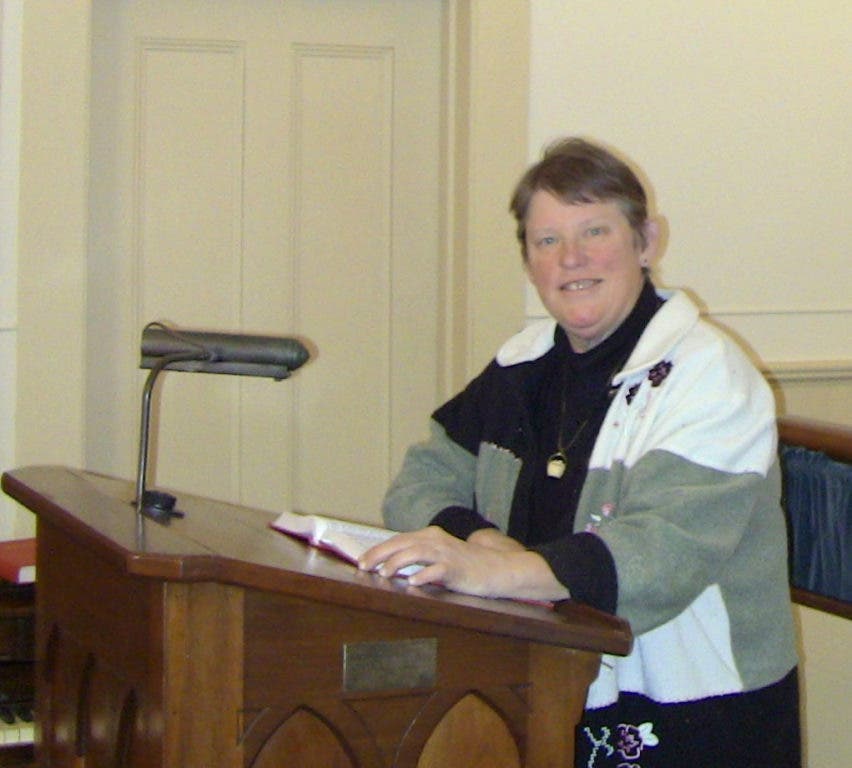


Little Compton residents Russell and Meredith Cornell were among friends at the Smith Neck Meetinghouse for worship last week. A gifted artist, Meredith is a member of in Little Compton, while Russ, a retired dairy farmer, is a Quaker elder at the Smith Neck Friends Meetinghouse in South Dartmouth, MA. Consequently, they are active members at both churches.
Serving as the clerk of the Spirituality Committee of Ministry and Counsel, Russ is also the fifth consecutive generation to wind the old wooden clock that ticks loudly during moments of silence. The stark white interior of the 1819 meetinghouse is very simple, with pulpit, pews, wrought iron chandelier and organ. Bibles and hymnals are scattered throughout the pews.
Interim Pastor Pamela Cole led the service, which incorporates prayer, responsive reading, hymn-singing and choral music. Included in worship is an unprogrammed portion where anyone who feels prompted by Christ’s Spirit is encouraged to share a message.
Find out what's happening in Tiverton-Little Comptonfor free with the latest updates from Patch.
Together the congregation prayed: “Dear God, as we follow at so great a distance in the steps of him who is our Lord, our Friend, our Guide, grant that we may never be discouraged by our failures but still reach out toward him who is far beyond us yet within us, and bring into our world some small fragment of his tenderness, his strength, his clarity, and his judgment. Amen.”
Known for their social testimonies of integrity, simplicity, peace and equality, Quakers are most distinguished by their emphasis upon the Inner Light of Christ.
Find out what's happening in Tiverton-Little Comptonfor free with the latest updates from Patch.
“This Spirit of God is present with us now as He was with the apostles and the prophets of old,” Quaker theology teaches. “When we gather for worship we can in silence allow God to speak to us and out of that silence speak God’s message to each other.”
“We’re our own ministers, each one of us,” said Russ. “We don’t believe in outward ceremony.”
He leads a very simple life.
“My strong point is simplicity,” he said. “I don’t have a credit card, cell phone or any computer. You can’t email me, and I don’t feel left out. That’s probably why I’m so active in the church and not involved in all that’s going on in the world.”
He also lives debt free.
“I don’t believe in buying things unless I have the money to pay for them,” he said. “If our government was that way, we’d be better off.”
Prayer is an important part of his daily life, and he said that the practice keeps him mindful of what he is doing with his time.
“There is no special place to pray in the house,” he said. “We pray before we eat at the table. Families today are not even eating together.”
Russ is proud of his heritage and thankful for the freedom to worship, a right that was denied to the early New England colonists.
According to “A Collection of the Sufferings” by J. Besse, “the Puritan leaders of the Massachusetts colony saw the Quakers as subverters of a holy experiment and as disrupters of civic peace. From their very first appearance, therefore, the Puritans burned their books, locked them up in prison, whipped them, cut off the ears of several who defied them, and in desperation hanged four of them – William Robinson, Marmaduke Stevenson, Mary Dyer and William Leddra – on Boston Common for returning after being banished.”
Mary Dyer had returned to Portsmouth from England in 1657, but was apprehended three years later while preaching in Massachusetts. Convicted and sentenced to death, she died a martyr for the crime of being a Quaker.
“By contrast, the experience of the Quaker ministry in Rhode Island was peaceful and unusually fruitful,” according to “Records of the Colony of Rhode Island.” “Within months after the arrival of the first Quakers on the Woodhouse in August 1657, there were numerous conversions in Newport and Portsmouth. Very soon the whole of Rhode Island became a base for Quaker missions to other parts of New England, a fact that so troubled the neighboring colonies that they tried to persuade Rhode Island to rid itself of its ‘notorious heretics.’ The colony refused to comply.”
The first New England Yearly Meeting of Friends was held in 1660 in Newport. Russ said that his ancestors were originally from Newport, but then settled in Portsmouth.
“When a group of Quakers grows too large or develops in a nearby geographic area, these groups are ‘set off,’” explained Pamela. “So here in South Dartmouth, the numbers of the Quakers were growing. In 1699, the Newport Meeting considered them a large enough number to ‘set off’ as the Dartmouth Monthly Meeting."
In the early 1800s, the Cornell family moved to South Dartmouth.
“That’s the way it was,” said Russ, who at 74 cherishes the faith of his fathers. He invites the community to their Meeting for Worship held every Sunday at 10 a.m. at 594 Smith Neck Road in South Dartmouth.
“Everybody is welcome to attend,” he said.
For more information, call (508) 997-8372 or email info@snfm.org.
AUTHOR’S NOTE: Built in 1815, the historic Friends Meeting House and Cemetery at 234 West Main Road in Little Compton was added to the National Register of Historic Places in 2007. It is operated by the Little Compton Historical Society.