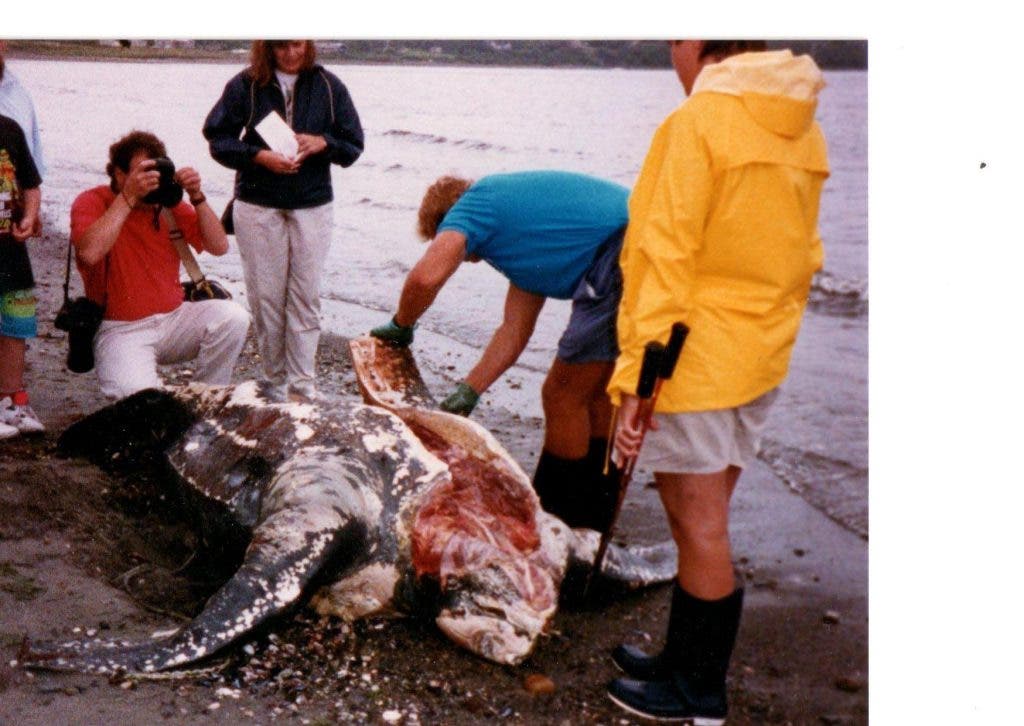
Rambling along the seashore can be an adventure; the strangest things seem to wash up on the beach. Sometimes storms bring in tons of seaweed or layers of mussels that rot in the hot summer sun. But by far the worst stench that has ever emanated from our stretch of coastline came from a most unusual source: the beaching of a dead sea turtle.
I remember well that overcast humid day when the strong sea breeze carried a foul odor that permeated the summer place. Drawn to its source, we rushed down toward the creek.
In the distance we sighted a gathering of our neighbors, surrounding a huge object lying in the sand. As we drew closer, the smell worsened; and I had an overwhelming urge to turn back rather than satisfy my curiosity.
Find out what's happening in Tiverton-Little Comptonfor free with the latest updates from Patch.
When we arrived at the scene, we were amazed at the size of the giant leatherback sea turtle, measuring in excess of ten-feet long.
Two marine biologists from the Wood’s Hole Oceanographic Institute dissected the carcass while the crowd of onlookers hovered around them. With each incision, the stench magnified.
Find out what's happening in Tiverton-Little Comptonfor free with the latest updates from Patch.
Toting cameras and notebooks, the local press began questioning the scientists. They explained that sea turtles inhabit warm ocean waters, bays and estuaries. Similar to tortoises and freshwater turtles, sea turtles are differentiated by their legs which have been modified into flippers to aid them in swimming. The leatherback turtle is able to withstand chilly waters off Canada and Iceland, where they roam in summer. As air breathers, sea turtles are capable of holding their breath for quite some time, although they can also absorb oxygen from their skin and mouth.
While most sea turtles remain in the sea during their entire lives, adult females briefly come ashore to nest in the summer. Mating in the spring, the females deposit between 80 and 200 eggs in a deep hole on the upper part of the nesting beach. Two months’ later, tiny hatchlings break through their eggshells and head for the water. On land they are prey to crabs, dogs, foxes, raccoons, opossums and gulls; in the sea, fish and seabirds await them. Less than 1 percent of sea turtles survive to maturity.
God said in Genesis: “Have dominion over the fish of the sea, the birds of the air, and all the living things that move on the earth.”
Life is so fragile. Some of the largest creatures among us are so vulnerable.
Although I was fascinated by the giant female leatherback turtle before me, as well as the interesting dialogue between the reporters and oceanographers, I turned away and headed back to the summer house. I longed to clear my lungs of the heavy fetid air that engulfed the place.
The next day I returned to the isolated spot, and there was no trace of the turtle. The oceanographers had carted away the carcass for further study, and the ebb tide had swept clean any remaining debris that had littered the beach the day before.
The giant turtle had seemed prehistoric, a dinosaur among land creatures; yet on the ocean, she was but a morsel in broth, sloshing around the ocean basin.
ABOUT SEA, SKY & SPIRIT: Drawing from the many seasonal faces of Fogland, Linda Andrade Rodrigues paints vignettes about nature and spirituality.