Sports
Video: Bird Watching Season Peaks In Tiverton and Little Compton
Tiverton and Little Compton offer a wide variety of bird watching and outdoor opportunities, but the Emilie Ruecker Wildlife Refuge is ideal – especially for children.


Even for those of us who failed Bird Watching 101, the telltale whistles and trills of spring have returned to Tiverton and Little Compton. As buds burst into light green foliage, the annual return of old feathered friends is highlighted in May by migrating species just passing through.
Early May is one of the most interesting times of the year according to Mike Tucker of the Rhode Island Audubon Society. Dubbed “the bird guy” by his Audubon colleagues, Tucker suggests that if someone wants to become better at bird identification there are two basic requirements. The first is to get out and observe – often. The next is to sign up for guided bird walks to get important information and tips from someone more familiar with local species.
“There’s no substitute for experience,” Tucker says. “However, binoculars and a good field guide also help.”
Find out what's happening in Tiverton-Little Comptonfor free with the latest updates from Patch.
Tucker suggests that beginners start with what they already know – a robin for example - and work from there. With practice and guidance, he is optimistic that even the most ornithologically-impaired can acquire some skill. “It’s just a matter of slowly learning more and more species,” he says.
Tiverton and Little Compton, says Tucker, are especially productive birding locations because of the varied habitats there.
Find out what's happening in Tiverton-Little Comptonfor free with the latest updates from Patch.
From Simmons Mill in Little Compton with its network of ponds and forest, to where Savannah Sparrows and Bobolinks are often sited in late May, to low damp maple swamps where Scarlet Tanager and Rose-breasted Grosbeak are regular visitors, Tucker, whose home base is at the in Seekonk, MA, says the variety of species in Tiverton and Little Compton bring him here often.
“It’s one of my favorite places to walk in early spring," he added.
Some not-to-be missed sites he mentions are the osprey nest at Simmons Mill, and for the lucky (and observant) a possible Glossy Ibis in Seapowet Marsh. Of course, there are also warblers and finches which might be spotted right in your backyard.
“Peak migration is around mid-May,” says Tucker, the excitement apparent in his voice. “That’s when everything is around.”
For those who want to be , or for those who just want to get out and enjoy a walk, now is the perfect time to explore. For those who are looking for a short, level walk that offers an interesting variety of marsh and woodland, the on Seapowett Road in Tiverton is a good choice, particularly for families with small children. There is a lot to see here on only 50 acres, with a network of short trails covering a total of one and three quarters miles.
Cleared in the 1930’s for farmland, the refuge in now grown in with a variety of native and invasive trees including red cedar, holly, and two magnificent (though invasive) Norwegian maples. The 30 acres originally donated by Emily Ruecker, whose family used the sprawling farmhouse on the property as a summer residence, has been expanded with the generosity of private donors.
Joe Metzen, of the Audubon Society of Rhode Island, has managed the refuge for the past 11 years, and maintains the house as well as the trails.
“This is a great place to introduce children to wildlife,” he says. “To get lost you’d really have to work at it.”
Although Metzen claims to know more about wild mushrooms than birds, after eleven seasons at the refuge he has certainly observed more than most. Visible from the house he has observed the handiwork of a Yellow-Bellied Sapsucker, a rare migrant whose strings of small holes resemble a beaded necklace across a tree’s bark.
He also points out a Cooper’s Hawk nest high in the trees just steps in from the parking lot.
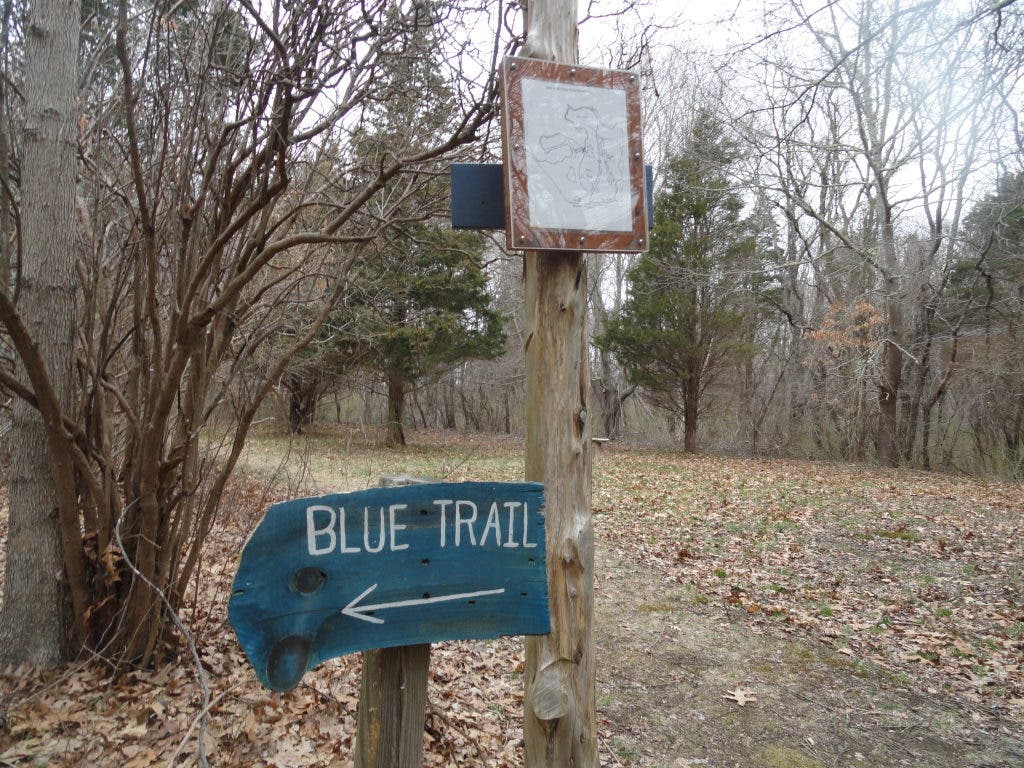
The refuge consists of a series of loops, three of which go out to a salt inlet where a variety of birds and wildlife may be spotted. Trail maps are posted at all main trail intersections.
At the end of the very short white trail loop there is a bird blind, a wooden wall with small openings, where patient observers might hide themselves and wait for a glimpse of a an otter, perhaps, or an “elusive snapping turtle,” the shell of which, according to Metzer is about a foot in diameter. It’s the only one he has seen on the refuge.
“If you spot it, it looks like a stone moving,” he says.
The blue trail is another loop out onto a peninsula that juts into a salt pond where great egrets and the smaller snowy egret, both with their vibrant white plumage and long beaks, stand and fly together across the shallow water between the end of the blue trail and Jacks’s Island, a separate part of the refuge accessible via a public road less than a quarter of a mile further down Seapowett Road.
Blue heron are often seen from the blue trail as well, said Metzer, who suggests staying very still, perhaps on the wooden bridge that traverses a tidal stream, to simply wait and see what happens.
With stillness, the sounds of Emilie Ruecker treat visitors as well. The trill of an American Toad and spring peepers add their sounds to the tapping of a Red-bellied Woodpecker.
“The woodpecker is no big deal,” says Metzer, but the toad’s trill is a sure sign of spring.
After the blue trail loop, visitors may choose to meander out on the yellow loop, which winds around the outskirts of a meadow (watch for deer) and onto another peninsula. Here, a pair of Mute Swans, another invasive though stunning species, may be spotted gliding across the calm waters.
Finally, the red trail loops visitors back to the parking area via a length of boardwalk through a murky spot where wild turkey may be spotted scurrying through the woods and deer tracks are clearly visible. Pudding stone, a natural stone which looks ,like a glob of cement with smaller stones stuck inside of it, may also be spotted here.
The only downside to Emilie Rueker is the mosquitoes, which, according to Metzer, are out in full force during the summer months, reinforcing that it is one good reason to visit soon.
“Spring and fall are probably the best times to be out here,” he said.
For a full schedule of Audubon sponsored events and walks, go to www.asri.org or call 401-949-5454. Programs are available for non-members as well as members.