Politics & Government
Homeowners Could Soon Pay Hundreds More
Angry residents vent their outrage at the City Council, some even calling for "revolution."
If the assessed value of your Woonsocket home is somewhere near $150,000, you could soon be paying another $470 or more in taxes this year.
Should the City Council and the state legislature both give their approval, the city will soon be sending out supplemental tax bills that seek an extra $3.15 for every $1,000 of assessed residential property value. The supplemental tax would also tack on $4.51 for commercial property, and $5.81 for motor vehicles.
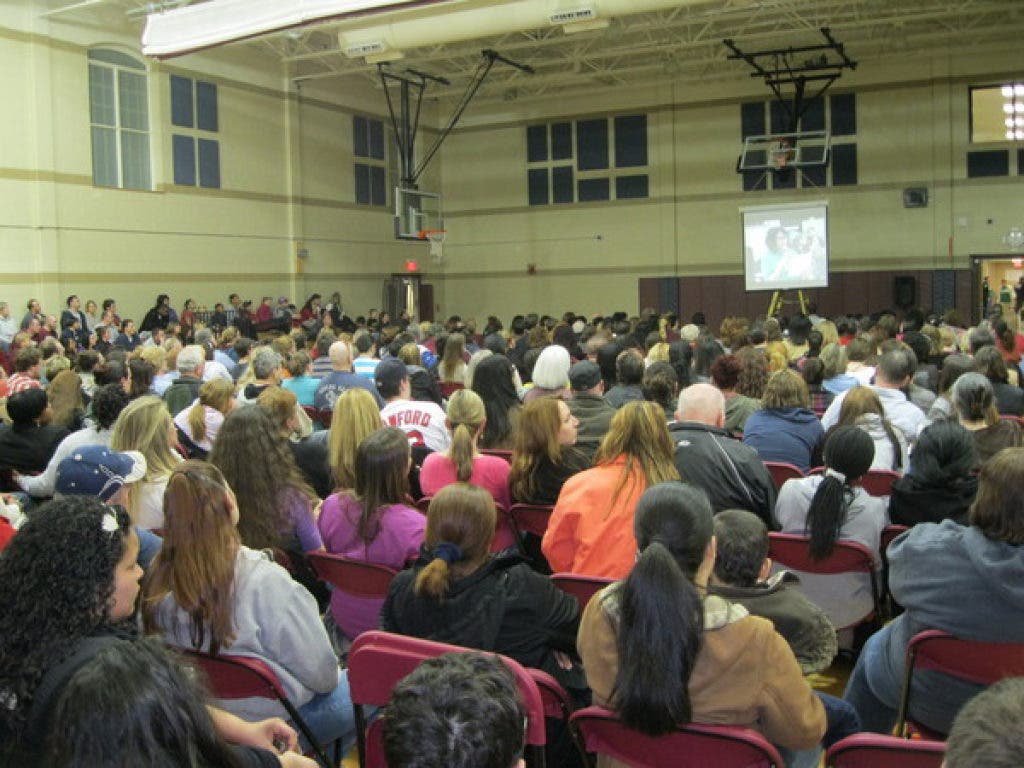
The extra tax — which some have dubbed "the fifth quarterly bill" — wasn't on the agenda when the City Council met Monday night, but it took up most of the session. The details of the plan are already widely known around the city, and close to 100 residents packed the meeting to offer protests. Speeches from angry taxpayers went on 90 minutes, and most who took the floor were eager to point accusing fingers. There was little agreement, however, as to whom the blame should fall on.
Find out what's happening in Woonsocketfor free with the latest updates from Patch.
"It shows the level of frustration people are feeling," Mayor Leo Fontaine said after the meeting. "People are looking for some fairness, but there really isn't any in this situation."
The supplemental tax proposal, which the City Council is scheduled to consider Wednesday night, is part of a plan to plug a projected $10 million shortfall in the School Department budget. Without a quick financial infusion, the city and the schools could run out of cash to pay vendors and employees by April 6. Tax payments won't be coming in by that time, but by moving on the plan, the city expects to be able to borrow until the money arrives.
Find out what's happening in Woonsocketfor free with the latest updates from Patch.
According to City Hall staff, issuing an extra tax bill will raise only about $6.6 million, not enough to cover the projected shortfall. "A supplemental tax bill alone will not solve this problem," warned Finance Director Thomas Bruce. "It must be combined with very serious cuts in the budget."
Fontaine noted the plan requires action by the General Assembly as well, and legislators will want to hear how Woonsocket expects to prevent future budget problems before they give their approval. "Presenting a supplemental tax bill to the state as the sole solution is not acceptable," he said. "They want some indication the School Committee is considering some of the budget reductions that have been recommended by auditors."
Some City Council members told those gathered they'll push to boost state aid to schools as a long-term solution to the budget woes in Woonsocket and other cash-strapped Rhode Island cities. Those remarks, however, fell largely on deaf ears.
A group of city residents and some elected officials preferred to blame others. Those they castigated included renters, landlords, capitalists, the state of Massachusetts, those who live in public housing, and anyone who receives any sort of assistance, be it food stamps or a college scholarship.
Larry Poitras, a Catholic school principal who sometimes hosts radio talk shows, drew applause by attacking a social group he called "the element." By the end of the meeting, others in the room were using the expression, too.
"They're the people who are on the receiving end of everything, who walk the streets until 10 or 12 at night and then sleep all day," Poitras said. "Our city is deteriorating. Just drive around and take a look. It's that element. As long as we have 16 or 17 percent of our housing subsidized, that element will keep on growing."
Poitras demanded a list of city residents who left public sector jobs because of disability. He never specified how he plans to use the list, but indicated he considers many people in that situation to be freeloaders. "They're sending their kids to the University of Rhode Island — for free!" he said. "I'm just disgusted."
Resident Joseph Lee called for creation of something he called "the provisional revolutionary council," an authoritarian force that could keep government and society running smoothly. City Council President John Ward attempted to end Lee's speech after several minutes, but relented when people shouted they wanted to hear more.
"A revolution!" said resident Allen Auclair. "That's what got this country started."
Charles Souders, who regularly plays the gadfly at City Hall meetings, spoke out against Woonsocket landlords. "They seem to think they're entitled to 30 percent, 40 percent, 50 percent profit," he said. "It's like a famous man once said: Greed knows no boundaries."
City Council member Robert Moreau told the crowd the city should look into creating a special tax for renters only. "We need to share this burden with those living in three, four and five family houses," he said. "We're supporting everybody else, the homeowners."
City Councilman Marc Dubois complained that he feels under attack by the populist outrage. "People call my house and swear at my kids," he said. "If you have something you'd like to discuss with me, do so in a civil manner."
Dubois said some have tried to make him "a scapegoat" for the city's financial problems because he served as School Committee chairman last year. The panel has been the target of public ire because it failed to notice financial problems at the schools until the end of last year.
"At our last meeting in November, I, along with the rest of the committee, was told we had a surplus," Dubois said. "We obviously were lied to. An auditing team came in, and they did not spot the deficit."