Weather
Austin Reaches 100-Degree Mark Saturday
If you've failed to heed advice from weather officials, paramedics before, it's time to get serious about staying hydrated, etc.



Update: Austin officially reached 100 degrees at about 4 p.m. CST. Make sure to drink plenty of water if you're out and about. Read safety tips toward bottom part of this story. Be careful out there.
From earlier:
AUSTIN, TX — The dog days of summer have encroached early, snarling with feverish temperatures forecast to reach 100 degrees on Saturday — which would mark the first triple-digit reading for the Austin area. This metaphoric climactic canine won't bite, but may deceptively put those in their path on the road to heat stroke for those most vulnerable.
Find out what's happening in Austinfor free with the latest updates from Patch.
Now that we've extended the canine metaphor to its outer limits, some serious business: The heat index for temperatures this high makes the temperature feel like it's 108 degrees. That kind of heat will strike those not hydrating themselves properly or wearing protective hats to shield them from the sun's harmful rays. It's hard to keep track of the instances of heat-related illnesses to which paramedics have responded in the past three weeks or so, but at least 20 such cases have been reported.
That old trope "it's not so much the heat, but the humidity..." often used as mere conversation filler is made real on Saturday. Elevated humidity will contribute in the upward temperature climb, according to weather officials. By early afternoon, the main weather gauge for Austin located at Camp Mabry was recording humidity levels at 38 percent.
Find out what's happening in Austinfor free with the latest updates from Patch.
The same gauge recorded a tolerable temp of 79 degrees starting the day at 9 a.m. this morning, but let us disabuse you now of the notion the weather will be that pleasant for the remainder of the day. By 3 p.m., the temperature already had climbed to 99 degrees, inching steadily to the 100-degree mark.
Aside from climactic nomenclature, that's pretty darn hot, so don't be lulled into a sense of complacency from the earlier, more tolerable weather that visited as you started your day. No less an authority on these matters than the National Weather Service is predicting 100 degrees by sometime today.
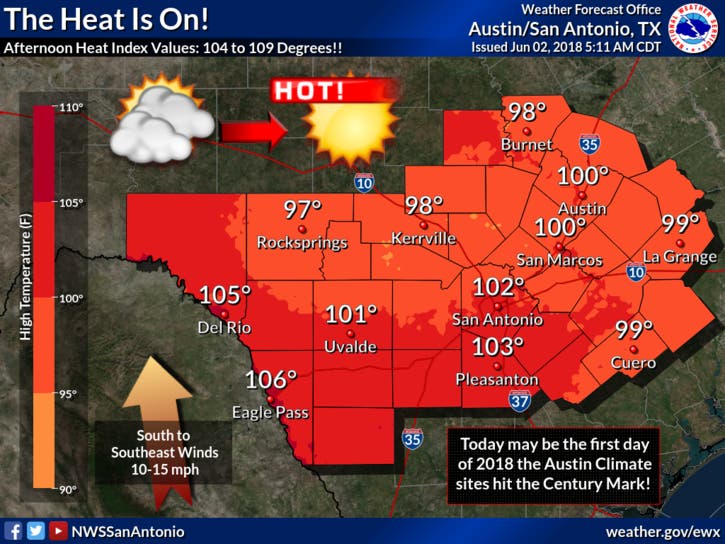
Graphic via National Weather Service
So far, we in the Austin area have been lucky in evading the triple-digit mark that's been reached elsewhere, including in nearby San Antonio in the past week. Saturday already has proved a triple-digit scorcher in other Texas cities: By 3:30 p.m., Del Rio was at 105 degrees; Uvalde hit 101 degrees; San Antonio was at 102 degrees; and Pleasanton — a town 110 miles south of Austin, just 36 miles from the Alamo City, with a cheerful name belying today's oppressive heat — registered 103 degrees by early afternoon.
The imminent summer period not scheduled to officially arrive until June 21 has, for all practical purposes, already arrived. May set the stage to usher in the high temperatures so far experienced — going into the books as the warmest May on record since 1996, according to weather officials.
Related stories:
Woman Hospitalized After Heat-Related Illness: Austin EMS
Austin EMS Rescue Of Heat-Felled Hiker Underscores Sun's Dangers
Still, the 100-degree mark has not hit yet. But it's only a matter of time, and that day could be today. That milestone came precariously close on Friday, when the Camp Mabry recorded a high of 99 degrees. We normally don't see 100-degree (or higher) levels until the first week in July in these parts, but the triple-digit reading has come as early as May, according to past readings. The record temperature for this day happens to be 100 degrees, set in 1998, according to records kept by Intellicast.
So please, Central Texans, take heed of weather officials' and paramedics' warnings and take protective measures. The most important thing is to stay hydrated. Enjoy all the open spaces the Austin metropolitan area has to offer, but take along some bottled water. These nuggets of advice aren't empty sentiments or attempts to make those with problems with authority figures bristle. The danger, my friends, is real. Heat stroke is nothing with which to be trifled.
The Mayo Clinic offers a list of tips to prevent becoming a victim of heat stroke, along with a list of symptoms you're already on that dangerously heat-suffused path. Left untreated, heatstroke can quickly damage the brain, heart, kidneys and muscles, according to the Mayo Clinic. Conditions worsen the longer medical treatment is delayed, and could lead to even more serious complications and even death, the Mayo Clinic says.
On their website, they outline symptoms, risk factors and prevention:
SYMPTOMS
- High body temperature. A core body temperature of 104 F (40 C) or higher, obtained with a rectal thermometer, is the main sign of heatstroke.
- Altered mental state or behavior. Confusion, agitation, slurred speech, irritability, delirium, seizures and coma can all result from heatstroke.
- Alteration in sweating. In heatstroke brought on by hot weather, your skin will feel hot and dry to the touch. However, in heatstroke brought on by strenuous exercise, your skin may feel dry or slightly moist.
- Nausea and vomiting. You may feel sick to your stomach or vomit.
- Flushed skin. Your skin may turn red as your body temperature increases.
- Rapid breathing. Your breathing may become rapid and shallow.
- Racing heart rate. Your pulse may significantly increase because heat stress places a tremendous burden on your heart to help cool your body.
- Headache. Your head may throb.
RISK FACTORS
- Age. Your ability to cope with extreme heat depends on the strength of your central nervous system. In the very young, the central nervous system is not fully developed, and in adults over 65, the central nervous system begins to deteriorate, which makes your body less able to cope with changes in body temperature. Both age groups usually have difficulty remaining hydrated, which also increases risk.
- Exertion in hot weather. Military training and participating in sports, such as football or long-distance running events, in hot weather are among the situations that can lead to heatstroke.
- Sudden exposure to hot weather. You may be more susceptible to heat-related illness if you're exposed to a sudden increase in temperature, such as during an early-summer heat wave or travel to a hotter climate. Limit activity for at least several days to allow yourself to acclimate to the change. However, you may still have an increased risk of heatstroke until you've experienced several weeks of higher temperatures.
- A lack of air conditioning. Fans may make you feel better, but during sustained hot weather, air conditioning is the most effective way to cool down and lower humidity.
- Certain medications. Some medications affect your body's ability to stay hydrated and respond to heat. Be especially careful in hot weather if you take medications that narrow your blood vessels (vasoconstrictors), regulate your blood pressure by blocking adrenaline (beta blockers), rid your body of sodium and water (diuretics), or reduce psychiatric symptoms (antidepressants or antipsychotics). Stimulants for attention-deficit/hyperactivity disorder (ADHD) and illegal stimulants such as amphetamines and cocaine also make you more vulnerable to heatstroke.
- Certain health conditions. Certain chronic illnesses, such as heart or lung disease, might increase your risk of heatstroke. So can being obese, being sedentary and having a history of previous heatstroke.
PREVENTION
- Wear loosefitting, lightweight clothing. Wearing excess clothing or clothing that fits tightly won't allow your body to cool properly.
- Protect against sunburn. Sunburn affects your body's ability to cool itself, so protect yourself outdoors with a wide-brimmed hat and sunglasses and use a broad-spectrum sunscreen with an SPF of at least 15. Apply sunscreen generously, and reapply every two hours — or more often if you're swimming or sweating.
- Drink plenty of fluids. Staying hydrated will help your body sweat and maintain a normal body temperature.
- Take extra precautions with certain medications.Be on the lookout for heat-related problems if you take medications that can affect your body's ability to stay hydrated and dissipate heat.
- Never leave anyone in a parked car. This is a common cause of heat-related deaths in children. When parked in the sun, the temperature in your car can rise 20 degrees F (more than 6.7 C) in 10 minutes. It's not safe to leave a person in a parked car in warm or hot weather, even if the windows are cracked or the car is in shade. When your car is parked, keep it locked to prevent a child from getting inside.
- Take it easy during the hottest parts of the day. If you can't avoid strenuous activity in hot weather, drink fluids and rest frequently in a cool spot. Try to schedule exercise or physical labor for cooler parts of the day, such as early morning or evening.
- Get acclimated. Limit time spent working or exercising in heat until you're conditioned to it. People who are not used to hot weather are especially susceptible to heat-related illness. It can take several weeks for your body to adjust to hot weather.
- Be cautious if you're at increased risk. If you take medications or have a condition that increases your risk of heat-related problems, avoid the heat and act quickly if you notice symptoms of overheating. If you participate in a strenuous sporting event or activity in hot weather, make sure there are medical services available in case of a heat emergency.
For more information, visit the Mayo Clinic website.
>>> Image via Shutterstock
Get more local news delivered straight to your inbox. Sign up for free Patch newsletters and alerts.