Neighbor News
The 5-Minute Crisis: Why Guelph Locals Are Stepping Up for Community Safety
Guelph locals are stepping up to improve community safety in a critical 5-minute crisis window—here's why it matters.
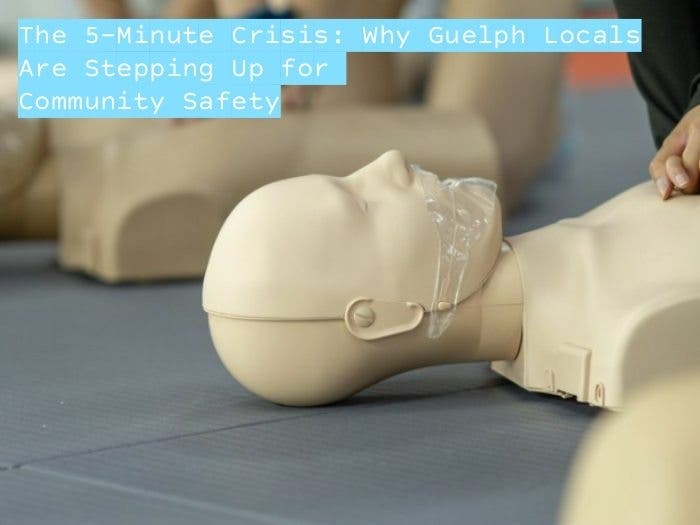
When medical emergencies happen in busy public spaces or at home, bystander panic is common. This article addresses the critical need for community-level emergency preparedness in growing areas like Guelph. It explains the severe limitations of ambulance response times for sudden cardiac arrest and highlights how accessible, blended CPR and First Aid training empowers everyday citizens to take life-saving action.
Imagine a typical Saturday afternoon. You are out running errands, grabbing a coffee, and navigating the weekend crowds. Everything is completely normal until the person at the table next to you suddenly collapses.
Panic sets in instantly. People pull out their phones. A crowd gathers. But everyone just stands there, looking around, waiting for someone else to step up and take charge.
Find out what's happening in Houstonfor free with the latest updates from Patch.
As our local community grows and our public spaces get busier, we cannot just assume someone else will know what to do in a crisis. When an emergency strikes, you are the help until help arrives. That is exactly why so many residents, parents, and local employees are actively seeking out CPR training near Stone Road Mall. They are deciding to become the person who acts, rather than the person who just watches.
Let's look at why taking control of your own emergency readiness is the ultimate form of community service.
Find out what's happening in Houstonfor free with the latest updates from Patch.
The Dangerous Reality of the Bystander Effect
We see it all the time in crowded places. A medical crisis happens, and nobody moves.
Psychologists call this the "bystander effect." It happens because when there are a lot of people around, we experience a diffusion of responsibility. Your brain automatically tells you, "Surely, there is a nurse or a doctor in this food court who will step in."
But what if there isn't? What if you are the only one standing next to a teenager who is having a severe allergic reaction to a peanut?
People freeze because they are terrified of making a mistake. They think doing CPR incorrectly will hurt the person more. But the harsh truth is that if someone's heart has stopped, they are already in the worst possible condition. Doing something—even if it isn't perfectly textbook—is always better than doing nothing at all. Taking a single weekend class replaces that paralyzing fear with a simple, repeatable action plan.
Why You Cannot Just Rely on Paramedics
We have incredible first responders in this city. They do amazing work every single shift. But physics and traffic are stubborn things.
If someone suffers a sudden cardiac arrest, the clock starts ticking the second they hit the floor. Brain tissue begins to die after just four to six minutes without a steady supply of oxygen. Even on a good day, an ambulance might take eight or ten minutes to navigate through gridlock, pull into a crowded parking lot, and actually reach the patient on foot.
Those first few minutes belong entirely to the bystanders. If nobody in the immediate vicinity knows how to perform chest compressions to keep blood pumping to the brain, the odds of survival drop significantly with every passing minute. You become the literal bridge between life and death.
The "I Don't Have Time" Excuse
Let's be completely honest. The main reason most adults do not know CPR is simple: we are all exhausted. Between working full-time, shuttling kids to hockey practice, and trying to keep the house clean, finding a free weekend feels impossible. The idea of sitting in a cold community center for two straight days to learn medical theory is a tough sell.
The good news is that the training industry has completely evolved. You no longer have to burn your entire weekend to get certified.
Modern training uses a "Blended Learning" format. This is a massive win for busy people. You can complete all the reading, videos, and multiple-choice quizzes online. You can do it from your couch after the kids go to bed.
Once you finish the online theory, you just go into a local facility for a short, hands-on session. You practice your chest compressions on a mannequin, learn how to use an AED (Automated External Defibrillator), and ask the instructor questions. It is fast, efficient, and highly effective. You can check out the local schedules and see how easy it is to book at https://www.c2cfirstaidaquatics.com/.
Building a Safer Neighborhood
Safety isn't just about locking your doors at night. True safety is knowing that the people living on your street, working in your local shops, and watching your kids have the skills to handle a crisis.
Think about the parents who bring their toddlers to the local parks. Choking is a terrifying, silent emergency that happens in a flash. A piece of an apple or a small toy gets lodged, and the child cannot even make a sound to ask for help. Knowing the difference between how to clear the airway of an infant versus a full-grown adult is a skill every parent, grandparent, and babysitter needs to have in their back pocket.
We cannot control when an accident will happen. We can only control how we react to it. Stop waiting for someone else to be the hero. Sign up for a class, learn the basics, and become the neighbor everyone wants around when things go sideways.
FAQ: Local First Aid Questions
Q: Do I need to buy a special First Aid kit after taking the class?
A: You don't need anything overly complicated. A basic kit with gloves, a breathing barrier (CPR mask), bandages, and gauze is perfect for your car or home. The most important tool is your knowledge of how to use those items.
Q: Is CPR different for kids than it is for adults?
A: Yes. Children and infants have much smaller, more fragile bodies. A Level C CPR course specifically teaches you the different hand placements, compression depths, and breathing techniques required for kids versus adults.
Q: Am I legally liable if I try to perform CPR and the person gets hurt?
A: No. In Canada, Good Samaritan laws exist to protect citizens who voluntarily step in to help during an emergency. As long as you act reasonably and within the scope of what you were taught, you are protected from legal liability.