Politics & Government
Hurricane Irma And Harvey: President Trump Signs $15B Aid Bill, Includes Debt Limit Raise
The House passed the bill earlier in the day, based on a deal the president worked out with Democratic leadership in Congress.

WASHINGTON, DC — President Trump signed a $15.3 billion disaster aid package passed by Congress Friday that will funnel funds to emergency response efforts to Hurricanes Irma and Harvey. The bill also knocks out two other must-pass legislative priorities this month: raising the debt ceiling and funding the government through December.
"@POTUS just signed H.R. 601 providing much needed support for storm survivors," tweeted Press Secretary Sarah Huckabee Sanders. "Our thoughts and prayers are with all impacted."
Despite opposition to the deal from Republican leadership in Congress, a majority of GOP lawmakers voted for the bill in both chambers. The legislation passed the House 316-90 Friday, with only Republican votes in opposition. (For more information on this and other political stories, subscribe to the White House Patch to receive daily newsletters and breaking news alerts.)
Find out what's happening in Across Americafor free with the latest updates from Patch.
Trump stunned Republicans by cutting a deal with Democratic leaders Sen. Chuck Schumer and Rep. Nancy Pelosi to increase the debt limit for three months, rather than the long-term approach preferred by the GOP leaders that would have gotten the issue fixed through next year's midterms.
Watch: House Approves Billions In Government Funding And Hurricane Aid Deal
Find out what's happening in Across Americafor free with the latest updates from Patch.
Conservatives disliked both options. Voting on the debt limit is politically toxic for Republicans, and the deal will make the GOP vote twice ahead of next year's midterm elections. Tying the measures to much publicized and needed aid for hurricane relief, however, along with the strong support of the White House, made the bill difficult to oppose.
Even the large sum of more than $15 billion is much less than will be needed in the long-term.
Congress is expected to approve additional funds as part of a federal aid package that could rival or exceed the $110 billion federal response after Hurricane Katrina, though future installments are likely to be more difficult to pass. It also kicks budget decisions into December and forces another politically difficult debt limit vote next year.
White House budget director Mick Mulvaney, a former tea party congressman from South Carolina who took a hard line against debt increases during his years in the House, and Treasury Secretary Steven Mnuchin pitched the measure to House Republicans at a closed-door meeting held just before the vote.
They were given a hard time from some Republicans upset with being forced to choose between voting for disaster aid and the debt limit increase.
Mnuchin elicited hisses when he told a closed-door meeting of House Republicans "vote for the debt ceiling for me," said Rep. Mark Walker, a Republican from North Carolina.
Rep. Ryan Costello, a Republican from Pennsylvania, described a surreal scene with Mnuchin, a former Democratic donor, and Office of Management and Budget Director Mulvaney, who opposed clean debt ceiling hikes as a congressman, pressing Republicans to rally around the disaster aid package.
"It's kind of like 'Where am I? What's going on here?'" Costello said, "If it wasn't so serious it kind of would have been funny."
Fiscal conservatives have clamored for deep cuts in spending in exchange for any increase in the government's borrowing authority. The storm relief measure had widespread support, but the linkage with the debt ceiling left many Republicans frustrated.
"It's like the Washington that Trump campaigned against," said Rep. Joe Barton, a Republican from Texas. "So, as much as I want to help Texas, I can't vote for something that just is a blank check on the debt."
But most in the GOP said they weren't upset with Trump himself.
Democratic votes are invariably needed to increase the debt limit — and avert a potential market-quaking default on government obligations — and Schumer and Pelosi successfully pressed to waive the debt limit through Dec. 8.
As a practical measure, since the arcane debt-limit suspension replenishes Treasury's ability to tap other accounts to maintain cash flows, the actual date of a potential default wouldn't come before February or March. That's according to a back-of-the-envelope calculation by Shai Akabas, who tracks the issue for the Bipartisan Policy Center, a Washington think tank.
Late Wednesday, Senate Majority Leader Mitch McConnell, a Republican from Kentucky, added $7.4 billion in rebuilding funding to Trump's $7.9 billion request to deal with the immediate emergency in Texas and parts of Louisiana.
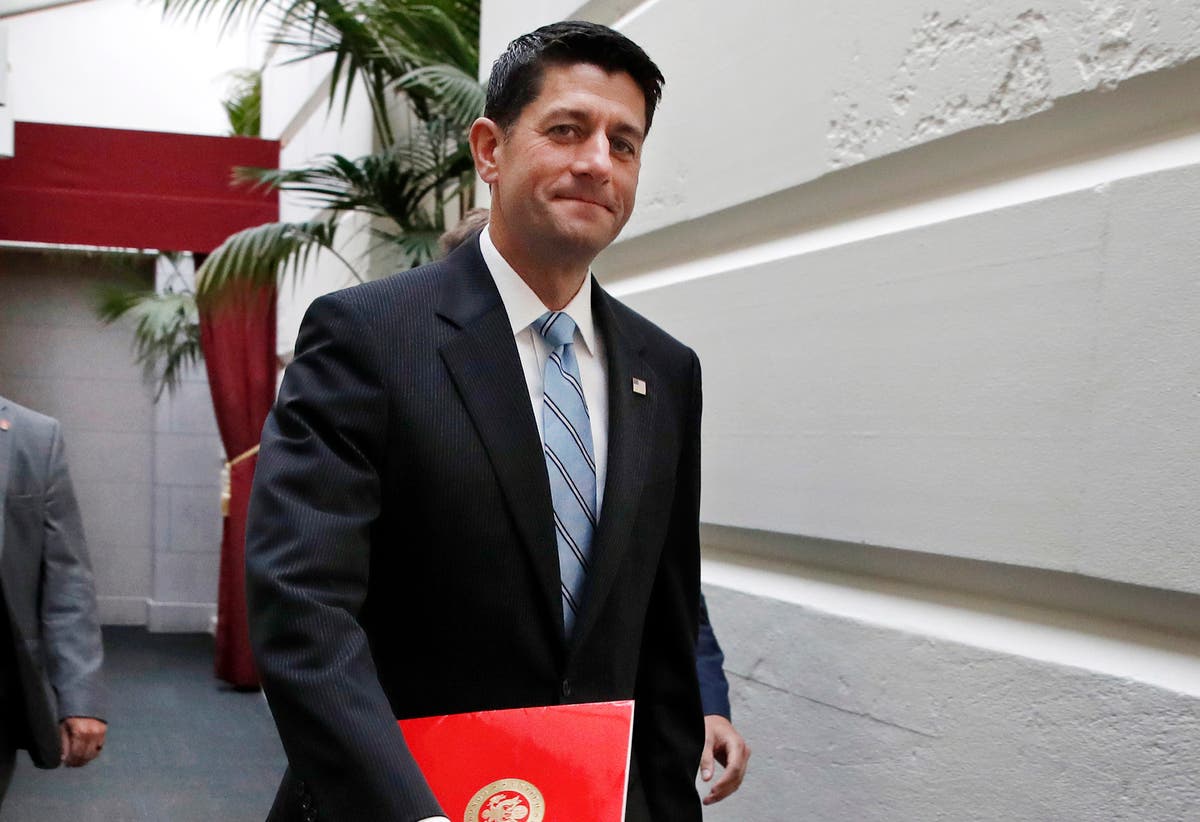
AP Photo/Jacquelyn Martin
![Taking Your Dog Everywhere Can Cross A Line Even Dog Lovers Draw [The Question]](https://patch.com/img/cdn20/shutterstock/790386/20261023/092028/styles/patch_image/public/shutterstock-2847904315___23090759374.jpg)