Politics & Government
Law Officials Round Up Hundreds of Undocumented Immigrants
Authorities say the raids are routine but activists and politicians dispute the assertion.


Officials in major metropolitan areas began rounding up hundreds of undocumented immigrants, the first extensive wave of such enforcement since President Donald Trump signed an executive order Jan. 25 to crackdown on the estimated 11 million people living in the United States illegally.
The precise number of those arrested around the country in unclear. Officials confirmed to the Washington Post that agents raided homes and workplaces in areas including Atlanta, Chicago, New York, Los Angeles, North Carolina and South Carolina.
In the Los Angeles area, officials with Immigrations and Customs Enforcement said that of the 160 immigrants rounded up in the region Thursday, at least 150 of them had criminal histories. The statement put out by ICE countered activists' claims that those targeted posed little threat to the community. Immigration activists said that family members or other undocumented immigrants present in the homes of those with deportation orders were also taken in the sweeps.
Find out what's happening in Across Americafor free with the latest updates from Patch.
In addition to those cities identified by the Post, a Texas congressman issued a statement saying he had confirmed that immigration officials had launched a targeted operation in South and Central Texas. There were several reports of people being detained by agents throughout the Austin area, and the Mexican Consulate confirmed that 44 Mexican immigrants were detained toward the end of the week in Austin.
In South Carolina, North Carolina and Georgia, 192 people were apprehended, the Atlanta Journal Constitution reported. Authorities said a majority of them had criminal convictions but did not immediately identify them or provide additional details.
Find out what's happening in Across Americafor free with the latest updates from Patch.
Officials have contended that the immigration enforcement is routine but activists and some politicians dispute that.
Sarah Owings, an immigration attorney in Atlanta, told the Daily Beast that she knows of two apartment complexes with a high concentration of Latino residents where ICE agents went door-to-door, asking everyone to present proof that they were in the country legally. Bob Libal, the executive director of Grassroots Leadership, an immigration advocacy group in Austin, said in various interviews that his organization's hotline had been overwhelmed with calls.
A Department of Homeland Security official confirmed to the Washington Post that though agents were targeting those with criminal histories, they were also rounding up non-criminals who did not have documentation.
Los Angeles Mayor Eric Garcetti issued a statement Friday in light of the raids, saying he told the Deputy Director of ICE’s Los Angeles Field Office that he wanted greater transparency about ongoing operations.
"I told the Deputy Director that I will do everything in my power — working alongside our City Attorney, the LAPD, immigrants’ rights advocates, congressional delegation and outside lawyers — to make sure that the legal rights of all Angelenos are respected and upheld at every stage of the enforcement process," Garcetti said in the statement.
Texas Congressman Joaquin Castro said in a statement that he has asked ICE to clarify whether the individuals targeted in the raids were in fact dangerous, violent threats to the community.
I'm concerned about the ICE raids in Texas. My statement: pic.twitter.com/SeeDSwAmyM
— Joaquin Castro (@JoaquinCastrotx) February 10, 2017
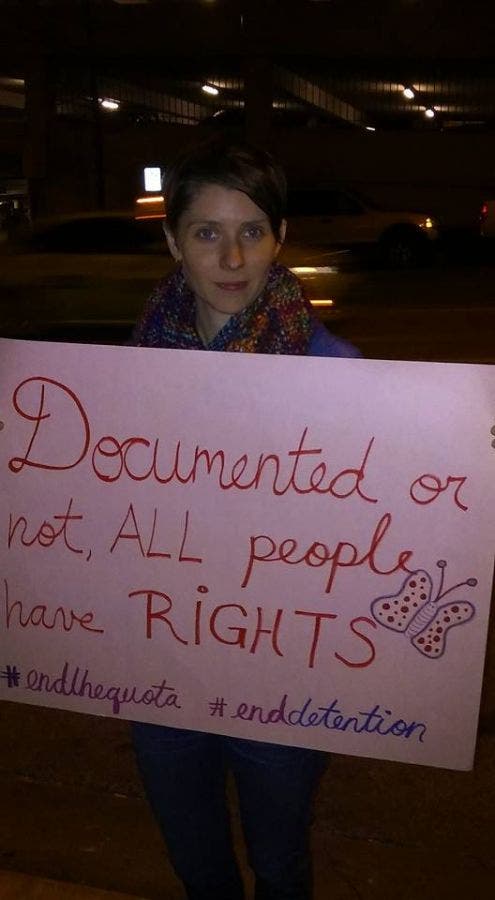
In response to the raids, people came out to show their support for undocumented immigrants at vigils and protests.
At a vigil staged in Austin, a woman from Honduras tearfully told the crowd about how her husband was detained as he left for his landscaping job. She said she and her husband fled Honduras after after the feared “Maras” gang killed some of her family members. Living in Austin for the past 10 years or so, the peaceful existence they found was threatened after her husband missed an immigration hearing in San Antonio, setting the stage for his likely deportation, she said.
“What do I do now?” Reyna Alvarado said in Spanish. "I had to go to school and tell my daughter that they’ve taken her father away. Where am I going now? Who'll take away this pain now that they've taken my husband?"
Tony Cantu and Paige Austin contributed to this report.
Image Credit: Tony Cantu/Patch
Get more local news delivered straight to your inbox. Sign up for free Patch newsletters and alerts.