Politics & Government
Democratic Debate Replay: Candidates Spar Before Iowa Caucus
Six Democrats appeared in the smallest, least-diverse debate of the 2020 election cycle in a final showdown before the Iowa Caucuses.


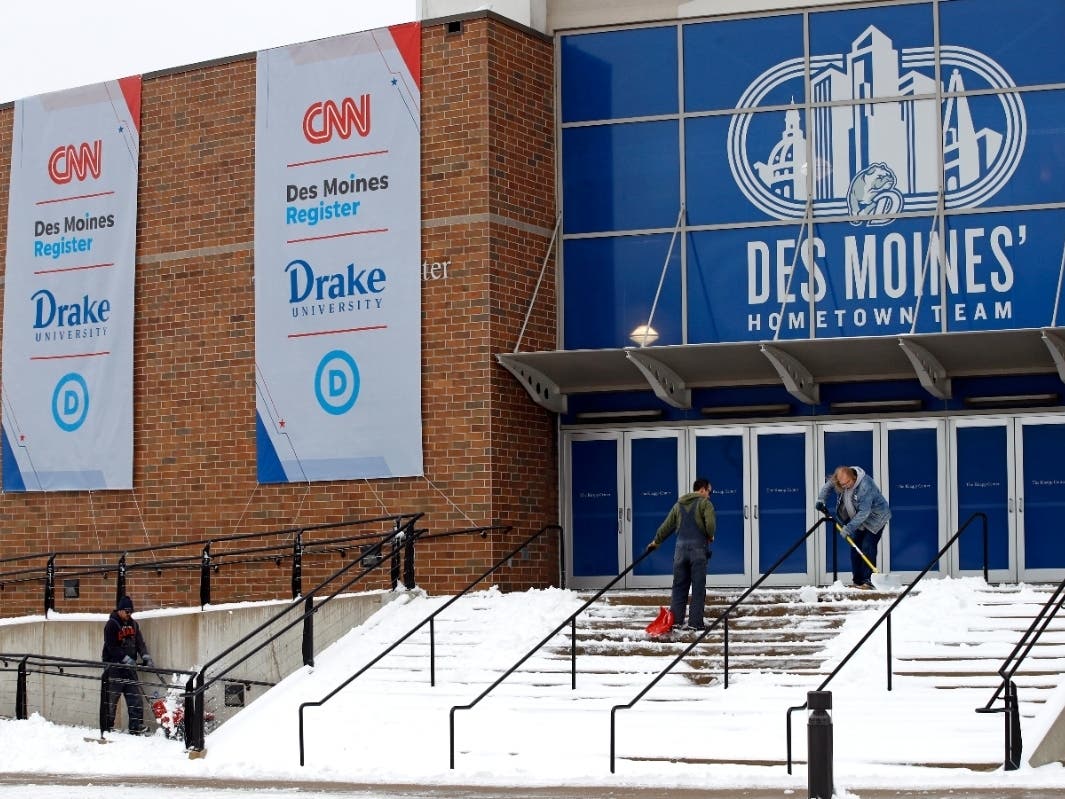
DES MOINES, IA — Escalating tensions between U.S. Sens. Bernie Sanders and Elizabeth Warren, the two leading progressives among Democrats who want to replace President Donald Trump in the White House, took center stage Tuesday in Des Moines in the final debate before next month’s Iowa Caucuses.
The feud illustrates what’s at stake for Democrats, both in the first-in-the-nation Feb. 3 caucuses, where no single candidate has a compelling lead, and in the Nov. 3 general election, where they hope to deny a second term to the polarizing and impeached Republican president.
Besides Sanders and Warren, four others among the 12 Democrats still in the race met the dual polling and fundraising qualifying rules of the Democratic National Committee: South Bend, Indiana, Mayor Pete Buttigieg, former Vice President Joe Biden, Minnesota Sen. Amy Klobuchar and businessman Tom Steyer.
Find out what's happening in Across Americafor free with the latest updates from Patch.
WATCH THE REPLAY: The CNN/Des Moines Register Democratic presidential debate was held at Drake University in Des Moines Tuesday. It was broadcast exclusively on air and through the website and various streaming apps.
Warren and Sanders have generally been on friendly terms during the campaign, but Warren took the gloves off Sunday, saying she was “disappointed” about reports that the Sanders campaign sent volunteers a “negative script” suggesting they “trash” her as a candidate who appeals mainly to affluent, educated voters and does little to expand the Democratic Party coalition.
At a campaign stop in Iowa, Warren implied that divisiveness among Democrats supporting Sanders, a Vermont independent, and eventual nominee Hillary Clinton in 2016 had helped Trump.
Find out what's happening in Across Americafor free with the latest updates from Patch.
“We all saw the impact of the factionalism in 2016, and we can’t have a repeat of that,” she warned. “Democrats need to unite our party, and that means pulling in all parts of the Democratic coalition.”
Sanders attempted to downplay the strained relationships between the two campaigns, calling it a “media blowup, that kind of wants conflict.” He said he didn’t order the script and pointed out he has never criticized Warren.
Tension between the two candidates grew Monday when Warren said Sanders had told her in a 2018 meeting that a woman can't win the White House.
“Among the topics that came up was what would happen if Democrats nominated a female candidate. I thought a woman could win; he disagreed,” Warren said in a statement.
Sanders denied making the comment, saying "it is ludicrous to believe that at the same meeting where Elizabeth Warren told me she was going to run for president, I would tell her that a woman couldn't win."
"It's sad that, three weeks before the Iowa caucus and a year after that private conversation, staff who weren't in the room are lying about what happened," he said.
Sanders' campaign also lobbed salvos at Biden over past positions on racial issues and a 2002 vote that led to the war in Iraq.
Writing in an op-ed Sunday in a South Carolina newspaper, Nina Turner, the Sanders campaign co-chair, claimed Biden “has repeatedly betrayed black voters to side with Republican lawmakers and undermine our progress.”
“We are going to be talking about the record,” Sanders told reporters after a weekend swing through Iowa. “People are talking about my record. I was just asked a question about my record. That’s kind of what a campaign is about. We will contrast records — nothing wrong with that.”
Biden has positioned himself in ads ahead of the debates and caucuses as the candidate who can unify America, but Warren is attempting to upstage him as the “unity candidate” who can “excite every part of the Democratic Party.”
“About 25 percent of the folks out there, when you look at Democrats, about 25 percent, for instance, say they would be unhappy if Vice President Biden was the nominee,” former Secretary of Housing and Urban Development Julián Castro, who ended his own campaign and threw his support behind Warren, said Sunday at the Marshalltown campaign event. “The person that scores the best on that, who people are good with, that they would get out there and vote if they’re the nominee, is Elizabeth Warren.”
Iowans remain unsettled on a clear favorite three weeks before the caucuses. Sanders, whose campaign lost momentum when he suffered a heart attack about three months ago, pulled ahead for the first time this election season in a new Iowa Poll, but not by much.
The poll shows that 20 percent of likely Democratic caucusgoers plan to support Sanders, and that Warren, Buttigieg and Biden are in a statistical tie for second place, polling at 17 percent, 16 percent and 15 percent, respectively.
Nearly half — 45 percent — of Iowans interviewed for the poll said they could be persuaded to support a different candidate, and 13 percent haven’t made up their minds.
The changing poll numbers reflect how quickly candidates gain and lose momentum in Iowa. Buttigieg had the support of 25 percent of likely caucusgoers two months ago and has dropped 9 percentage points since then.
Tension with Iran and the Middle East will almost certainly be a topic at the debate. That’s likely to help Biden, a former chairman of the Senate Foreign Relations Committee and a two-term vice president who has positioned himself as a steadying hand. But it also could backfire, giving Sanders and others another chance to hit him on the Iraq vote nearly two decades ago.
Cerro Gordo County Democratic Chair JoAnn Hardy told The Associated Press that “there’s a lot of support” in Iowa for Biden, who many see as Democrats’ best chance to beat Trump in November, “but for most people it’s not enthusiastic support.”
“It’s like, we gotta do what we’ve gotta do to beat Trump,” Hardy said.
Impeachment, health care, climate change and a trade war that has hurt farmers in America’s heartland are also likely to come up.
The debate stage is the smallest of seven held so far, and is the least diverse, without a single person of color qualifying. New Jersey Sen. Cory Booker, who had criticized the lack of diversity on previous debate stages under Democratic National Committee rules, dropped out of the race Monday. Both he and businessman Andrew Yang met the donor requirement but missed the DNC’s polling threshold. Sen. Kamala Harris dropped out in December; and Castro, the only Latino in the field, quit the race earlier this month and put his support behind Warren. Deval Patrick, the first African American elected governor in Massachusetts, is still in the race but didn’t get any support in the recent Iowa Poll.
Though Sanders jumped ahead of other candidates in the Iowa poll, his lead is not commanding, poll director J. Ann Selzer, president of Selzer & Co., which conducted the poll, told the Des Moines Register.
“There’s no denying that this is a good poll for Bernie Sanders,” she said. “He leads, but it’s not an uncontested lead. He’s got a firmer grip on his supporters than the rest of his compatriots.”
The Iowa Caucuses are different from other early tests candidate strength in that they’re not simple voting events, but evening-long grassroots party meetings in which neighbors try to convince other neighbors to support their candidate.
“The caucus process is an invitation to keep an open mind,” Selzer told National Public Radio.
Get more local news delivered straight to your inbox. Sign up for free Patch newsletters and alerts.

![Sexy Costumes, Politics And Booze At The Office Halloween Party [The Question]](https://patch.com/img/cdn20/shutterstock/790386/20261002/020904/styles/patch_image/public/shutterstock-2533780867___02140552316.jpg)