Politics & Government
Virginia, DC Sue To Block Trump's 250-Foot Arch Near Arlington Cemetery
Virginia and DC joined Arlington County in challenging Trump's proposed arch, citing traffic, public safety and federal law.


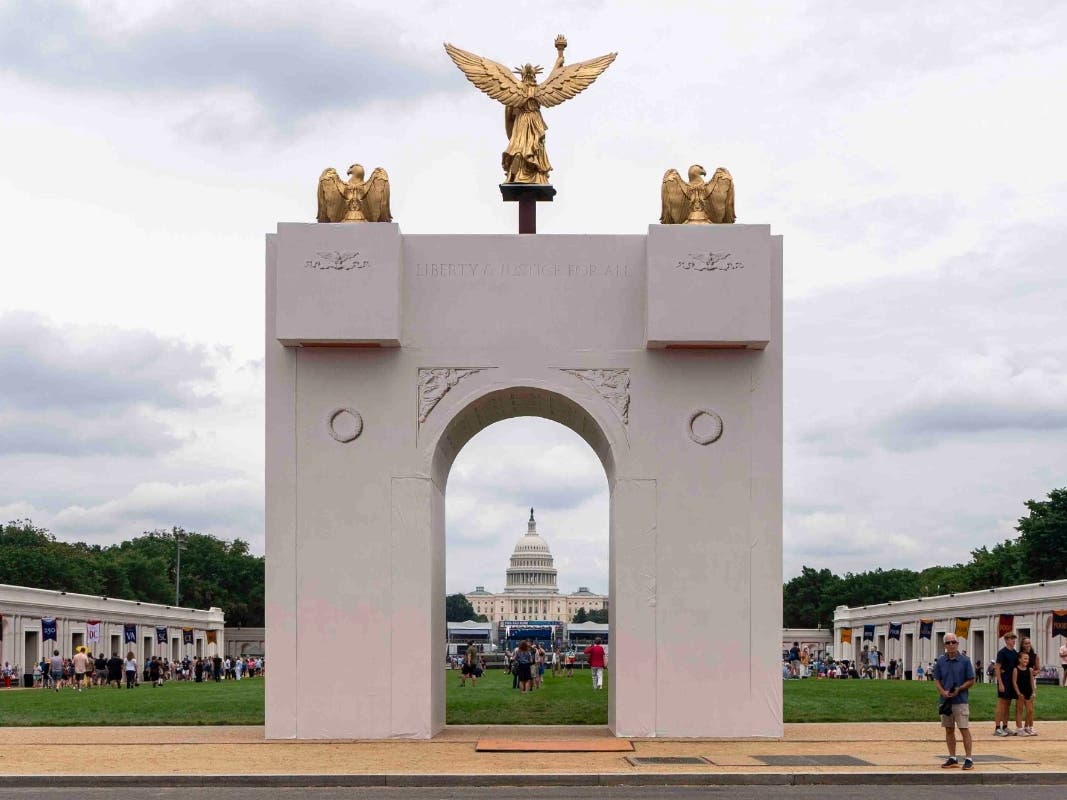
ARLINGTON, VA — Virginia and Washington, D.C., filed a federal lawsuit Saturday to block construction of President Donald Trump's proposed 250-foot triumphal arch near Arlington National Cemetery, adding to an earlier legal challenge Arlington County filed over concerns about traffic, public safety and historic preservation.
The 46-page complaint, filed in U.S. District Court for the District of Columbia, challenges plans to build the monument at Memorial Circle, the traffic circle connecting Arlington Memorial Bridge to Memorial Avenue and Arlington National Cemetery.
The Trump administration could begin construction as early as Thursday, Nov. 5, the same day the National Capital Planning Commission is scheduled to consider final approval, according to the lawsuit.
Find out what's happening in Arlingtonfor free with the latest updates from Patch.
Virginia Attorney General Jay Jones and D.C. Attorney General Brian Schwalb are asking a federal judge to halt construction before work begins.
The lawsuit names the National Park Service, the U.S. Department of the Interior, Interior Secretary Doug Burgum and National Park Service official Jessica Bowron as defendants.
Find out what's happening in Arlingtonfor free with the latest updates from Patch.
The plaintiffs claim the administration has failed to obtain required congressional authorization, exceeded federal building height restrictions and disregarded laws governing environmental reviews and historic preservation.
The new lawsuit follows a separate legal challenge the Arlington County Board filed Oct. 8 in the U.S. District Court for the Eastern District of Virginia.
As Patch previously reported, Arlington officials argued that the National Park Service failed to adequately evaluate how the monument would affect county residents, transportation, emergency services and nearby historic landmarks.
The county's lawsuit focuses primarily on the federal government's environmental review, while the new Virginia-D.C. complaint raises additional claims involving congressional authorization, building height restrictions and historic preservation requirements.
Neither lawsuit has resulted in a final court ruling on the project's legality.
Construction Could Disrupt Arlington Traffic For Years
Both lawsuits raise concerns about the impact on commuters, cyclists, pedestrians and emergency responders who use Arlington Memorial Bridge and Memorial Circle.
According to National Park Service figures cited in the new complaint, more than 27,000 vehicles, 1,100 bicyclists and 1,200 pedestrians travel through Memorial Circle daily.
Construction is expected to take two to three years, with work occurring up to 20 hours a day.
During that period, the south side of Memorial Circle would close for construction and staging, while westbound traffic from Arlington Memorial Bridge would be reduced to two lanes.
The project could also generate substantial truck traffic, with approximately 20 to 30 trucks carrying 80 to 100 loads of materials daily.
The lawsuit cites the National Park Service's acknowledgment that construction would increase congestion, create intermittent delays and make travel times less predictable.
Arlington County raised similar concerns in its earlier lawsuit, warning that changes to Memorial Circle could affect Washington Boulevard, Route 110 and other major routes, potentially diverting drivers onto already congested roads.
County officials also warned that road closures and congestion could delay emergency responders.
The Arlington County Fire Department provides emergency services to Arlington National Cemetery and surrounding areas and assists with emergencies at Reagan National Airport.
According to the county's complaint, Arlington emergency personnel responded to 52 calls at or near the airport during the 60 days preceding the filing.
The new Virginia-D.C. lawsuit raises additional concerns about mutual-aid responses between Arlington and Washington, noting that Memorial Bridge also serves as an emergency evacuation route from the District.
Permanent roadway changes would include new traffic signals, redesigned traffic patterns and a dedicated passenger pickup and drop-off area along Memorial Avenue.
Monument Would Block Historic Views, Lawsuits Claim
The proposed arch would stand between the Lincoln Memorial and Arlington House, the historic Robert E. Lee residence overlooking Arlington National Cemetery.
Both lawsuits argue that the monument would obstruct a historic sightline deliberately preserved when Arlington Memorial Bridge was designed nearly a century ago.
The bridge and surrounding landscape were intended to symbolize reconciliation between the North and South following the Civil War.
According to the new complaint, the National Park Service has acknowledged that the arch would obstruct the reciprocal view between Arlington House and the Lincoln Memorial.
Virginia also claims the monument would adversely affect other historic properties, including Arlington National Cemetery, Fort Myer and the Pentagon.
Arlington County's earlier lawsuit raised concerns that construction noise would disrupt ceremonies and funerals at Arlington National Cemetery, which hosts more than 5,000 funerals annually.
The proposed structure would rise 250 feet, nearly twice the 130-foot maximum generally permitted under Washington's Height of Buildings Act, according to the Virginia-D.C. lawsuit.
The plaintiffs argue that the administration has not demonstrated that the structure qualifies for an exception.
They also claim the project violates the Commemorative Works Act, which requires specific congressional authorization for certain monuments in the nation's capital.
Concerns About Reagan National Airport
Both lawsuits raise questions about the monument's potential impact on aviation safety.
Arlington County argued in its earlier complaint that the 250-foot structure could interfere with flight paths used by aircraft departing Reagan National Airport, including airspace reserved for certain emergency departure procedures.
The county warned that changes to those routes could increase airplane noise over Arlington neighborhoods.
However, the National Park Service's environmental assessment concluded that the project would not significantly affect airport airspace, according to the county's complaint.
The new Virginia-D.C. lawsuit also cites aviation concerns, noting that construction cranes could reach approximately 320 feet.
The plaintiffs argue that the monument's proximity to the airport would require additional emergency planning, particularly given the possibility of military operations at the site.
Arch Could Include Military Equipment
The lawsuits also challenge plans to incorporate military functions into the monument.
Trump announced in September that he wanted the structure to serve as a military complex capable of housing drones, ammunition and sniper positions.
Although the National Park Service's final design documents do not describe those functions, the new complaint cites declarations from federal defense and homeland security officials describing the arch as a dual-purpose monument with military capabilities.
Arlington County previously argued that those proposed uses raise public safety concerns the National Park Service's environmental review did not address.
The county also raised questions about potential interference with Arlington police drone operations and how firefighters would respond to an emergency involving ammunition stored at the site.
Virginia and D.C. similarly argue that the military functions have not been adequately evaluated for environmental and public safety impacts.
Trump Administration Plans To Move Forward
Trump first announced plans for the arch in October 2025.
The National Park Service subsequently developed a proposal for a monument commemorating the nation's 250th anniversary.
The structure would be built from concrete with granite or marble veneer and topped with a winged figure and two statues.
Plans also include an interior gallery, ticketing and security facilities, and an observation deck.
The National Park Service estimates the completed monument could accommodate 450 visitors at a time and attract between 2,000 and 22,000 visitors daily.
Interior Secretary Doug Burgum has publicly supported the project, describing it as a major addition to the nation's capital.
The National Park Service has completed environmental reviews and found that the project would have no significant environmental impact.
The Trump administration has defended its review process. In response to Arlington County's earlier lawsuit, the White House said federal officials had complied with applicable legal and procedural requirements and characterized the county's claims as meritless.
Arlington County is seeking a court order requiring a more comprehensive environmental review before construction or demolition work begins.
The new Virginia-D.C. lawsuit goes further, asking the court to declare the project unlawful, block construction and site preparation, and overturn federal approvals.
The plaintiffs also claim federal officials improperly shortened consultations with historic preservation agencies in both jurisdictions.
The National Capital Planning Commission is scheduled to consider final approval Nov. 5.
The new lawsuit cites an Oct. 21 federal government notice stating construction could begin that same day if the commission approves the project and the Interior Department issues final authorization.
Get more local news delivered straight to your inbox. Sign up for free Patch newsletters and alerts.