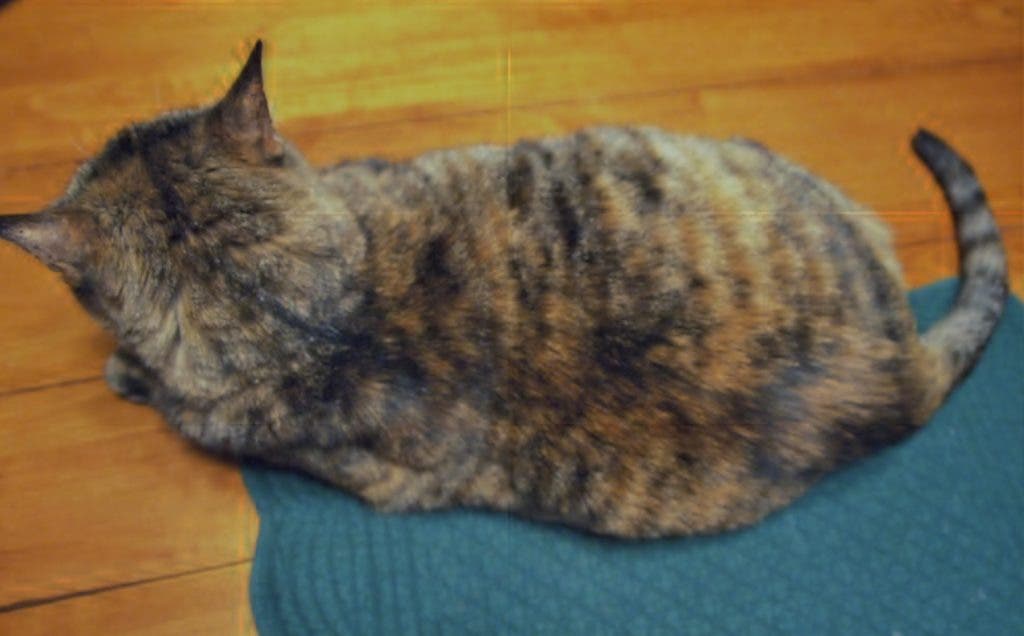
One of the major health issues facing our dogs and cats is obesity. Overweight pets are more prone to joint disease, heart disease and a host of other health conditions.
As with humans, excess fat visible from the outside means there's probably fat surrounding the heart and kidneys, infiltrating the liver, and adding excess stress on joints and spine. Excess fat often means that muscles are not as strong and conditioned as they should be, because exercise is not comfortable and stamina and strength are greatly diminished.
One way to tell if your pet is overweight is by gently feeling for the ribs. If you cannot feel the individual ribs without burying your fingertips in fat, then your pet is probably overweight. You also want to be able to feel the boney tops of the vertebrae along the spine. Gently probing down the center of your pet’s back, can you feel the bones? If not, your pet may have a thick layer of fat preventing you from finding them.
Find out what's happening in Burkefor free with the latest updates from Patch.
Looking at your pet from the side, can you see a little tucked up area in front of the back legs? And looking down on your pet from above, can you see a “waist?” The ribcage of the dog and cat actually extends about 2/3 the length of the body. There should be a little narrowing of the silhouette between the widest part of the ribcage and the hips.
Dogs and cats have areas on their bodies that can act as super storage areas for fat. Like the dreaded “saddlebags” that humans bemoan, the dog often stores fat in the muscle and tissue on the top of the hips. Sometimes this area can look lumpy, and on occasion people worry that their dog might be developing some kind of tumor. Gently massaging the area, see if there is a matching protuberance on the other side. These fat storage areas are almost always bilateral, and should be fairly equal in size.
Find out what's happening in Burkefor free with the latest updates from Patch.
Cats often store fat in the loose skin folds in the groin area, between the back legs. As a cat trots away from you, you might see those pockets swinging from side to side. Dogs and cats with these fat storage compartments are not necessarily obese or out of condition; they simply have areas of fat concentration.
Not uncommonly, especially as our dogs age, fat can organize into a discrete mass under the skin, and even under muscle layers. They often feel smooth, and round or flat. These fatty masses are called “lipomas” and are usually not a problem unless they grow large in areas where they might inhibit motion (such as in the armpits, groin area, or near joints), or on the chest where they might put pressure on the neck and throat and restrict breathing. Your vet should check all such lumps to be sure they are benign lipomas and not something more serious.
Some people think spaying or neutering causes obesity. Spaying and neutering, which occurs in a pet's adolescence, eliminates the calorie utilization involved in the reproductive system. If we continue to feed our pets as they mature like we did when they were puppies and kittens, we will have overweight pets. It’s not the spaying and neutering that makes the pet fat, it's we who feed them.
Next week I'll offer advice for feeding to prevent or relieve obesity.
Editor's Note: We have four Burke veterinary practices in Burke Patch's 'Places':