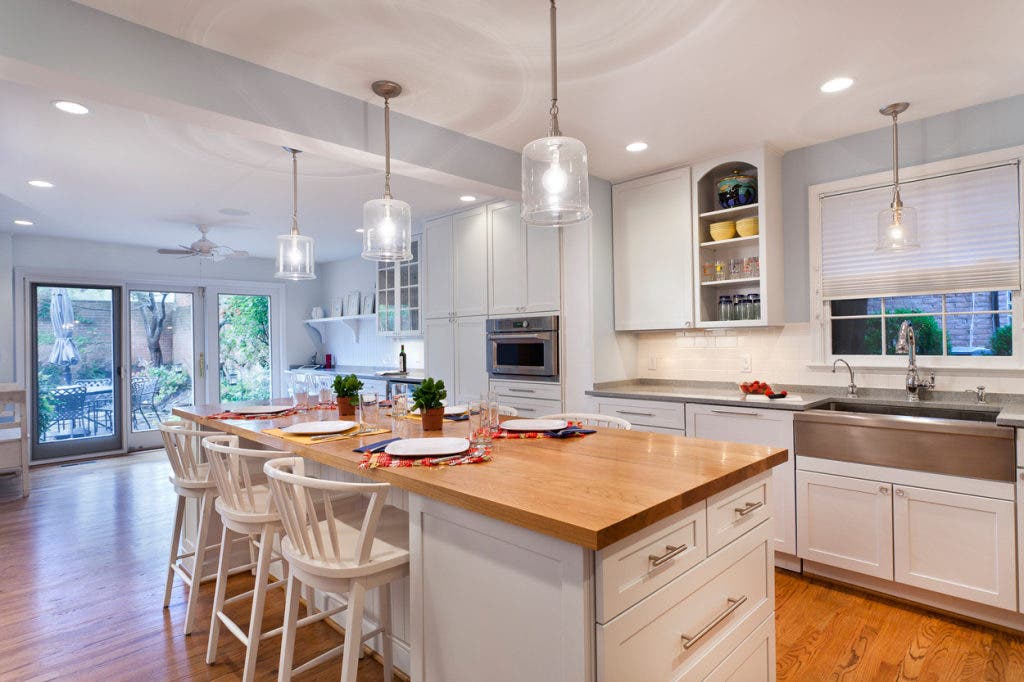

Clean lines and simplistic elegance make a Shaker-style kitchen suitable for any home. To create an authentic Shaker kitchen, the key is to keep it simple.
Born in 18th-century England, the Shaker movement emerged in New England in the late 1700s and reached its peak in the United States during the Industrial Revolution.
Keen craftsmanship became the hallmark of Shaker architecture and furniture design. Shakers considered work an act of worship. They pursued perfection as praise to God. In this pursuit, Shakers designed with three tenets in mind: utility, simplicity and durability. An authentic Shaker kitchen has all three.
Find out what's happening in Clarendon-Courthouse-Rosslynfor free with the latest updates from Patch.
Features of a Shaker-style kitchen
Because Shakers believed in strong community, continuity and order, the interiors of their homes featured open floor plans. This makes the Shaker style perfect for modern families who multitask and use kitchens as dining rooms and home offices.
Find out what's happening in Clarendon-Courthouse-Rosslynfor free with the latest updates from Patch.
Timber was abundant in New England, so Shakers had access to the finest woods. Select maple, birch, cherry or honey pine for your cabinets, which should be tall, simple with flat-panel doors and wooden knobs.
Wide-panel wood floors in oak or pine add warmth; the less glossy the finish, the better. While a butcher block countertop would be historically accurate, installing the more practical granite or solid surface countertop in a simple earth tone will not diminish the overall Shaker look.
Select a trestle table for the kitchen nook and surround with classic Shaker ladder-back chairs. Use ladder-back stools around a bar area. Simple Windsor chairs, although not Shaker, are less expensive and easier to find. These provide a similar aesthetic without compromising utility and durability.
Whatever you choose, Shakers used plant dyes to produce colors for furniture and textiles, so limit your palette to red, blue, orange, yellow and green.
Remove the clutter!
Unlike the more decorative farmhouse or arts-and-crafts styles, the Shaker kitchen is free of clutter. So avoid knick knacks and embellished hardware. Because they believed everything in the home should have a function, Shakers shunned unnecessary objects. Instead of accessorizing for decorative purposes, use Shaker-style boxes and baskets to neatly store coupons, recipes or dry goods.
Shakers were expert basket makers. Often these baskets were stored in large armoire-sized cupboards. Replicas make ideal pantries.
In the Shaker home, everything had its place. This is why they invented peg rails and mounted them high on walls to hang chairs, brooms, hats and mops, leaving the floors bare and rooms in order. Use peg rails over a cook top to hang cooking utensils. Or mount peg rails on a free wall to store aprons, linens and pot holders. Finally, hang industrial-style pendant lights over a kitchen island for added charm.