Politics & Government
Deer Population in Early Stages of 'Eruption'
Part I: County wildlife biologist, residents go on the record about deer
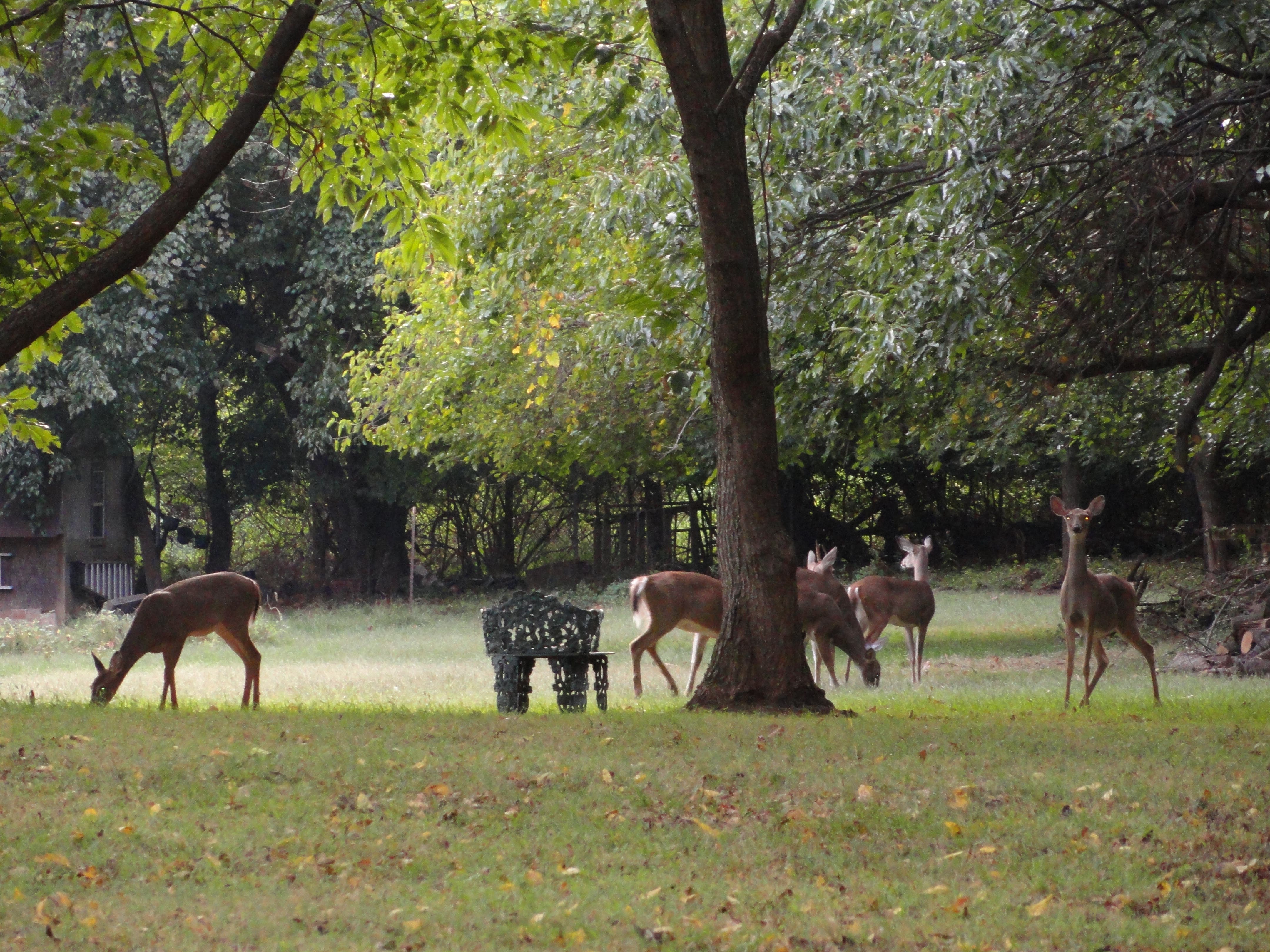


Most Fairfax Station residents are all too familiar with the growing population of deer in the southwestern part of Fairfax County—and two-thirds of respondents to an online County survey want to see fewer of them.
According to Fairfax County's 2009 "Annual Report on the Environment" this population is not only overabundant, it is in the early stages of "eruption." The population may be especially problematic in the fall and early winter, during deer breeding season, when most car-deer collisions occur.
County and state officials base this determination on four factors: deer threatening human life or livelihood in vehicle collisions, destroying favored species, a deer population too numerous "for its own good," and deer numbers causing ecosystem dysfunction.
Find out what's happening in Fairfax Stationfor free with the latest updates from Patch.
Though specific populations are difficult to track, populations at Northern Virginia Regional Parks range from 90-200 deer per square mile, according to the report. By contrast, Bull Run Park in Centreville has a recorded population of over 400 deer per square mile.
Fairfax County's Wildlife Biologist's office says a healthy "carrying" population is 15-20 deer per square mile.
Find out what's happening in Fairfax Stationfor free with the latest updates from Patch.
In 2007, the Institute for Insurance Safety ranked Virginia 7th nationally in deer-vehicle collisions; that ranking jumped to 5th in 2008.
As a 28-year veteran of the Fairfax County Police Department, Lieutenant Mark Blackington has seen his share of deer-vehicle collisions.
"I've seen numerous accidents," he said. "I've seen fatal accidents. It's bad."
As part of the Deer Management initiative, the County recently performed an online survey to determine residents' experiences and opinions regarding the deer population.
An overwhelming 66 percent of nearly 7,000 respondents said they would like to see the deer population decrease.
Half were "very concerned" that they would be involved in a deer-vehicle collision in the next 12 months.
In fact, the Insurance Institute estimates that one in 136 Virginia drivers will have a deer-related accident in the next 12 months. More than 40 percent of Fairfax County deer-car accidents occur in October and November. Deer breeding season runs from October through January.
In an effort to address the deer problem, Fairfax County, in cooperation with the Virginia Department of Wildlife and Game Fisheries, has implemented a multi-pronged Deer Management Program.
The program includes public education efforts, an archery program, and police sharpshooting. The results are "right on target with the objective," says Victoria Monroe, Fairfax County's Wildlife Biologist.
Monroe, a self-described "department of one," works under the aegis of Fairfax County's Office of Animal Control, a branch of the County Police Department. She holds a BS in Animal Behavior Psychology from Colorado State University and a Masters Degree in Zoology from James Cook University in Australia.
Since being hired in June 2009, she has made public outreach a focus, distributing a newsletter to 2,000 homeowner associations countywide. Monroe refers to her blackberry as her "electronic leash" and says she sometimes logs as many as 100 hours a week on the job. Deer management is her primary responsibility.
Of particular concern to residents and officials is the fact that our local deer have become overtly tame and accustomed to suburban surroundings, and are no longer exhibiting the behavior characteristic of wild behavior.
"They rely on instinct and their instinct has been dulled," Monroe says.
Without natural predators to quell the population, Monroe says deer have become akin to "attractive cows."
Fairfax Station resident Pat Haworth says the problem is particularly serious along Fairfax Station Road between Colchester Road and Route 123.
It's not unusual for him to see deer hopping Fairfax Station Road during his 6 am commute to work, he remarks, adding that he saw an eight-point buck browsing alongside the road well before dawn recently. He says several neighbors of his have been compelled to mount deer stands in their own back yards to reduce the population.
Cyndy Pratt's husband, Richard, is an avid gardener and she says her family is "constantly battling the deer."
Deer jump their "various fencing systems" and linger on their back deck, grazing on her husband's bean plants. On her way to the bus stop, she says she has had several "close calls" with her children in the car.
The Pratts are regularly approached by archers requesting permission to hunt on their property, but with four children under the age of 11, she says the idea makes her "uneasy."
This article is the first part in a multi-part series on the deer population in Fairfax Station and throughout Fairfax County. Here's Part II: .