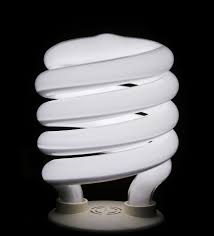
If you are like me, you have a houseful of fluorescent bulbs: traditional four foot tubes in the laundry room, circular tube in the kitchen fixture, and compact fluorescents (CFLs) in lamps and ceiling lights throughout the house. They are energy efficient and last a long time, but when they finally do burn out, what is the best way to dispose of them? It is best to recycle them! Fluorescent bulbs contain a small amount of mercury vapor that will be released into the environment if the bulb is broken. You don’t need to call a hazmat team if you do break a bulb. Just follow these simple steps:
1. Open a window to ventilate the room for 15 minutes.
2. Put on protective gloves and a dust mask.
3. Carefully scoop up any glass fragments and powder using cardboard and place them in a sealable container or zip-top plastic bag.
4. Using sticky tape, pick up any remaining small glass fragments and powder. Place the tape in the sealable container or zip-top plastic bag.
5. Wipe area clean with damp paper towels and place the discarded towels in the container or plastic bag.
6. Do not use a broom or vacuum cleaner to clean up broken bulbs on hard surfaces. If necessary, vacuum carpeted surfaces after all visible materials are removed.
7. Remove the vacuum bag or empty and wipe the canister and place the vacuum debris in the container or sealed plastic bag.
8. Place the cleanup materials in a trash receptacle outside the building for normal trash disposal.
9. Wash hands and launder gloves.
These cleanup tips are courtesy of the USEPA and the VA Department of Environmental Quality.
Hopefully, you won’t break a bulb and you are able to recycle it at one of many locations. We offer fluorescent bulb recycling at the Regional Landfill for tubes and compact ones. Some stores that sell CFLs like Lowe’s, Home Depot, IKEA, and Batteries Plus also accept them for recycling.
Batteries are another item that accumulate around the house especially if you have a young son with remote control trucks, handheld electronic games, and wall-mounted nightlights (They are awesome and look like baseballs, but suck AAA batteries dry nearly every night.). Like fluorescent bulbs, batteries need proper disposal too. Alkaline batteries, the ones typically used in remote controls and flashlights, are OK to place in the regular trash. The battery industry has begun making them with less mercury. Rechargeable batteries are another story. They really should be recycled. We accept lead-acid car and other equipment batteries for recycling at the Regional Landfill, as do many other places. Lithium-ion, Nickel-cadmium, and Nickel-metal Hydride, and Nickel-zinc batteries may be taken to various retailers for recycling: Radio Shack, Staples, Lowe’s, Best Buy, and Batteries Plus.
If you would like to bring your rechargeable batteries to the Regional Landfill, we ask that you wait until the next scheduled household hazardous waste day. The days are typically scheduled in April or May and again in September or October.
These retailer resources are not intended to be a comprehensive list. It was just an attempt on the R-Board’s part to provide convenient alternatives to the Regional Landfill. Individuals are not required to recycle fluorescent bulbs or batteries. Depending on the amount generated, commercial entities should check on disposal requirements with the VA Department of Environmental Quality.