Community Corner
Remembering Herndon's History: Harvey Earlton Hanes
Barbara Glakas writes about H. Earlton Hanes, a prominent lawyer and community leader in Herndon.


By Barbara Glakas
HERNDON, VA — Harvey Earlton Hanes, who went by his middle name and was commonly referred to as H. Earlton Hanes, was a prominent resident of Herndon, who eventually became a lawyer and a delegate to the Virginia General Assembly, representing Fairfax County.
Hanes was born in Ashburn in 1871 and had several siblings. He was the son of George Washington and Gertrude Hanes. His father was a blacksmith and wheelwright, as well as a former Confederate soldier.
Find out what's happening in Herndonfor free with the latest updates from Patch.
Hanes went to public school in Ashburn up to the seventh grade. He initially worked in his father’s blacksmith shop. In the meantime, he also taught himself telegraphy, which helped him earn money. During the years from 1888 to 1890, Hanes worked as a telegraph operator for the Southern Railway in the summer while he taught school in the winter in an unincorporated area of Culpeper, called Brandy (later Brandy Station). He continued to study on his own in his spare time, teaching himself Latin, Greek, mathematics, and other academic subjects.
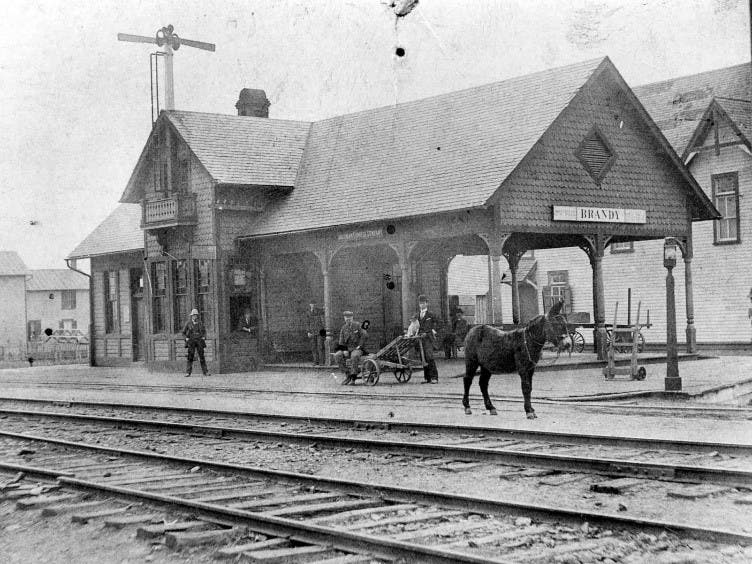
By 1891, he taught math and Latin at the Eastern View Academy in Culpeper. In the following school year, he taught stenography, bookkeeping and other business-related topics at a business college in Culpeper. It was during this time period (in 1892) that he married Annie Blanche Fitzhugh (b. 1872), daughter of William DeHart and Elizabeth Grayson Fitzhugh of Culpeper. Hanes met her during his time at Brandy Station. Blanche was a descendent of Virginia’s famous Fitzhugh family, whose ancestors served in the Virginia House of Burgesses and in local Virginia county militias.
Find out what's happening in Herndonfor free with the latest updates from Patch.
In 1895, Hanes and his wife had their first baby whom they named William Champe Hanes. The baby was stillborn. From 1893 to 1898, Hanes was the principal of the high school section of the Herndon School, located on Center Street in the Town of Herndon. The school housed both secondary and elementary grades. While there he also taught English, Latin, French, German and math. Lottie Dyer, who was born in Herndon in 1879 and attended the Herndon School, once wrote:
“Our teacher was Prof. Harvey Hanes, one of the best teachers I ever had. He taught me how to study and increased my love of learning. His influence helped shape my habits and aided greatly in my development. A great teacher never dies for his influence, like a light, ever falls across the pathway of his students.”
Lottie went on to be an educator. Lottie’s younger sister, Ruth Dyer, a less studious student, had a different experience with Professor Hanes. She wrote:
“Mr. Hanes found me rather hard to control at school. He tried to force me into obedience and that did not work with me. One day I was talking with Lula when I should have been paying attention to him. I said something that made Lula laugh, so he shouted: ‘Ruth, you are talking!’ I admitted that I was. ‘What were you saying?’ This was asking a little too much, for what I was saying was not worth repeating, so I refused to answer and received the verdict: ‘You stay in at noon hour and tell me.’ The result was I lost half my noon hour and, as I still would not tell, he made me stay in a half hour every noon until I would tell. This made me hurry with my lunch and when two weeks had gone by and I still would not tell, Mr. Hanes called on mother to get her to make me tell. Mother said: ‘I do not think she will ever tell you so you might just as well give her time to eat her lunch properly.’“
H. Earlton and Blanche Hanes went on to have three more sons — Harold, Stanley and Grayson. In 1900, Hanes, his wife and their 2-year-old son Harold lived in a boarding house in Middlesex, Massachusetts, where he served as a “draughtsman.” Soon after, and up until 1906, Hanes served as a mechanical engineer and ship’s draftsman for the Navy Department in Washington, D.C., commuting on the Washington and Old Dominion Railroad. He assisted in designing various war vessels. At the same time, he took undergraduate coursework and studied law in the evening at George Washington University. He graduated in 1905 and soon after began practicing law.

In their early years in Herndon, the Hanes family rented homes, first on Center Street and later on Elden Street. The 1910 census record showed that Hanes (age 37) and his wife Blanche (age 37) lived in a rented home on Elden Street. His occupation at that time was listed as a “lawyer.” Also living with them were their three sons: Harold Fitzhugh (12), Stanley Bartlett (6), and Grayson Bland (0). Additionally, a young Black servant was living with them, Victoria Honesty (17). By 1920, the Hanes were living on Monroe Street, still renting, in what is now believed to be 805 Monroe St..
Hanes was also known to have musical talents. A 1926 Fairfax Herald newspaper article noted how he played “special violin music” at an event.
In 1924, Hanes briefly served on the Herndon Town Council, appointed in July of that year to fill a vacancy of a retired member. He served on the Road and Light Committee, the Finance Committee, the Public Property Committee, and the Ordinance Committee. While on council, Councilmen Poole and Hanes — at the suggestion of the Chamber of Commerce — proposed an ordinance to levy a tax on automobiles to raise funds for town roads, payable on the first day of each July. It was later passed by the council and became effective in 1925. Hanes also made a motion to authorized the mayor to issue licenses to people “selling soft drinks, circuses, etc.” It was passed by the council. Hanes was the only councilman to vote against the town granting a franchise to the C. & P. Telephone Company. Hanes resigned from the Town Council in November 1924.
In 1925, he was elected as a representative to the Virginia General Assembly, where he served from 1926 to 1928. He was against drinking spirits of any kind and ran politically as a prohibitionist. Under Virginia Governor Byrd, Hanes served on the Virginia Park and Planning Commission and on the state Audit Committee.
He later attempted three times to run from Congress, but was never elected. One of his grandsons commented that “he failed because he did not wait his turn for endorsement from the Byrd machine and they didn’t support him.” However, he added that his grandfather “got a lot of votes anyway.”
By 1930, the Hanes owned their home on Monroe Street. It was noted on the census that they had a radio set in the home. According to the National Archives:
“The 1930 census reflected the emerging values of early twentieth-century America, in particular the growing influence of consumerism and mass culture. The 1930 census included for the first time a question regarding a consumer item. Respondents were asked whether they owned a 'Radio set,' a luxury that had become increasingly common in the 1920s. As historian Roland Marchand has argued, in the early decades of the twentieth century, American business and political leaders viewed radio as a source of cultural 'uplift' for the population as well as a valuable medium for advertisement of mass-produced goods. The inclusion of a question on radio ownership reflected this new interest in the possibilities of consumer items and methods of mass communication.”
Some of Hanes’ sons and grandsons followed in his legal footsteps, becoming attorneys themselves. One of his sons, Stanley B. Hanes, was elected mayor for the Town of Herndon in 1931. He served as mayor until 1933. After his term ended, he was appointed as the Town of Herndon’s Corporation Counsel, a position that is now called Town Attorney.
During his many years in Herndon, Hanes was very active in his community. He was a long-time member of the First Baptist Church of Herndon, which was built in 1900. He was known for his Sunday school work, acting as the superintendent of the Sunday school there for many years. He was also a member of the Herndon Masonic Lodge, serving as its master in 1908. Additionally, he was a member of other fraternal groups including the Shriners, the Order of Red Men, and the Knights of Pythias.
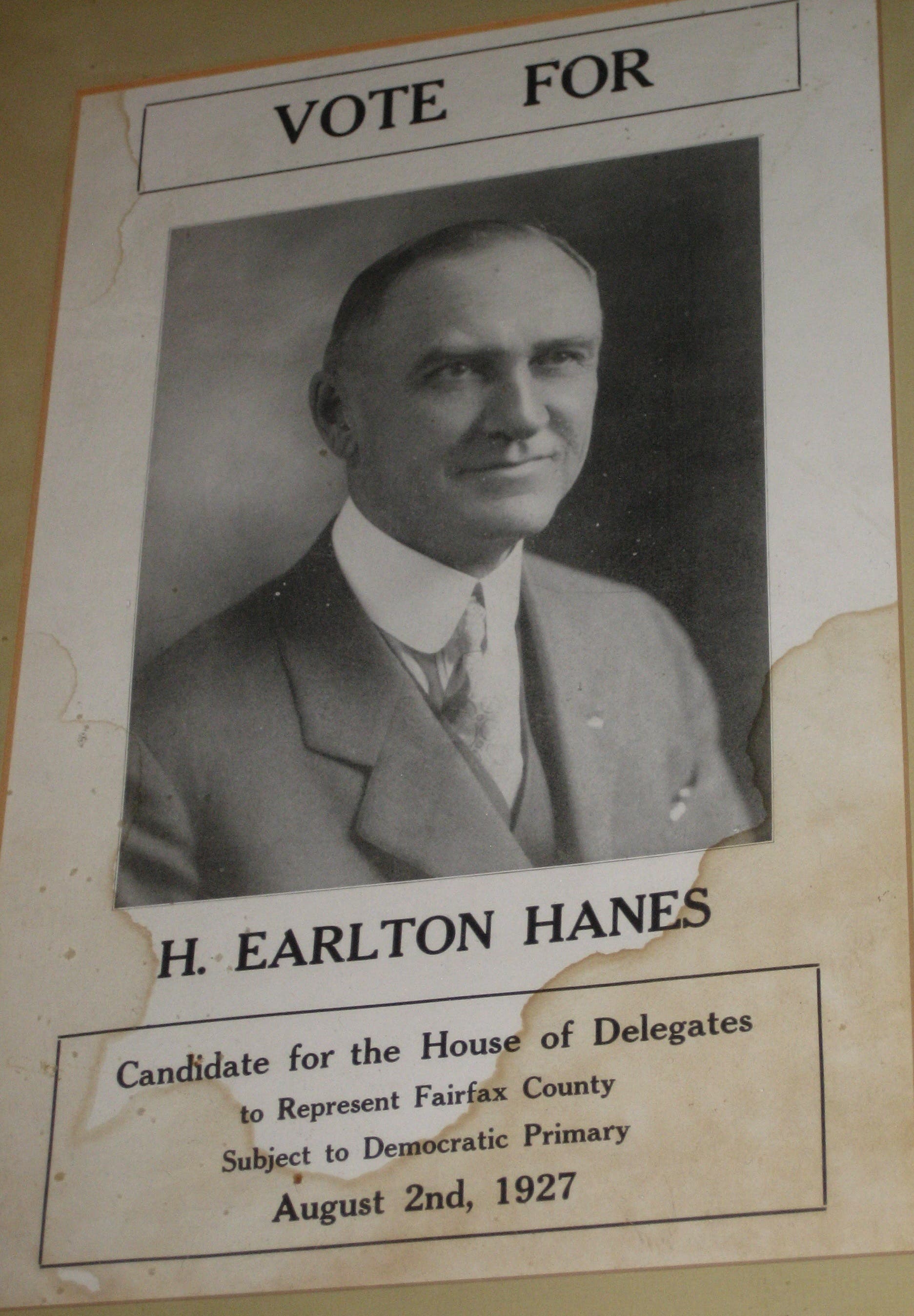
A 1932, Washington, D.C., directory showed that Hanes was still practicing law. He had an office at 733 15th St. in Northwest Washington, although he still maintained his residence in Herndon.
Blanche died of a stroke in 1938 at the age of 65. After his wife died, and for the rest of his life, Hanes continued to own and occupy the Monroe Street home, but he also had an apartment in Washington, since his law office was located there. In the 1940 census, Hanes, then a 68-year-old lawyer, is listed as living on Connecticut Avenue in Washington, D.C., with a new wife, M. Elizabeth Griffith Hanes. Elizabeth was a public school teacher who was born in Front Royal in 1890.
Some of Hanes' grandchildren were very young when their grandfather was alive, but they still hold fond memories of him. One grandson remembers digging his first fishing worms in his grandfather’s garden for fishing excursions they would take to a pond along Sugarland Run. After catching perch, Hanes told his grandson, “Let’s take it home and clean it,” which they did. The same grandson also remembers pushing a golf cart for his grandfather as he played at the Purcellville Golf Course (now the Loudoun Golf and Country Club).
Hanes was a well-respected man but was also known to be a strict man. One grandson recalled that everyone called him “Mr. Hanes,” adding, “I was scared to death of him!” He also said:
“One thing I do remember is the formality of the Hanes family to its family members. The requirement of being polite and honest was drilled into us. My grandfather was so revered by his wife that she always referred to him as 'Mr. Hanes.'”
Another grandson remembers Hanes to be a strikingly handsome man, about 6-foot-3 or 4, who stood tall and erect.
“He was what I would call ‘formal’ in appearance and bearing, somewhat Victorian you might say, almost regal in his bearing. I don't recall being afraid of him at all. Quite the contrary, I thought he was a wonderful grandfather, even though he was so formal, Victorian and genteel that he appeared to be distant or maybe even stern, but who was nonetheless, a warm and loving grandfather.”
The same grandson remembered the clay tennis court on the south side of the house, where their grandfather played. He also recalled their grandfather’s “Big Buick” parked in the garage (which they described as being more of a barn). Additionally, he recalled how his grandfather kept a garden:
“While I was young, I have a distinct memory of my grandfather hoeing his well-kept garden in the hot summer sun while dressed in seersucker trousers with navy blue suspenders, a long-sleeve pale blue dress shirt with a heavily starched white collar, a bow tie, arm garters, with a brass-collar button and tie, and a flat-top straw boater hat. I also have a memory of my grandfather walking from his garden behind his home on Monroe Street to my home on Vine Street with a basket of freshly picked vegetables to give to my mother for us all to have for dinner that night. He would bring my mother tomatoes, peppers, onions and lettuce and other vegetables, carrying them in a shallow, long wicker basket which he carried on his arm. He was wearing the same clothes, as my memory of him working his garden: shirt & bow tie, etc.”
Hanes passed away in Herndon in 1946 of heart disease. Following his death, and in accordance with his last will and testament, his sons Grayson and Stanley along with his grandson William "Skippy" Hanes, inherited ownership of the home, subject to his wife, Elizabeth, being allowed to remain living there for the remainder of her life. Elizabeth died in 1975. Hanes, along with his wives Blanche and Elizabeth, are all buried in Herndon’s Chestnut Grove Cemetery.
Harvey Earlton Hanes was a man of many accomplishments and ambitions. A life-long Virginian, he rose from modest means and valued education. He spent most of his adult life in the Town of Herndon where he served his community in many capacities. Some of his descendants continue to live in, or remain closely connected to, the Town of Herndon.
About this column: “Remembering Herndon’s History” is a regular Herndon Patch feature offering stories and anecdotes about Herndon’s past. The articles are written by members of the Herndon Historical Society. Barbara Glakas is a member. A complete list of “Remembering Herndon’s History” columns is available on the Historical Society website at www.herndonhistoricalsociety.org.
The Herndon Historical Society operates a small museum that focuses on local history. It is housed in the Herndon Depot in downtown Herndon on Lynn Street and is open every Sunday from noon until 3:00. Visit the Society’s website at www.herndonhistoricalsociety.org, and the Historical Society’s Facebook page at https://www.facebook.com/HerndonHistory for more information.
Note: The Historical Society is seeking volunteers to help keep the museum open each Sunday. If you have an interest in local history and would like to help, contact HerndonHistoricalSociety@gmail.com.
Get more local news delivered straight to your inbox. Sign up for free Patch newsletters and alerts.