Community Corner
Remembering Herndon's History: The Herndon Community Cannery
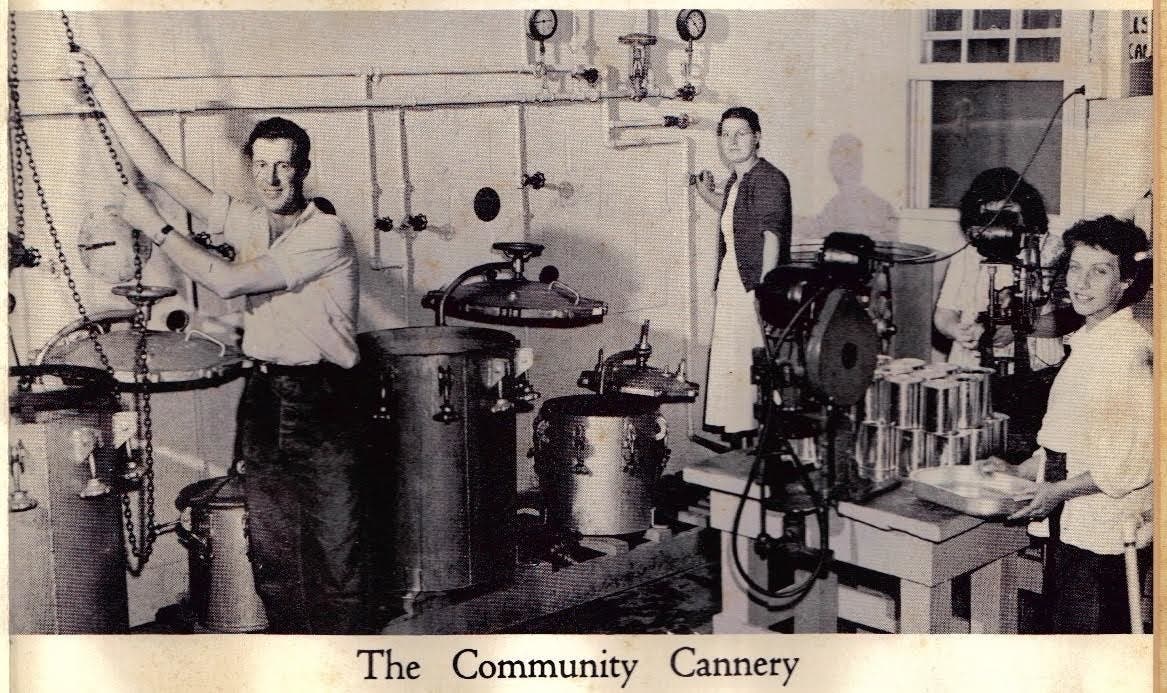
Main image: The Herndon Cannery from a 1950 Herndon High School yearbook


By Barbara Glakas
One unique amenity in the Herndon community was The Herndon Community Cannery that operated behind Herndon Middle School on Locust Street from 1944 to 1984.
In June of 1944, the Fairfax Herald newspaper announced that the community cannery was being built on the Herndon High School grounds (later Herndon Middle School) and was almost complete, inviting residents to come see the new facility. The cannery was a public service supported by state and county funds. Any family could use the cannery to can food for their own use.
Find out what's happening in Herndonfor free with the latest updates from Patch.
The purpose of the cannery was to encourage food production and to conserve foods during the time period when there was rationing and Victory Gardens during World War II. A Victory Garden is a home garden planted to increase food production during the time of war. This would help prevent food shortages, ensuring that the United States War Department had enough food for our soldiers fighting around the world, saving money that could be spent elsewhere for the military.
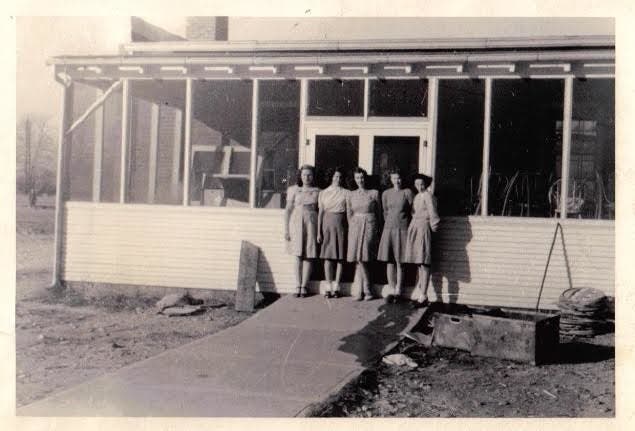
High school girls standing outside the south wall of the cannery, c. 1940s. Photo courtesy Margaret Cyrus.
Find out what's happening in Herndonfor free with the latest updates from Patch.
During the 1940s, rationing became necessary to support the war effort. Rationed items included things such as gasoline, aluminum, steel and electricity. Food products were also rationed, such as sugar, fruits, meat, cheese and butter. The cannery influenced residents to grow and can their own food supplies so that they could have enough food throughout the winter.
Initially, the cannery was run by school employees. Home economics or agriculture teachers were employed to supervise the cannery. These teachers may have done this as a sideline job for additional income. As time went on, local residents whom were not teachers were hired to supervise the cannery.
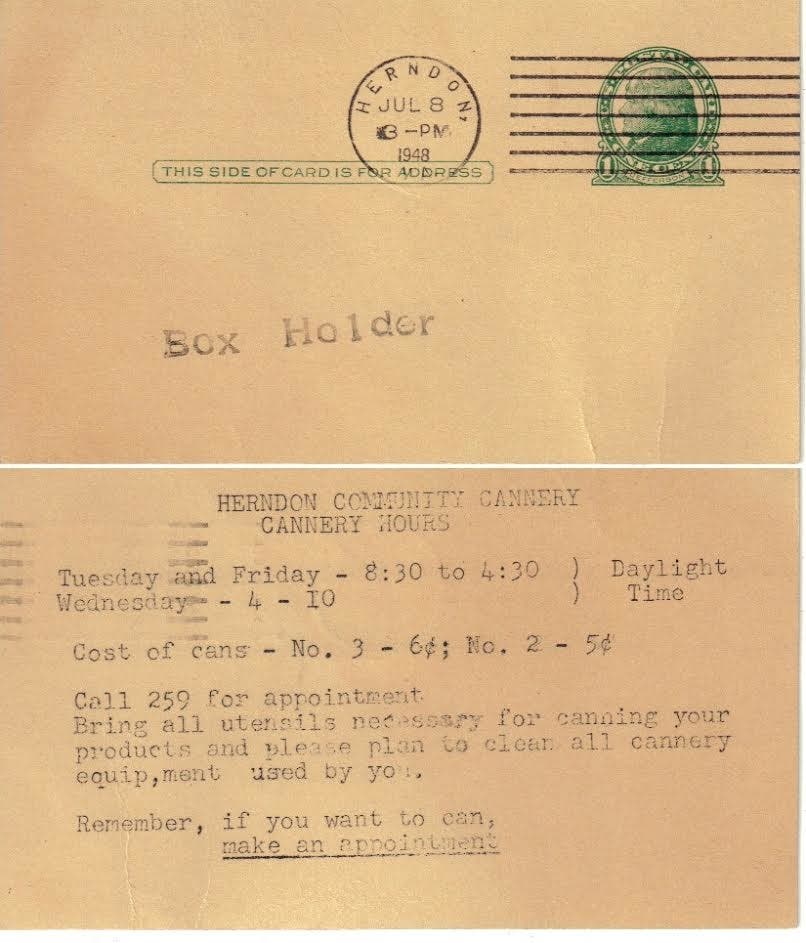
1948 postcard announcing the seasonable opening of the cannery.
The cannery was open to the public. Any person who used the cannery had to pay for each can they used. The cannery usually provided two different size cans. In 1948 number 2 cans cost five cents each, while number 3 cans cost six cents each.
The cannery was open three days per week, usually Monday and Friday mornings, and Wednesday evenings. It was a seasonal operation, opening in the summer after the school year was over, and closing at the end of November until the next summer. Articles were regularly published in newspapers to announce the seasonal opening and closing dates of the cannery each year. Those announcements included the hours of the cannery, the price of the cans and the telephone number that could be used to make an appointment. Postcard announcements were also used; one such post card with a Herndon postmark dated July 8, 1948, was discovered, addressed to “Box Holder,” announcing the cannery’s hours and prices for that season. These post cards were placed in each resident’s mail box, in the post office formerly located in Herndon’s old Town Hall.
In the early years residents were encouraged to bring their own salt, sugar and vinegar if needed, as well as dish towels and soap. As the years went on, the operation became more efficient, with most utensils and supplies being available at the cannery. Canners were encouraged to bring their own paring knives and any special spices that they may want to use with their fruits or vegetables.
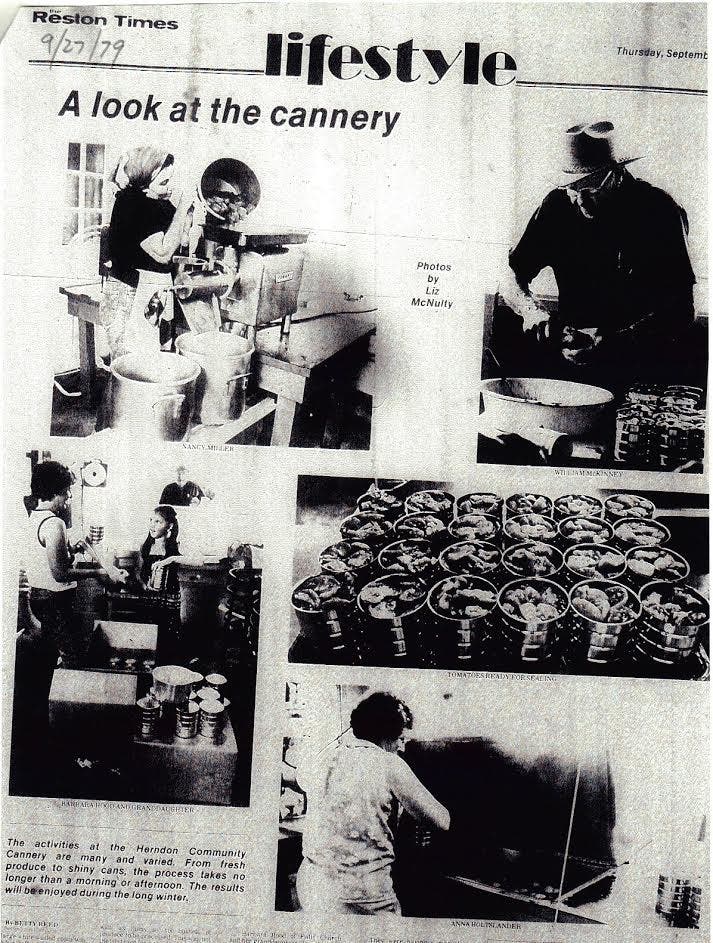
A 1979 newspaper article about the cannery. From The Reston Times.
Those who wanted to use the cannery had to call ahead for an appointment. At the appointed time, residents would bring in their food. The cannery supervisors provided instructions on how to prepare the food and how to use the cannery equipment. The cannery supervisors provided advice and assistance while the residents provided their own food and labor.
An article in a 1976 Reston Times newspaper described one resident’s initial experience in the cannery:
“A few days before my arrival at the cannery, I called the manager to set up an appointment. At that time she asked what vegetables were to be canned and in what quantity. Had there been special preparation necessary, she would have given me instructions.
“At the appointed hour I arrived with my little sack of green beans. It was somewhat overwhelming to find that there were some customers there with as many as six bushels of produce to be processed. This was not the first visit for a couple of the patrons.
“The initial preparations were carried out on a screen porch built into what once was the kitchen when the intermediate school was a high school.
“The air was decidedly friendly and there was a feeling of camaraderie between the peelers, shuckers and slicers as they readied their peaches, tomatoes and beans. A breeze brought pleasant relief from the heat of the kitchen a few steps away.
The first step was to wash the beans and snap the ends….. Next, the beans went into a cauldron and were cooked in water until they reached a rolling boil. Then the vegetables were put into cans and were placed in a steam bath until the temperatures of the contents reached 160 degrees, the temperature necessary for safe sealing.
“My sealed cans were lowered into a mesh cage into one of three enormous pressure cookers. [I saw the manager help a lady] operate the heavy hydraulic lift and the locks on the pressure cooker. The beans were cooked at 240 degrees for 25 minutes.
“While this step was being carried out I had an opportunity to chat with other canners. Four women, all sisters-in-law, were busy peeling and quartering [four bushels of] tomatoes. They were having a marvelous time catching up on each other’s gossip.”
Indeed, the cannery was also a social place where friendships were made and where neighbors could meet, chat and exchange recipes. Residents from all around the area used the cannery, from Floris to Reston to Great Falls.
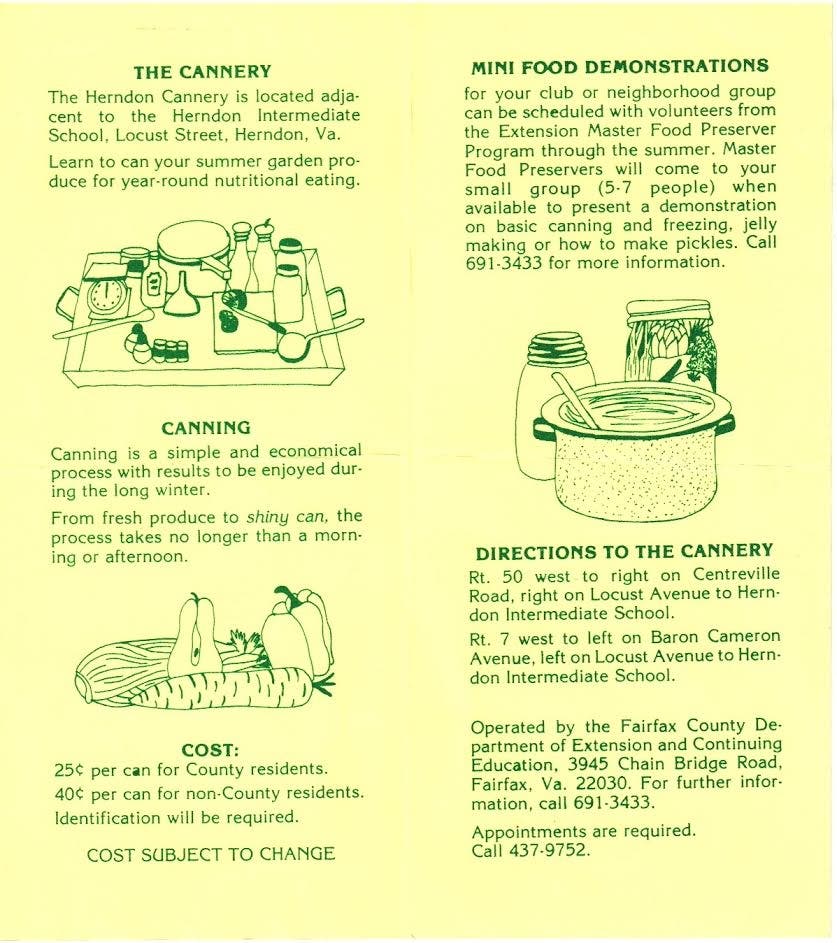
An excerpt from a 1982 cannery pamphlet.
One Great Falls resident – who had used the cannery for over thirty years – recalled:
“Remember that day that we packed 500 cans of tuna? ‘Spent a week on a tuna boat off Montauk, N.Y., some years ago. Caught fish all day long, and each night we’d clean ‘em and freeze ‘em. At the end of the week I loaded my pickup, a layer of ice and a layer of fish, like that. Started out from Long Island at 9:00 at night and got home at 6:00 in the morning. Spent the whole next day at the Cannery puttin’ that tuna in pint cans.”
At some point in time the cannery came to be operated under the supervision of the Fairfax County Department of Extension and Continuing Education. The annual budget was between $10,000 and $12,000 per year, which was partially off-set by the charges the canners paid for each can. By the 1970s, County residents paid 25 cents per can, while non-residents paid 30 cents per can. By 1982, non-residents paid 40 cents per can.
Many current and former long-time Herndon area residents still have fond memories of the cannery. One long-time resident, who taught Home Economics at Herndon High School in the 1960s, said she would sometimes help with food preparation at the cannery. She said, “People would come from as far away as the Blue Ridge Mountains. Some would back their pick-up trucks to the cannery and unload bushels of tomatoes and beans.” In addition to fruits and vegetables, she recalled that some people also canned things like venison and sausage. She also noted that the last thing that was canned at the cannery was water by a religious group. “These were the days before you could buy bottled water,” she noted.
Virginia Clarity, who grew up in Herndon, remembers how her father worked as one of the managers at the cannery. As a young girl, she – along with her mother – would help out at the cannery, doing food preparation on the hot screened-in porch.
Dallas “Porter” Hutchison, who grew up in Chantilly and attended Herndon High School as a young boy, once recalled how he and his school chums were sometimes conscripted to help work in the cannery. As an adult, he and his wife, Libby, were regular patrons of the cannery. Libby once said, “It beats messing up your own place.”
By 1982 the future of the Herndon Community Cannery seemed uncertain. In April of 1982 the Reston Times reported that the County Board of Supervisors approved enough money to keep the cannery open for a while, but acknowledged that its future was in doubt.
In May of 1983, as a result of the passage of the fiscal year 1984 county budget, it was reported that the cannery would no longer receive county money and, as a result, the cannery would be forced to close.
--------------------------------------------
About this column: “Remembering Herndon’s History” is a regular Herndon Patch feature offering stories and anecdotes about Herndon’s past. The articles are written by members of the Herndon Historical Society. Barbara Glakas is a member. A complete list of “Remembering Herndon’s History” columns is available on the Historical Society website at www.herndonhistoricalsociety.org.
The Herndon Historical Society operates a small museum that focuses on local history. It is housed in the Herndon Depot in downtown Herndon on Lynn Street and is open every Sunday from noon until 3:00. Visit the Society’s website at www.herndonhistoricalsociety.org, and the Historical Society’s Facebook page at https://www.facebook.com/HerndonHistory for more information.
Note: The Historical Society is seeking volunteers to help keep the museum open each Sunday. If you have an interest in local history and would like to help, contact HerndonHistoricalSociety@gmail.com.
Get more local news delivered straight to your inbox. Sign up for free Patch newsletters and alerts.