Community Corner
Remembering Herndon's History: The Irrepressible W.T. Updike
Barbara Glakas of the Herndon Historical Society recounts the life of long-time developer W.T. Updike.


By Barbara Glakas
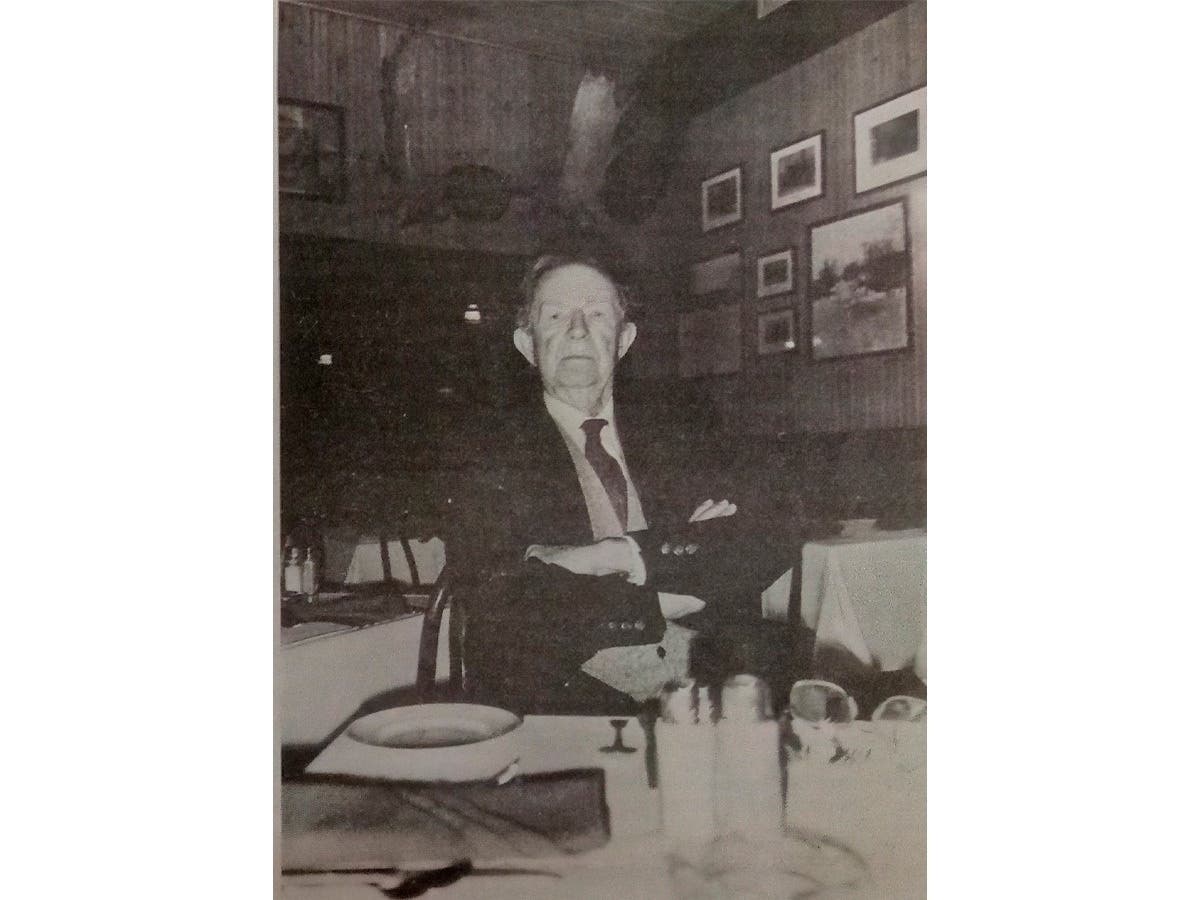
HERNDON, VA — W.T. Updike was a former town resident described in local newspaper articles as a man of many behaviors, from mean and ornery, to thoughtful, winking, chuckling, bashful, bold and sly. Dan Chamblin, one of the original owners of the Ice House Café, described him as “a real piece of work.”
Two of those Herndon Observer newspaper articles were published in February and March of 1988, which recounted some of his exploits and how Updike built some Herndon housing developments in the 1940s and 1950s — with or without the town’s permission — despite the fact that he wasn’t really a developer at all. One article had a tongue-in-cheek title, “Herndon’s Original Downtown Developer.”
Find out what's happening in Herndonfor free with the latest updates from Patch.
Born in 1905 in South River in Warren County, Virginia, Welton Trenton “Uppy” Updike was the son of a flour grist mill owner. Updike lived with his parents in Warren County up through the 1920s, having completed one year of a high school education. By 1930, the family was living in Washington, D.C., where Updike and his father worked as grocery store clerks.
Updike married Eloise Printz in 1932. Updike continued to work for the Sanitary Grocery Company (pre-cursor to Safeway) in Washington, at one point becoming a branch manager. Various Washington City Directories from the 1930s indicated that while he was working in Washington, he had residences in both Washington and Herndon. We speculate that he may have ultimately moved to Herndon because his wife’s family had deep roots in Herndon.
Find out what's happening in Herndonfor free with the latest updates from Patch.
In the 1940s, Herndon was still a sleepy farming town. Updike, who later went into the real estate business and sold real estate with his father-in-law, Raymond C. Printz, said he helped move people out to Herndon so that they could “smell the cows and fresh air.” He thought that many people in Herndon did not envision the future of the town and were not too keen on growth, remembering the brouhaha that occurred when the first stop light was installed in Herndon. Former resident, Hal Landers, later recalled that, “[Updike] was the only one back then who had any faith in the future of the town.”
There were many stories of him having run-ins with the Herndon powers that be, which — by all accounts — he himself enjoyed. In the 1940s and 1950s, he had some buildings constructed in and around downtown Herndon. He never considered himself a “developer,” but instead claimed that there was no need to waste money hiring high-priced planning professionals “when you can do the work yourself. I was my own architect and engineer.” He considered getting building permits to be an annoying task, and he sometimes built without them.According to one article, Updike thought the town fathers were sometimes “anti-progress, so sometimes a fellow had to kind of bend the law and get on with things.”
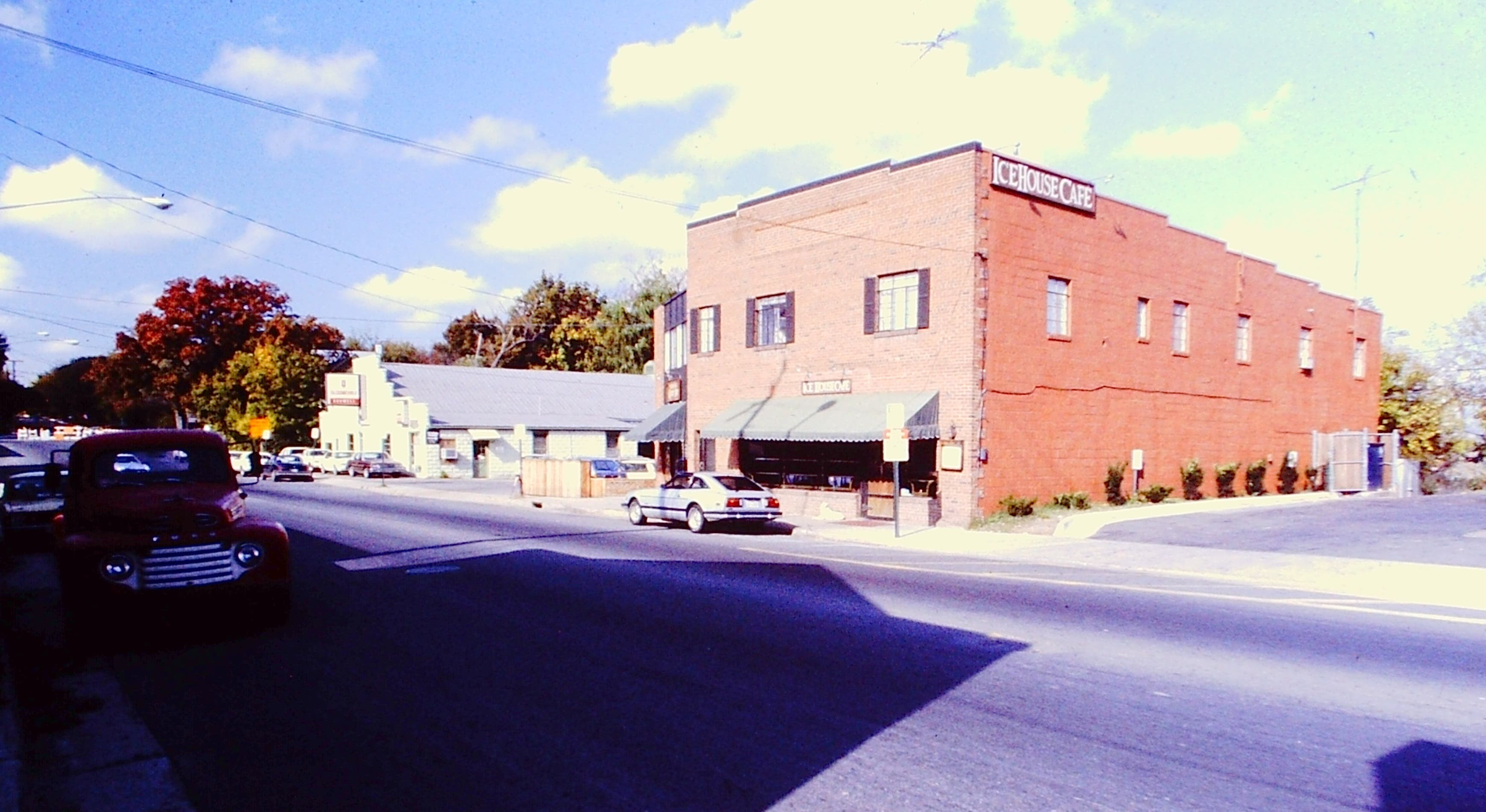
One shining example of this viewpoint is how he went about building what is popularly known as the Ice House Café building at 760 Elden St. Updike decided that the town needed some substantial brick commercial buildings. And he also thought Herndon should have a top-quality pharmacy on Elden Street. That is how he planned the beginning of the Ice House Café building, to be a drug store on the ground floor and rental apartments on the second floor, in order to earn himself some income.
But Updike recalled, “The town fathers weren’t interested in seeing any progress,” and the building permit was not forthcoming. Updike told a town official, “If the permit isn’t in the mail by 10:00 o’clock, I’m going to go ahead and build it anyway.” And that’s what happened. He checked his mailbox, which was then in the town hall. There was no permit in his box, so he headed over to the site, telling the men he had hired to commence working. When the town manager, who had followed Updike from the town hall over to the site, attempted to stop the work, Updike informed him that he was trespassing. Hours later, Updike got his building permit. As he planned, a pharmacy opened in the building. Over the years, the businesses on the first floor changed hands to different pharmacy and restaurant proprietors until it ultimately became the Ice House Café in 1979.
But that’s not where it ended. There was a vacant lot on the west side of the building that had the Folly Lick Creek running through it. Updike decided he wanted to build on it. Although the town zoning regulations did not prevent him from doing that, the town fathers fiercely opposed the idea. That did not stop Updike. His request for a building permit was denied but, in defiance, Updike poured a concrete slab right by the creek. Updike hired friends and workers who secretly used a lot in Loudoun County that he owned as a staging area where they constructed a one-story building. In a stealthy mission one evening, the workers loaded the building onto a truck, drove into Herndon and pushed it onto the slab that Updike had created over the creek. A life-long town resident who was about 18 years old at the time, remembers watching this event happen that evening, as he sat across the street outside the Herndon Theatre (now the Upholstery Shop). He described what he thought was a bunch of drunk men — who he said appeared to be friends of Mr. Updike — bring a shed-like building on a flatbed truck, that had been built elsewhere, and watched them place it on the slab. The next morning — voila! — the building was there on Elden Street for all to see.
Alas, the town refused to grant Updike an occupancy permit. The one-story building was eventually removed from the slab and sold, where it later turned into a house on another lot. Updike was later granted a building permit and the current addition (which later became the Oyster Bar) was constructed.
Updike, the not-really-a-developer guy, was also responsible for building some affordable housing in Herndon. The first basic house he built was on Spring Street, near the intersection of what is now Herndon Parkway, which he sold for $2,500. Ultimately, he built a half dozen houses along Spring Street which he sold himself. These basic homes typically had three bedrooms with privies in the back yard, requiring only $100 down.
Updike also built his own traditional brick house on Spring Street, closer to downtown Herndon, not far from the fire station. Although there is not one plumb wall in the house, Updike used hardwood floors that he had bought from Georgia, and he boasted how his heating system was “the most efficient around.” He left his name scrawled in the wood underneath his basement staircase. Various real estate websites now estimate his former house to be worth over $800,000.
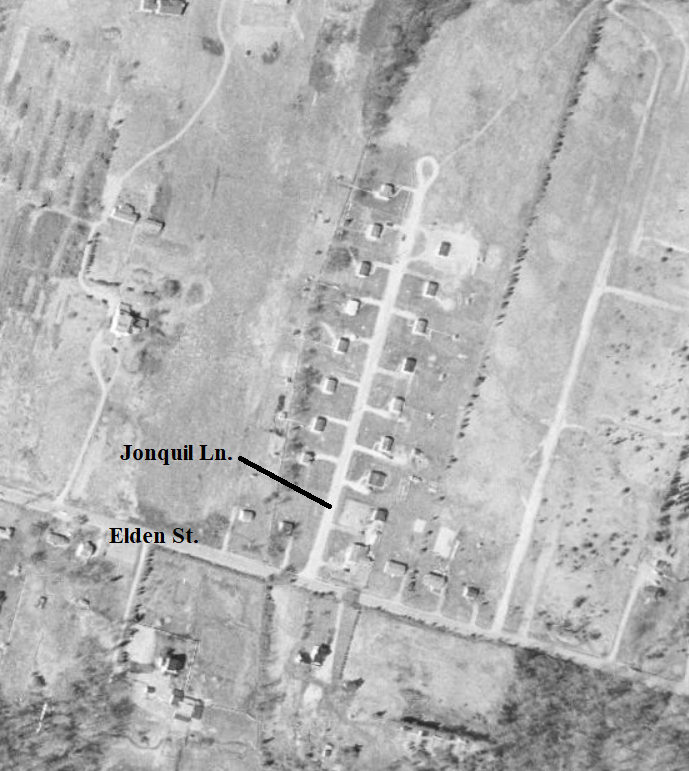
He also built affordable houses — which we might describe as small, boxy cottage homes — on Jonquil Lane, a street which intersects with east Elden Street. Updike started this venture by purchasing a half-acre lot for $450 on the highly visible Elden Street (which was then called Washington Street). The east end of Elden Street was not yet developed, nor paved, and was ever still a country road. With the help of his friend, Herndon lawyer Mike Martin, Updike met with U.S. Senator Harry Byrd, which resulted in funds being made available to improve the road (Elden Street) between Herndon and Leesburg.
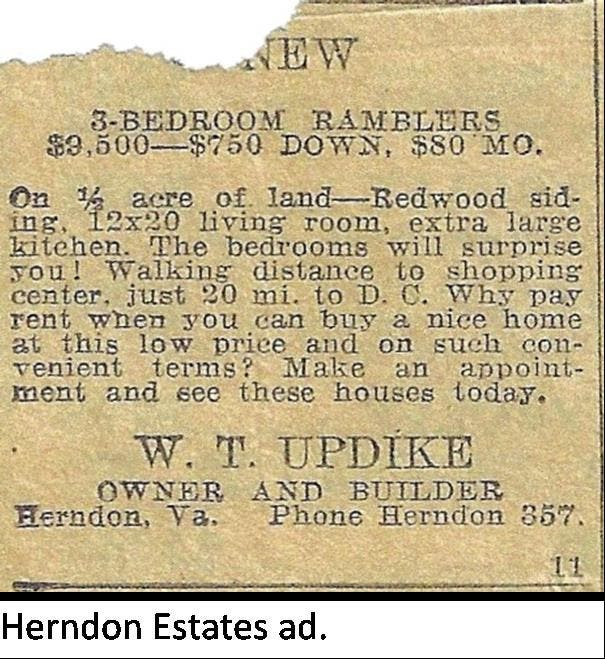
Updike’s Jonquil Lane project was called “Herndon Estates.” Again, the town fathers indicated their disapproval for the project. The mayor said, “He had no sewer and the land would not percolate.” But Updike said, “They never did a test to see if the property percolated … they did not want me building there." Not wanting to go broke, because he borrowed money to build there, Updike was able to get around the town officials. Updike went to Richmond where the state issued permits to build outdoor privies.
According to the Herndon Observer newspaper article:
“Mind you, the houses along Jonquil Lane and Rosemary Lane (now the section of Herndon Parkway that runs past Stuart Woods Apartments) and along Washington Street, were constructed with bathrooms, their intake pipes fed with well water. The fixtures just didn’t drain into the town’s network of sewer pipes. Instead, the plumbing fixtures’ water run off fed outside through a simple device called a ‘grease trap.’ The first three homes in Herndon Estates were fitted out with these fads which somehow never quite caught on, experimental electric toilets developed at Purdue University.”
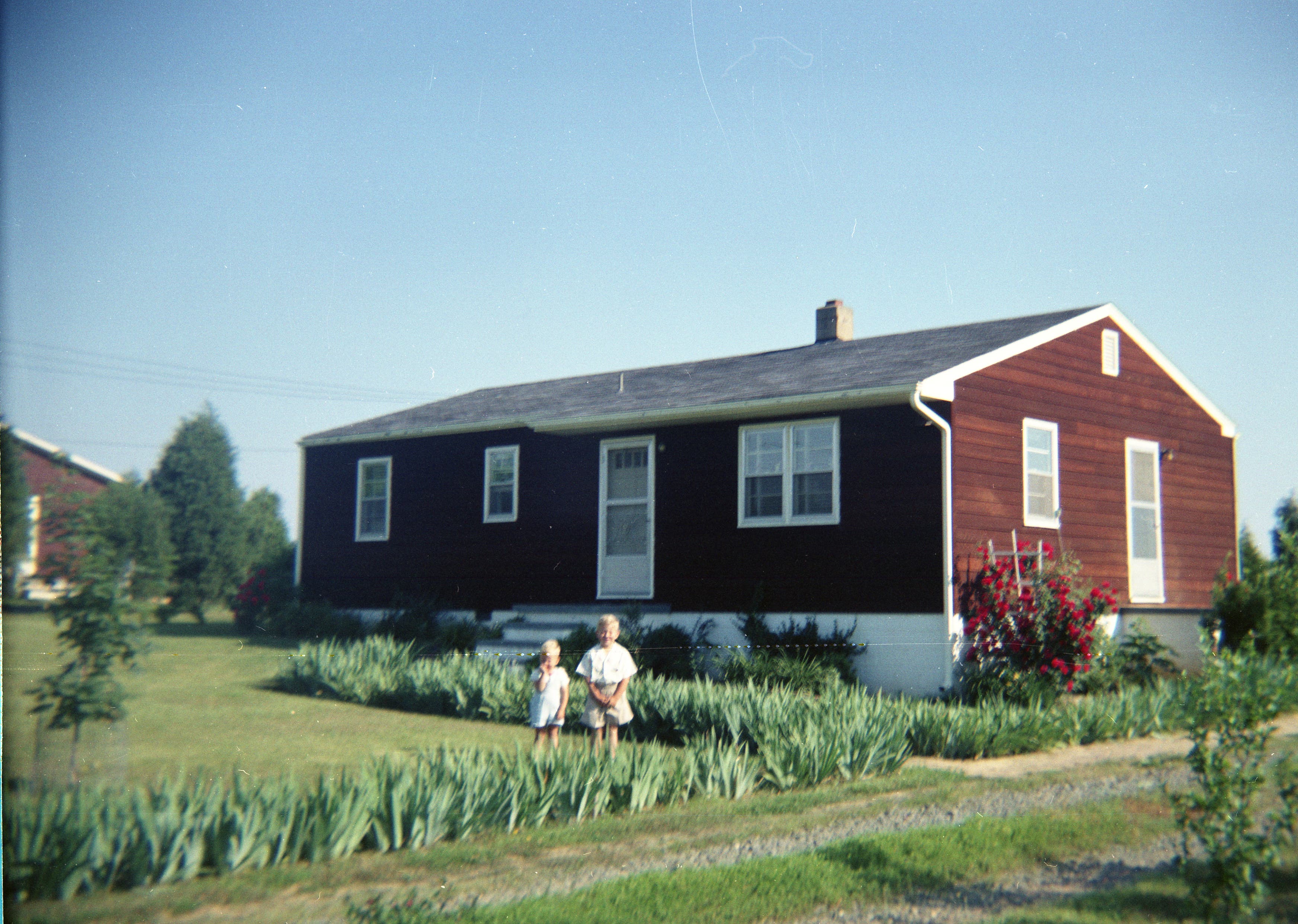
Some of those basic homes on Jonquil Lane measured no more than 24’ x 24’, but managed to fit two bedrooms, a kitchen, a bathroom and a living room.
Former Herndon resident, Dave Farmer, whose parents bought one of Updike’s Herndon Estates homes on Elden Street, at the mouth of Jonquil Lane, described the house and property like this:
“[They] signed a purchase agreement in the amount of $9,450.00 with Welton T. Updike to buy a house to be built in Herndon… [as part of] the Herndon Estates Subdivision. The house was to be the same as the house on the adjacent [lot, with] a dug well not exceeding 14 feet. A Sanitor sewerless sanitary closet was included. The contract called for $250.00 to be paid at contract signing, with an additional $250.00 due within 10 days. The house was under construction at the time of the purchase agreement; the transaction went to settlement on 15 May, 1953. The house, situated on a half-acre lot, had redwood siding and I remember it was painted red on the outside. [My parents] referred to that house as the “Little Red House.” There were three bedrooms (two 15’ x 12’ and one 9’ x 12’), 20’ x 12’ living room and a 15’ x 15’ kitchen. No appliances came with the house. The heat was provided by an oil furnace in the floor in the main hallway. I remember that we also had a Sears Coldspot refrigerator with a freezer on the bottom and a square Maytag wringer washing machine. The water source was a well in the backyard, and since an automatic clothes dryer was not likely in my parent’s budget in the Little Red House, clothes were air dried on the clothesline in the back yard.”
Some complaints about stink resulted about Updike’s project, which had been built without any town permits. Much of the controversy centered around the electric toilets, but they were guaranteed to be totally sanitary. Updike insisted that any stink came from the large dairy farm located behind Herndon Estates, being that the housing development was down wind of the farm. Updike drove the mayor to Herndon Estates so that he could check the odor situation for himself. Updike placed his handkerchief on the ground so that the mayor could kneel and smell the ground. The mayor failed to smell any stink, so the issue was dropped. Later in the 1960s, the town’s water and sewer lines were extended and Updike arranged for the Herndon Estates homes to have modern plumbing.
At the time the newspaper articles were written in 1988, developers were looking to purchase the Jonquil Lane land for redevelopment. One previous Jonquil Lane homeowner, Mary Thompson, said she had bought her home in 1954 for $6,400, and now she was resisting offers to sell her property for six figures.
Ultimately, the property along Jonquil Lane was redeveloped and now is home to a neighborhood of high-end townhomes called The Village at Herndon Mills.
Updike was quoted as saying, “I never cared to hang on to the land myself,” saying he preferred to pass the land along to others and find new ground to develop and sell. “Some people will probably tell you they thought I was a scrooge or crook. Don’t believe them! I had a philosophy then and still have it. Tell the truth. I’ve never misrepresented anything I’ve ever sold. Another thing: never let people sign anything they don’t understand. That’s the way I did business. I could always look in the mirror and settle up with myself afterwards.” Lastly, he commented, “Always dress sharp and drive a nice car. People like to do business with success.”
Updike had many nicknames. “Uppy” was mentioned at the beginning of this article, with some calling him “Uppity.” When he died in 1998, his tombstone was engraved with, “‘Chief’ Welton T. Updike.” Mary Thompson said that Updike was a “wonderful man” and her children called him “Pappy.” Thompson continued, “He kind of looked out for the folks who weren’t rich. Pappy thought it was important for people to own their own houses and he tried to make it possible for them.”
About this column: “Remembering Herndon’s History” is a regular Herndon Patch feature offering stories and anecdotes about Herndon’s past. The articles are written by members of the Herndon Historical Society. Barbara Glakas is a member. A complete list of “Remembering Herndon’s History” columns is available on the Historical Society website at www.herndonhistoricalsociety.org.
The Herndon Historical Society operates a small museum that focuses on local history. It is housed in the Herndon Depot in downtown Herndon on Lynn Street and is open every Sunday from noon until 3 p.m. Visit the Society’s website at www.herndonhistoricalsociety.org, and the Historical Society’s Facebook page at https://www.facebook.com/HerndonHistory for more information.
Note: The Historical Society is seeking volunteers to help keep the museum open each Sunday. If you have an interest in local history and would like to help, contact HerndonHistoricalSociety@gmail.com.
Get more local news delivered straight to your inbox. Sign up for free Patch newsletters and alerts.