Neighbor News
Local SAR Chapter helps remember 1775 Gunpowder Incident
Virginia Governor Dunmore ordered British Sailors toremove Gunpowder from the Williamsburg Magazine under cover of Darkness in April 1775
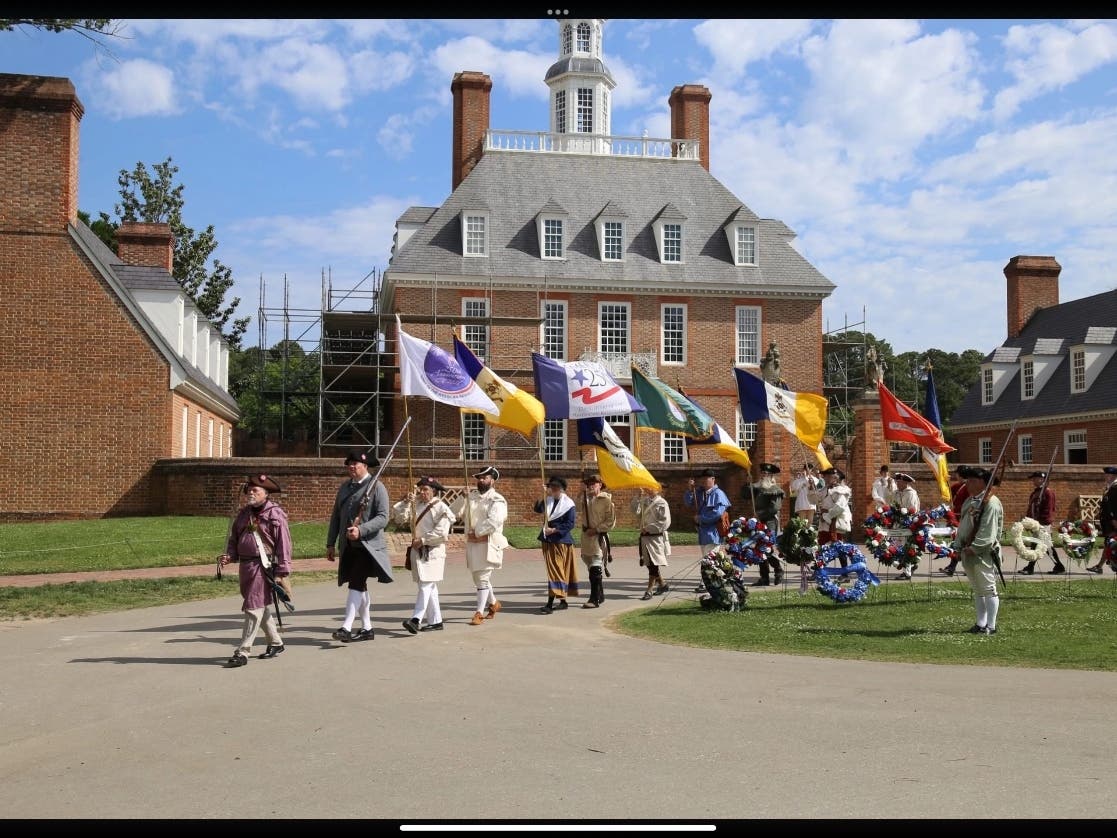


The 250th Anniversary of the 1775 Williamsburg Gunpowder Incident was commemorated at Williamsburg by a Sons of the American Revolution team of men in Colonial militia attire on Saturday, May 3, 2025. Representing the Sgt Maj John Champe Chapter Virginia SAR were chapter Historian David Welker and past president Ken Bonner. Mr. Bonner performed as Color Guard Commander and presented the Chapter wreath. Mr. Welker carried a musket in Honor Guard. Opening remarks were given by Virginia SAR President Dr. Michael Weyler.
The nation commemorated the “Shot heard around the World”, or the opening shots of the American Revolution on April 19, 1775 at Lexington & Concord near Boston. Could that shot have happened in Virginia? After all, both regions were hotbeds of Patriot fervor that had marched more or less hand-in-hand toward independence. And British officials in both regions were moving in late April to seize weapons and gunpowder the Americans had stockpiled. We all know about the events in Lexington and Concord, but to understand why the Revolution’s opening shots weren’t fired right here in Virginia, we need to discuss Williamsburg's Gunpowder Incident.
Virginians had begun forming militia companies and gathering weapons and gunpowder to arm those troops since early 1775, stepping up these efforts following Patrick Henry’s fiery "Give me liberty or give me death!" speech at the Second Virginia Convention on March 23rd. Royal Governor Lord Dunmore decided that given this "it [was] prudent to remove some Gunpowder which was in a Magazine in this place [Williamsburg]." Lacking British Army troops—they were pulled from Virginia in September 1774, following Massachusetts’ Gunpowder Alarm—Dunmore turned to the Royal Navy, which had several ships hovering in the nearby James River.
Find out what's happening in Leesburgfor free with the latest updates from Patch.
On April 21, 1775, Lieutenant Henry Collins of HMS Magdalen quietly led a company of British sailors (sometimes reported to be Royal Marines) into Williamsburg under cover of darkness. By 4:00 a.m. they had successfully removed 15 half barrels of powder from Williamsburg’s famous octagonal brick Magazine and placed them aboard the Magdalen.
Despite Dunmore’s precautions, locals quickly discovered the act and instantly sounded the alarm, calling out the militia and sending riders to spread word of the incident. In response, an angry Patriot crowd gathered in front of Williamsburg’s Governor’s Palace—Dunmore’s home—and threatened the governor if he did not return the stolen powder. As Dunmore later wrote, the colonists resolved “to seize upon, or massacre me, and every person found giving me assistance if I refused to deliver the Powder immediately into their custody.”
Find out what's happening in Leesburgfor free with the latest updates from Patch.
Although Dunmore had armed his servants and household staff as an emergency measure, he knew physically stopping the mob was unlikely. Instead, knowing that Virginians feared a slave revolt as much or more than they feared England, Dunmore used perhaps the most effective weapon available – his silken, deceptive tongue. The governor spun a Grinch-like tale, claiming he had removed the powder for the colonists’ own good, to prevent it from being used by slaves in an uprising he had conveniently just learned was being planned. And it worked.
Spooked by this unexpected threat, Peyton Randolph and other colonial leaders agreed to meet with Dunmore inside the Governor’s Palace to discuss the incident. According to Lord Dunmore, they were now mainly “apprehensive of Insurrection among their slaves (some reports having prevailed to this effect)” and agreed to leave the powder safely aboard the British ships.
Having used deception to diffuse the situation, the next day, April 22nd, Dunmore turned the threat around, warning that if he or any British official was harmed, he would “declare Freedom to the Slaves, and reduce the City of Williamsburg to Ashes.”
Williamsburg residents might have been fooled by Dunmore’s mix of deception and bluster, but not Richmond’s Patrick Henry. He vocally demanded Dunmore return the powder or pay the colonists its full £330 value, and began raising militia to march on Williamsburg to enforce his demands. When news of what had occurred at Lexington and Concord reached Virginia by April 28, it so enraged Dunmore that he declared “I have once fought for the Virginians, and by God I will let them see that I can fight against them.” He next ordered Henry’s militia dismissed or he would free and arm Virginia’s slaves. Yet on May 4th, it was Dunmore who this time blinked, moving to deescalate tensions by paying Patrick Henry for the powder. Once again, it seemed as if Dunmore had won.
In the final analysis, the “shot heard round the world” was fired in Massachusetts, rather than Virginia, largely because these two English governors took very different approaches to London’s orders to seize the rebellious colonists’ military supplies. In New England, military governor General Thomas Gage used open, aggressive, armed force to take Patriots’ weapons leading to the Revolution’s first armed conflict. In Virginia, Royal Governor Dunmore used trickery and deceit to accomplish the same task, avoiding a fight.
Yet Virginia colonists, motivated by Williamsburg’s Powder Incident, began forming ever more militia companies and it would be Virginia regiments that would have the final word later in 1775 and beyond about the Powder Incident’s lasting impact.
Story by David Welker, Historian Sgt Maj John Champe Chapter VA SAR
For more information about the Sgt Maj John Champe Chapter please visit our website at https://johnchampe-sar.org