Business & Tech
Hard-hit Communities Demand Better Loan Modification Practices
Residents scathed by predatory lending and a lack of accountability from banks in the loan modification process demand action.

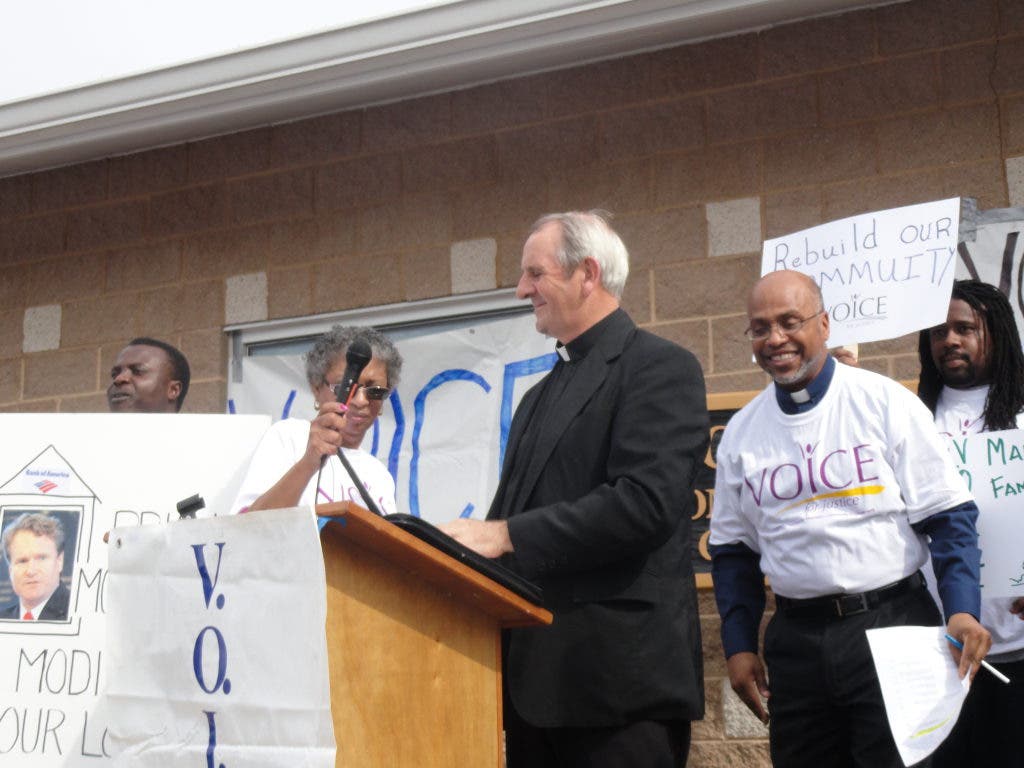


The sun was shining Sunday and there was not a cloud in the sky, but it was certainly raining voices in one Manassas community as more than 200 people gathered demanding accountability from CEOs of financial institutions in the loan modification process to help keep struggling families in their homes.
The event was organized by Virginians Organized for Interfaith Community Engagement (VOICE)—a community organization of 48 congregations and community organizations in Northern Virginia.
Religious leaders from First Baptist Church Manassas, Holy Family Catholic Church and Mt. Olive Baptist Church spoke at the event, announcing a campaign to demand financial institutions to correct the mortgage modification and foreclosure process and create a multi-million dollar fund to help rebuild communities devastated by the foreclosure crisis and the lack of accountability on the part of the banks to help keep people in their homes.
Find out what's happening in Manassasfor free with the latest updates from Patch.
Homeowners from Manassas and Prince William County stood in front of the Georgetown South Community Center Sunday afternoon telling the crowd of how for years they have toiled “with countless bank representatives and lost paperwork only to get denied mortgage modifications,” despite their tireless efforts.
According to a press release issued by VOICE, Prince William County has been hit hard in the state’s foreclosure crisis with Manassas and Manassas Park seeing over 16,000 foreclosures in the last five years. In fact, VOICE is organizing in communities that have seen 25-33 percent of homes go into foreclosure. Two of the communities—Georgetown South and Irongate—are right here in Manassas. According to VOICE, these and other neighborhoods saw disproportionate numbers of bad loans that helped create the high foreclosure rates.
Find out what's happening in Manassasfor free with the latest updates from Patch.
From 2004-2008, Manassas and Manassas Park saw 15 percent of households go into foreclosure, while more than 10 percent of households in Prince William County were foreclosed on during the same time period.
Edgar Lemus, a Prince William County resident and member of Holy Family Catholic Church, told his story of dealing with a broken loan modification system:
"I have never missed a payment in his 10 years as a homeowner. In Feb. 2009, he applied for a modification on his loan with Chase Bank. After four months of paperwork, he received a trial modification and then a permanent modification on his loan in October of 2009. He continued making payments as he always had when he received a disturbing letter from the bank. “It said that we never sent our paperwork back to the bank to make our modification final and we now owed $26,000 in back pay and late fees.”
“If the original document is lost, then the mortgage is null and void,” said Tarie Towman, a Manassas resident.
According to a study released in Feb. of this year, nearly 50 percent of homeowners are underwater on their mortgage. Towman is part of that group and is currently trying to get her loan with Suntrust Mortgage modified but was told she had to wait a year. “I cant’ wait a year,” she said. Towman said her hours have been cut back at work and her husband is the only one with a full income right now.
“Someone is losing their home as we speak and another one just lost their home last month” she said of her neighbors in the Roseberry Farm neighborhood.
“It’s not that they [the banks] can’t, they won’t,” Towman added. They [the banks] do what they need to do to receive federal tax breaks and that’s it, she said.
VOICE has teamed up with The Reinvestment Fund and local government employees to identify and map all foreclosures in the Prince William County region in attempt to link them back to their original lenders for accountability.
Georgetown South resident, Leslie Jones, agrees with VOICE’s mission of requiring the financial institutions, who participated in predatory lending practices that targeted low-income and multi-racial communities in particular, to be held accountable by investing in “ a multi-million dollar reinvestment fund to address the issues that have arisen and raise property values.”
“Our homeownership rate dropped from more than 60 percent to less than a third,” Jones said. “Our neighborhood went through a depression; friends disappeared, homes stood vacant, inviting drug dealers and other crime. Investors scoped up properties cheaply and become slum landlords barely maintaining the properties and threatening tenants. Problems like these affect a whole community.”
According to a study recently released, Prince William County has the 26th highest percentage rate of homeowners underwater on their mortgage in the United States.
VOICE has identified CEO and Chairman of General Electric Jeff Immelt, CEO and Chariman of JPMorgan Chase Jamie Dimon and CEO of Bank of America Brian Moynihan as just some of the business elite that should be held accountable for the broken loan modification system that has destroyed communities and families in our region.
According to VOICE, some common themes that have led to the current broken system include:
- Banks taking over a year to respond to modification requests and repeatedly losing borrower’s documents
- Banks taking 401 Ks and all savings from delinquent borrowers before agreeing to modify loans
- Banks foreclosing on Active Military personnel
- Banks agreeing to negotiate modifications while the same bank in a different department continues foreclosure proceedings
- Banks pursuing homeowners after short-sales for deficiency payments (the difference between loan amounts and short-sale price)
- Banks consistently failing to offer reductions in principle or to negotiate with homeowners whose loans are too far underwater
Advocates said that because of the federal bailout—at the expense of the tax payer— banks are supposed to modify some of the bad loans they have made to make the loans more sustainable for families and be held accountable for their practices.
Participants at Sunday’s event in Manassas are looking to the following solutions based on best practices around the country like what ESOP has done in Cleveland, Ohio:
- Housing counselors have a single pint of contact at each servicer
- Foreclosure proceedings stopped once banks receive all paperwork (no dual track process)
- Specific timeline for completed process (3-4 months vs. over a year)
- Consistent and clear accountability process (weekly phone calls, clear appeal process, etc.)
- End predatory practices (i.e. draining 401 Ks, exorbitant fees)
- Financial institutions provide additional funding for housing counselors and access to delinquent borrowers
The ESOP program has negotiated mortgage modifications for 75 percent of homeowners the program works with. The organization has also helped keep 16,000 families in their homes.
Currently, non-profit counselors in the Prince William County region are effective 20-40 percent of the time— a number local advocates are working to increase as they launch their campaign.
Get more local news delivered straight to your inbox. Sign up for free Patch newsletters and alerts.