

Tip of the Week: Landscape Product Trends
In the last few years landscape design has evolved to offer better products and materials for your outdoor projects. No longer are home owners’ beholden to just a few choices like brick, stone, or concrete. Now there are an array products and finishes, which are engineered to last longer, improve drainage, and reduce the impact of water run-off.
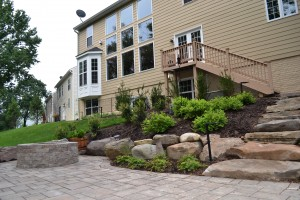
Without exception the leap in landscape design products, has led to more sustainable and lower maintenance options. One of the biggest breakthroughs in recent years has been the evolution of pavers. Pavers come in three basic materials; concrete, brick, and stone. And, because of their interlocking ability, pavers give landscape designers and home owners the opportunity to create unique designs and achieve looks they could not have years ago. No longer are pavers just used for patios and walkways either; there has also been a shift in recent years to use pavers for driveways as either an accent boarder, parking pad, or even sometimes on the entire driveway. The primary reason for this shift is quality and durability. Home owners and designers have found that unlike stamped concrete, which was once a popular choice to dress up a driveway or walkway; pavers are engineered not only to support the weight of vehicles, but also provide better drainage, and can easily be repaired or replaced – making them the ideal alternative. In addition to the durability of paver products; they are also timeless and able to fit into contemporary or transitional homes and neighborhoods as well as historic areas like Old Town.
Find out what's happening in Old Town Alexandriafor free with the latest updates from Patch.
In addition to product variety and selection, the landscape industry has evolved to engineer products that address environmental issues such as erosion and water run-off. Perhaps one of the biggest leaps in technology is the use of permeable pavers and other porous paver products. Permeable products allow water to seep through surfaces directly into the ground, reducing water shed run-off. While permeable products are becoming more mainstream, they are most often paired with green home construction, green renovations, and green home certifications. In fact, another recent trend in landscape design is green home certifications, which requires the use of permeable pavers. Chief among these green certifications is the LEED’s certification, which requires the home and/or development project to meet specific green criteria. But, while most home owners aren’t seeking a LEED’s certification, the use of permeable pavers is an outstanding solution to reduce standing water, erosion, and water run-off, which is in my experience a universal issue.
Finally, while hardscape projects are of course a huge aspect of any landscape designer’s business – including my own; plantings are always popular. Recently, I’ve noticed more and more home owners willing to take on gardens because of the huge selection of drought, disease, and deer resistant flower varieties. This is great news for home owners and landscape designers because we’re able to collaborate and bring what were once considered difficult plantings and luxury materials to the mainstream consumer.
Find out what's happening in Old Town Alexandriafor free with the latest updates from Patch.
Question of the Week: Each summer when it gets really hot and really wet, my mulch grows a yellow and sometimes gray fungus or mold. What is it and what can I do about it? Well, you’re right it is a fungus and it’s very common in mulches. The best thing to do is get rid of the infected area. Using a shovel take out the first couple of layers of mulch and dirt. Be sure to throw it away and wash off your shovel. Let the sun hit the infected area for a few days and then lay new mulch on top. If it’s particularly bad you may have to remove all of the mulch and/or treat the area with a fungicide. But, get rid of it as soon as you see it!
Happy Landscaping!
Aaron Gorski
Owner, The Greener Side Lawn & Landscaping, LLC