Neighbor News
Stroke Comeback Center: A unique non-profit founded by a woman, run by women, serving the whole community.
How a non-profit powered by women helps stroke and brain trauma survivors after they are told they cannot improve anymore.
Bonita Bedoin was getting ready to leave for work on January 11 of 2011, she didn’t know she would be up for the biggest challenge of her life that day. A federal government employee, she enjoyed her work in the Contract Administration for the Middle East desk: Iran, Afghanistan and Iraq.
When she set down for a few minutes to check her email before heading out, she felt something funny in her head and she fell down. “I crawled to my main door, to the front door, couldn’t open it“, she says. “I cannot remember the rest”. The policemen found her lying unconscious at her door 11 hours later, upon repeated calls by her sister in New Jersey.
"I had a blood clot in my brain," she explains. Bonita, at the prime of her life, had a massive stroke. She woke up 11 days later in the hospital. “My thoughts were jumbled up but my sister was my key.” She says. “She was there.” After a long time in the hospital and six months of therapy she was discharged out of the insured care system. She knew that she had a long way to go, she was no way near recovered yet. But one year after her stroke, her doctor said: “Six months and you are done.”, implying she shouldn’t expect any further recovery. She said: “OK, you’ll see! I will get even better!”
Find out what's happening in Viennafor free with the latest updates from Patch.
This determination lead the two sister-team, Lee and Bonita, to further research and eventually to the Stroke Comeback Center in Vienna, VA: a unique non-profit that helps stroke and brain-trauma survivors with their recovery after their insurance runs out or they are told they shouldn’t expect much further improvement. Today, Bonita is an active member of the Stroke Comeback Center. She is also one of the spokes people for the Center. She explains coming to the Center was a turning point in her life: “I set myself goals and I achieve them and when I get better I set other goals. I work hard.”
Darlene Williamson, founder and Executive Director of the Center claims “Study after study shows that the brain has the capacity to heal indefinitely. As we see at the Stroke Comeback Center, a survivor can keep improving for years.” And she should know. Head of the National Aphasia Association, Williamson has more than 35 years of experience in all levels of post-stroke care. She was previously the Clinic Director at The George Washington University, in Washington, DC, and continues as adjunct faculty.
Find out what's happening in Viennafor free with the latest updates from Patch.
The Center has a unique group approach to recovery. “We do all our work in groups, and our groups are built around areas of communication as well as movement.” Williamson says. Each group consist of 3 -6 members and a certified facilitator to manage the session.
Communication groups are facilitated by Speech Language Pathologists (SLPs); movement groups are managed by certified personal trainers with experience designing and teaching fitness programs for stroke and brain trauma survivors. Nancy Selden, who teaches the fitness classes says: “I love the classes and I think the socialization and peer support is a tremendous benefit.” The Stroke Comeback Center’s five-person, all women SLP team, with 117 years plus of experience in Speech-Language Pathology among them, keep up with the latest research to foster improvement in speech, listening, reading, writing and cognitive skills. But they don’t stop there, part cheerleader, part confidant they are both professionally and emotionally invested in each survivor’s improvement.
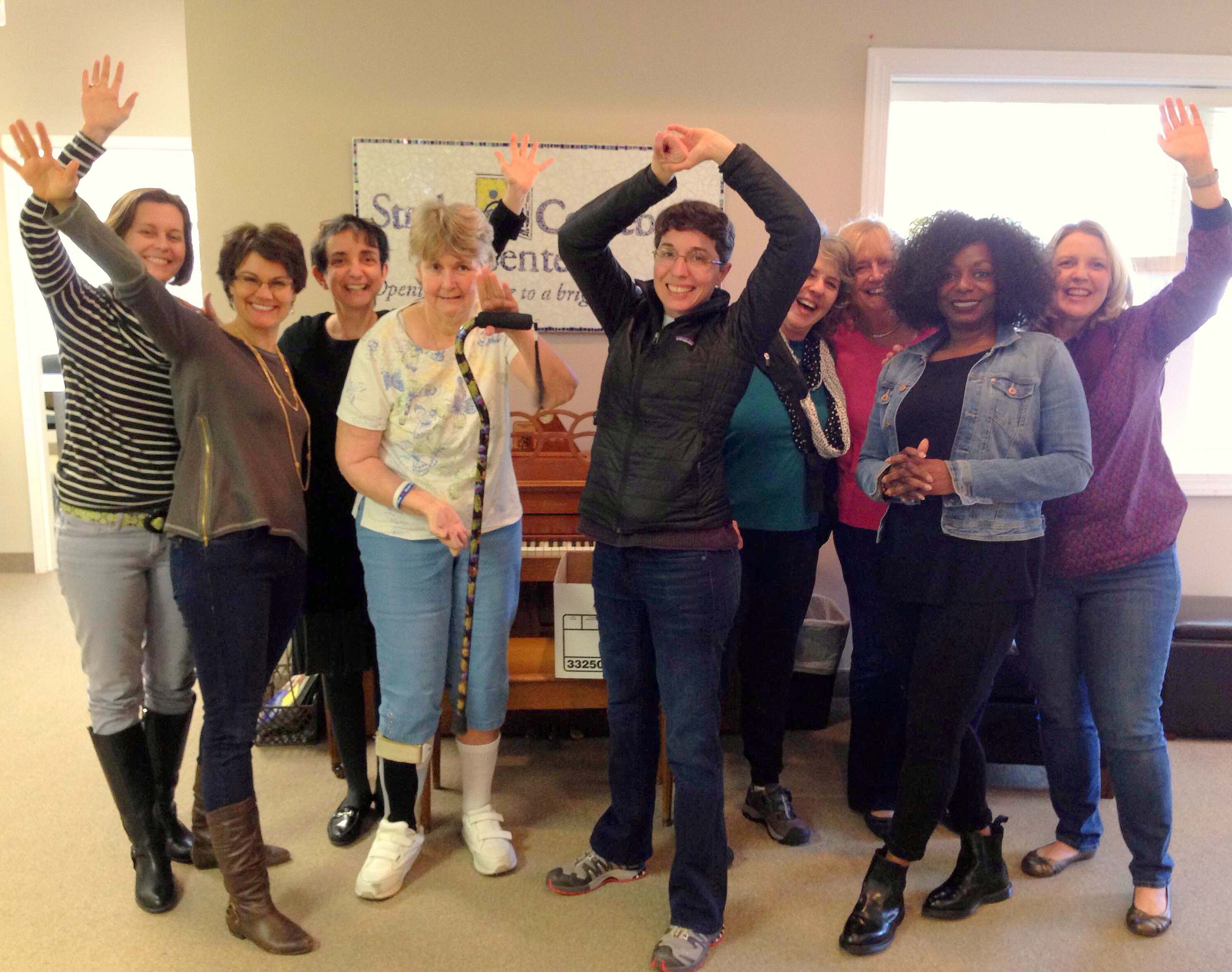
Part of the success of the Center comes from the design; the women’s touch is apparent in every detail. The feeling is cozy and comfortable, family like, with couches in the main area, a piano, framed pictures on the wall, a kitchen… Ashley Beard, who started coming to the Center two years ago says: “It is a relaxing place, I feel at home. I love that. It’s is a different feeling, the dynamics of the group, the cheering on, trading secrets.” Banu Turhan, a volunteer for the Center and a fellow stroke survivor describes the group dynamic among survivors as “The easy camaraderie among the survivors and professionals alike is key in recovery. People feel they are among friends who will cheer them on, and gently nudge them to be the best they can be. In this no-stress setting, the brain can put all its energy to building new connections as the person becomes more and more confident within the community.”
After 2 years at the Stroke Comeback Center, Bonita went to the same doctor who initially said “Six months and you are done.” and talked to him, supplying him with 11 different articles about stroke and brain plasticity. “He was amazed at how much my speech was improved.” She says with a smile.
Founded by a woman, chaired by a woman, run by a full women staff, surrounded with a group of mostly female care partners, the Stroke Comeback Center is just another example of women’s ingenuity, serving the whole community.