Schools
Racine Unified WKCE Scores Improve, Writing Shows Consistent Growth
District officials are pleased with the progress students are making, but see a slight dip in sixth grade math scores. They will analyze the data and urge school data teams to to use the test results to devise a plan to address the issue.


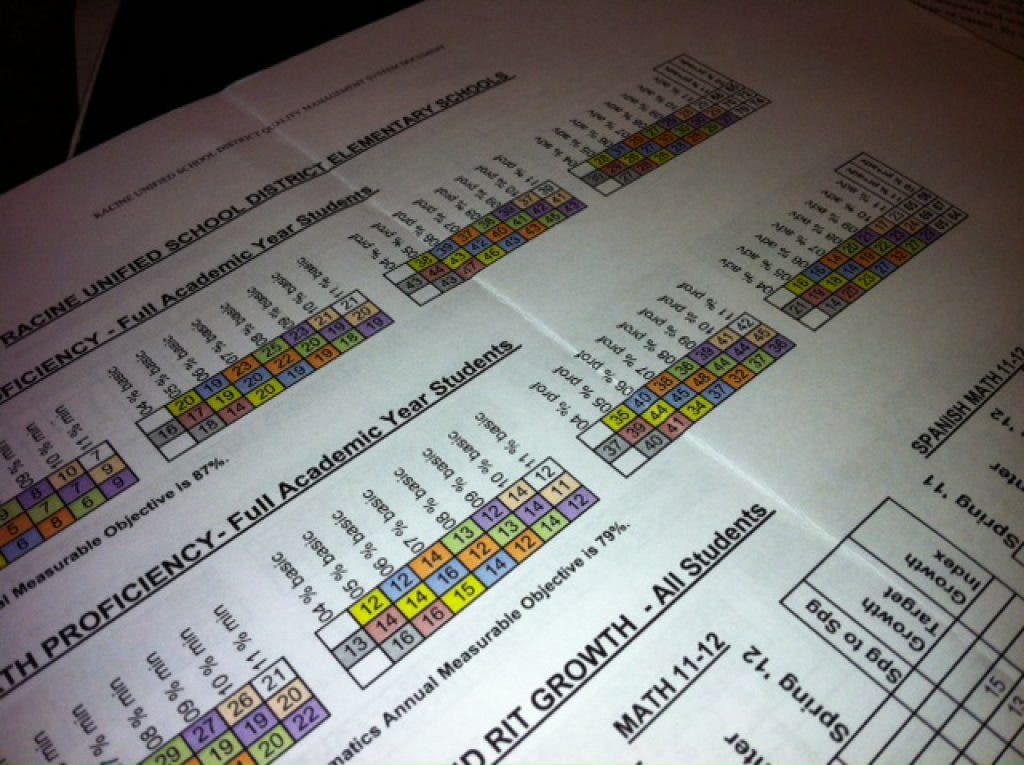
Despite a dip in sixth grade math scores, Racine Unified students have improved math, reading and writing test scores nearly across the board for grades three through eight and high school sophomores.
District officials released the report from Wisconsin Knowledge Concepts Examination (WKCE) on Tuesday.
"Overall, we see some impressive growth in math on the WKCE this year, with increases in the number of students proficient or advanced at all grade levels but one," said Superintendent Ann Laing in a written statement. "In third grade we saw a seven percentage point increase. This confirms that the efforts we've made to implement new curriculum last year and increase course rigor are having a positive impact."
Find out what's happening in Mount Pleasant-Sturtevantfor free with the latest updates from Patch.
Reading
Stephen Miller, director of Standards, Assessment and Accountability for Unified, said reading scores are more of a mixed bag, and the report from WKCE would confirm his assessment. Third and 10th graders went up, but fourth through eighth went down.
Find out what's happening in Mount Pleasant-Sturtevantfor free with the latest updates from Patch.
"We have areas of weakness, but if you look at our third graders, our scores have gone up by three points while the state's averages stayed the same," Miller said. "That's really encouraging because we can infer that how we're delivering that area of instruction is paying off."
The goal then, he added, is to take those same methods and apply them to different subject areas and see if the same improvements hold true.
"Third grade is a pivotal time in a child's schooling," Jeff Blaga stated. "Students go from learning to read to reading to learn so it's critically important to achieve success with higher scores because of how that carries them forward into higher grades."
Blaga is the interim executive director of instruction and curriculum.
Writing
Four years ago the district set a goal of continued improvement in writing and overall, that goal has been met. Using a rubric to score the quality of samples from fourth, eighth and 10th graders, the District has met or exceeded progress expectations.
Here's how it works: the state Department of Public Instruction doesn't set a goal but instead has districts set their own benchmarks. Using the scoring rubric of nine possible points, Racine Unified wanted students writing at a level six or above within four years of implementing the program. The state average hovers around a 5.4 to a 5.6.
According to the test scores released Tuesday, students are making steady progress: fourth graders have gone from 6.1 percent meeting a six or greater to 34.3 meeting that goal. The district considers this good news even though students missed the overall target of 35.6 percent.
Eighth and 10th graders are also improving, meeting or exceeding district goals; 27.9, which is over 23.9 in eighth grade and 40.5 over 26.9 in 10th grade, respectively. District staff are taking a closer look at the eighth grade scores because while students are still scoring higher than the benchmark, the 2011-2012 scores are lower than the 2011-2010 scores, 27.9 to 47.4.
"We are pleased to see District-wide progress and proud of the number of RUSD schools that are exceeding state scores," Laing said.
'Rithmatic
When it comes to math scores, third grade is, again, where the improvement shines brightest with an increase of seven points at the proficient or advanced level. Fourth grade went up by two points; fifth, seventh and eighth grades are all up by one point; and sixth grade is down by four points.
Miller said the district will be looking more closely at the data to try and pinpoint a reason or set of circumstances that caused the dip. One step will be to give the data to the data teams at each school so they can monitor conditions and devise a plan that addresses their unique student bodies.
Each Unified school has a data team comprised of individuals at all levels like the principal, teachers, teaching assistants and staff members like the school engineer and the food service director. They get together a few times a school year to gauge progress and devise an improvement plan for the following school year.
"The point is to create conversations for and about student achievement," Miller stated. "Every school is different so this gives leaders at each building the ability to devise plans that fit their students."
Both Miller and Braga said some of the improvement can be credited to the increased community involvement through programs like Racine Reads, Schools of Hope, and Mentor Kenosha Racine. This is important to note because nearly 75 percent of the residents in the Racine Unified community do not have a child currently in school.
"Parents make the most difference," Miller stated. "But if residents want to see an improved Racine Unified, then they need to invest by becoming an caring, intervening adult in the life of a child. Doing so pays back into the life of a community by 10 times, a hundred times."
Get more local news delivered straight to your inbox. Sign up for free Patch newsletters and alerts.