Neighbor News
Pasty Fever; Cornish Pride
Peter Wilt seeks a tasty pasty (does not rhyme) & learns Cornissh culture at Greater MKE Cornish Heritage Society's annual pasty luncheon.


Last week’s column hinted at my passionate interest for certain foods. That interest – some would say obsession – carries over to grilled cheese sandwiches, corn dogs and the inimitable pasty.
Yesterday ended National Grilled Cheese Month and today begins National Stroke Awareness Month, National Brain Tumor Month and National Fungal Infection Awareness Month. I don’t believe, but am not certain, that there is any link between the chronological order of the celebratory months. It’s worth noting that May is also Better Sleep Month, National Good Car Care Month, National Photo Month, National Salad Month, National Egg Month, National Barbecue Month, Revise Your Work Schedule Month, Date Your Mate Month and National Hamburger Month.
This week’s blog is about the pasty. Not the patches that cover a woman's nipples. I’m referring to the delicious meat and vegetable pie native to Cornwall in the United Kingdom. Pasties were made for Cornish miners, because they kept warm until lunchtime and were simple to eat in the tin mines.
Find out what's happening in Whitefish Bayfor free with the latest updates from Patch.
Cornish immigrants brought them to mining communities throughout the United States including the lead mines in southwestern Wisconsin and the copper mines in Michigan’s Upper Peninsula. My Italian grandmother was raised in Ishpeming, Michigan and made the world’s best pasties – IMHO. The simple recipe was passed on to my mother, so I grew up dining on these delicious meat and veggie pies regularly.
Since moving to Milwaukee 34 years ago pasties have become more of a special treat. A couple times a year, I will venture to Reynold’s Pasty Shop on 35th and Burleigh for a hot out of the oven pasty with brown gravy. Every five years I drive to Ontonagon, Michigan in the UP to commemorate my 1968 near death experience on Lake Superior and am sure to get a pasty from Syl’s Café.
Find out what's happening in Whitefish Bayfor free with the latest updates from Patch.
So last week I was thrilled to read about a Pasty Luncheon hosted by the Cornish Society of Greater Milwaukee. On Saturday I arrived at Christ United Methodist Church hall a little before noon expecting to feast on pasties, learn a little about Cornish heritage and meet some fellow pasty lovers.
Almost three hours later I left filled with much more than a delicious pasty. I also was filled with knowledge about Cornwall’s struggle for recognition and independence and with friendship from the fellowship of a very welcoming group of Midwesterners who can all trace their heritage to Cornwall.
I was greeted by Bob O’Hagan. Bob’s name sounds as Irish as can be, but it’s his Cornish roots that are important to the former Marquette University star running back. Bob and I spoke for 15 minutes about Cornish mining, old time football at Marquette and . At Marquette, he played under legends Paddy Driscoll and Frank Murray. The former MU captain told me about his time in the Marquette backfield before and after serving four years in the US Army during WWII. He later turned down a $500 signing bonus to play for the Detroit Lions, because decent pay and job security were far from certain in those days.
This was the Greater Milwaukee Cornish Society’s 27th Annual Pasty Luncheon. Before the event began, I checked out an exhibit on Cornish mining and the Society’s scrap book with articles on pasty making workshops and other Cornish Society news going back to the 1980s. I also viewed the merchandise for sale including Cornish Society of Greater Milwaukee mouse pads! When the program was ready to begin, I settled in at a table with octogenarian member Jean Windberg from Waukegan. Jean gave me the bad news that historic Waukegan seafood restaurant Mathon’s closed and was bull dozed in 2004. I blame myself for not going there enough.
Jean is a retired teacher who began her career at Whitefish Bay High School. We had a great chat and became fast friends. She told me about the differences between Michigan and Wisconsin pasties. Michigan uses carrots and cubes their meat and potatoes. Wisconsin uses rutabagas and slices its meat and potatoes.
I checked with my mom and sure enough, she cubes her meat and potatoes (don’t tell Jean). My mom uses chop suey meat (half beef and half pork), onions and spices with seasoning salt and pepper and butters the pastry inside and out. She makes her own pastry shell as well, but doesn’t use carrots or vegetables, because that’s the way her mother taught her.
Bob O’Hagan sat at my table as well, along with his wife Tommi. Tommi is a “Bard of Cornish Gorsedd”. That esteemed title, and the really cool wooden badge around her neck, identifies her as one of the designated members of the American Cornish Society who has studied the traditions and history of Cornish tradition and is charged with passing it on to others.
Bards are also responsible for preserving the Cornish language, which nearly became extinct in the early 20th century before attempts to revive the language were made. There are currently 7,358 living languages known. It is believed. However, that by 2050 90% of these languages will be extinct as the world language system is restructuring. The Bards of Cornish Gorsedd are fighting to keep Cornish among the survivors.
Cornish Society of Greater Milwaukee leaders Joe Trewyn and Tom Rowe handled the meeting portion of the luncheon with updates on all things Cornish. Among other topics were the new English tax on pasties, the PBS show Doc Martin based on a socially challenged Cornish doctor and introductions of new members and self-invited pasty lovers.
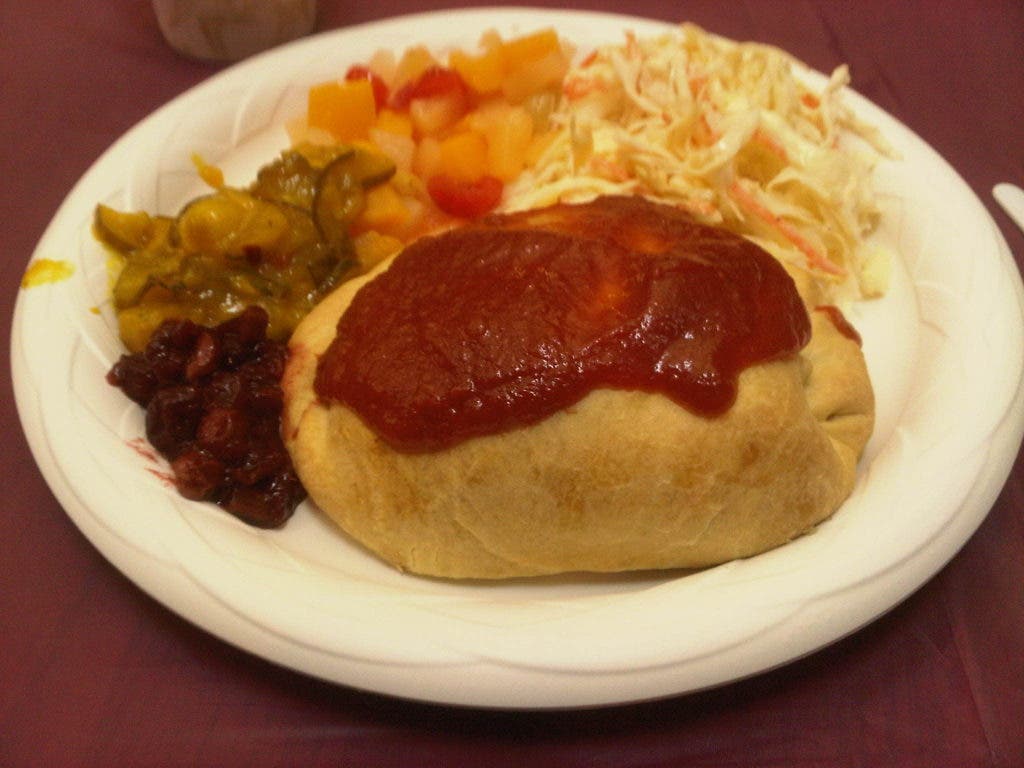
The pasties the society served were delicious. They were imported from the Pasty Oven in Quinnesec, Michigan. Be sure to visit their web page to see how you can order a variety of pasties online and don’t forget to play their custom made pasty jingle!
The pasty was only one part of an amazing traditional ethnic meal. Sides included proper Cornish chutney (made by the bard herself, Tommi O’Hagan), beets, cole slaw and chow-chow from the UP. I was thrilled to see that next to the chow-chow they had a couple bottles of my preferred pasty condiment: Heinz Chili Sauce. My Grandma Vilona made great chow-chow in addition to her pasties, so the chow-chow was both a sentimental and taste treat for me.
The meal was followed by a program, but first Joe Trewyn played a recorded song “We're not English” which emphasizes the Cornish disdain for the English. The lyrics in part were:
"This isn't England no matter what they say. It's part of Britain and the UK, but this isn't England let's get that straight. This isn’t England no matter what they say. This isn’t England - it’s up the other way."
Being Irish by marriage, I’ve listened to and sang along with plenty of rebel songs against the English and this one could hold a candle with the best of them. The essence of the Cornish Society of Greater Milwaukee – and its parent Cornish Society of America – is preservation of Cornish heritage and recognition of Cornwall as its own entity separate from England. England treats Cornwall as one of its counties, but Cornwall is also a duchy formed in 1337. It is still viewed as one of only two duchies in England, along with Lancaster.
Cornwall is one of the original Celtic nations along with Scotland, Ireland, Brittany, Isle of Man and Wales. Cornwall is the peninsula of land at the southwest end of the British Isles connected to England only by a three mile wide strip of land. The end of the peninsula is a small settlement and headland called Land’s End…and in fact, the Dodgeville, Wisconsin based retailer, Lands’ End, is named after a sailboat equipment company, which was named after this Cornwall location. The misplaced apostrophe in the retailer was noticed after the founder printed materials in 1963 and was deemed too expensive to correct.
The featured program speaker was Tom Rusch. Tom is the president of the Cornish American Heritage Society and a high school teacher in Watertown, Wisconsin. He spoke about the importance of ethnic heritage societies in general and noted the many efforts the Greater Milwaukee Cornish Society does to educate the public on Cornish culture including a presence at the annual Holiday Folk Fair. He also spoke about the risk of ethnic heritage societies fading into the woodwork as ethnic blood is diluted generation by generation.
Tom noted that the size and passion of this group was still very strong and he remained optimistic about the group’s future. I hope he is right, because as I looked around I made note that though I am not young, I was younger than at least 80% of the Cornish descendants in the hall. Pride in one’s cultural heritage, though, is more important than age or percentage of ethnicity. This group showed the tremendous pride that is necessary to continue to educate the public on the wonderful Cornish culture.
After Tom’s talk, the 29 Cornish descendants and this newly deputized honorary Cornish representative stood and sang the unofficial Cornish national anthem (though some believe “One and All” should be the anthem). It was a 19th century Cornish ballad called “Trelawny”. Also known as “The Song of the Western Man”, it was first written in 1825 as a poem about Bishop Jonathan Trelawny and his role in the Glorious Revolution, which saw William of Orange overthrow King James II. Bishop Trelawny was imprisoned with six other bishops for seditious libel. They opposed King James II decree to permit religious freedom for Catholics inside their homes.
The music for Trelawny was added in 1861. It’s an inspiring ballad…even if it doesn’t mention a single pasty:
A good sword and a trusty hand!
A merry heart and true!
King James's men shall understand
What Cornish lads can do!
And have they fixed the where and when?
And shall Trelawny die?
Here's twenty thousand Cornish men
Will know the reason why!
And shall Trelawny live?
And shall Trelawny die?
Here's twenty thousand Cornish men
Will know the reason why!
Out spake their Captain brave and bold:
A merry wight was he:
'If London Tower were Michael's hold,
We'd set Trelawny free!
'We'll cross the Tamar, land to land:
The Severn is no stay:
With "one and all," and hand in hand;
And who shall bid us nay?
And shall Trelawny live?
And shall Trelawny die?
Here's twenty thousand Cornish men
Will know the reason why!
And when we come to London Wall,
A pleasant sight to view,
Come forth! come forth! ye cowards all:
Here's men as good as you.
'Trelawny he's in keep and hold;
Trelawny he may die:
But twenty thousand Cornish bold
Will know the reason why
And shall Trelawny live?
And shall Trelawny die?
Here's twenty thousand Cornish men
Will know the reason why!