Community Corner
COLUMN: Old Recording Reveals Alabama Soldier's Lost WWII Stories
Tuscaloosa Patch Founder and Field Editor Ryan Phillips share a personal tale about family stories that were thought to be lost to history.


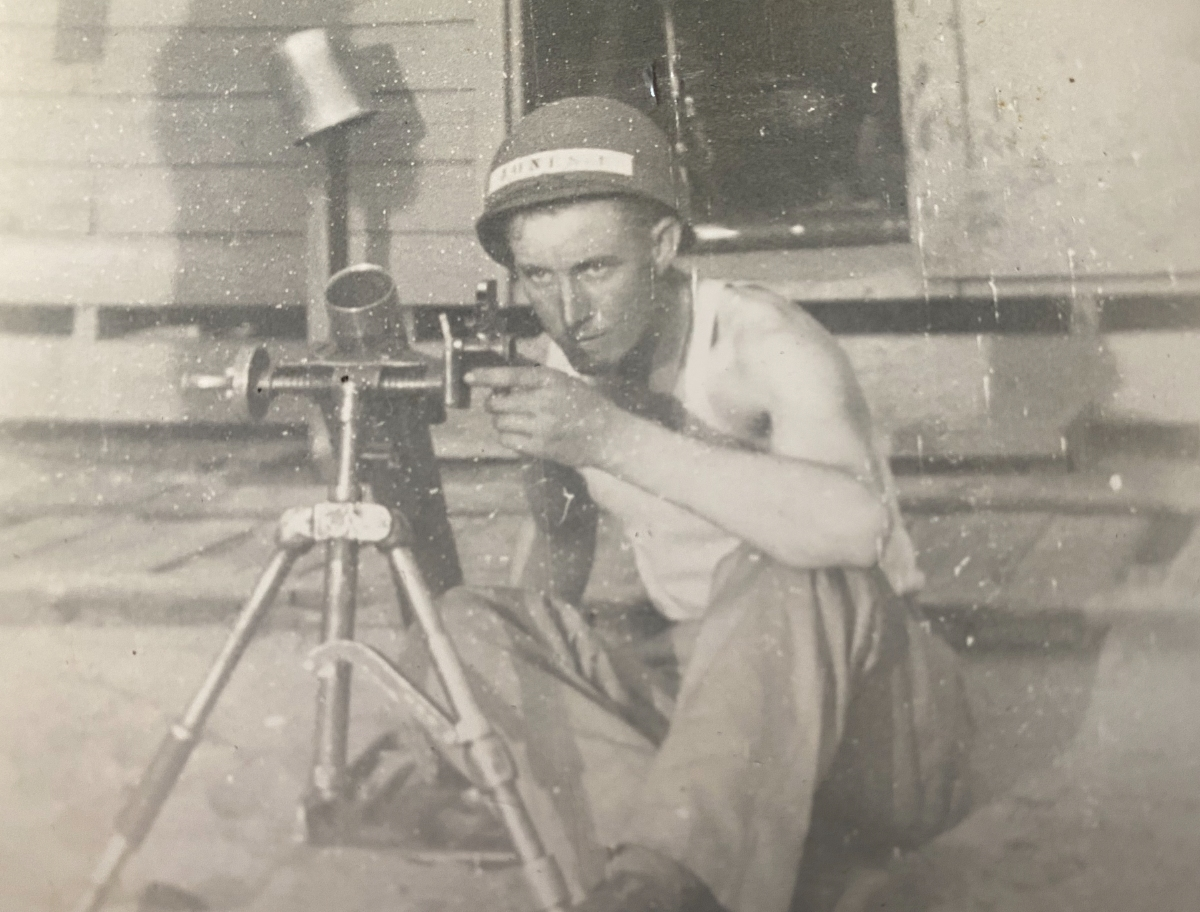
Editor's note: This story is a combination of personal column and historical narrative, the details of which have all either been verified or come from firsthand accounts. I hope you enjoy this feature and I'm thankful that these family memories will not be lost to history.
Haguenau, France (1944)
After a day of clearing war-torn buildings and working patrol, U.S. Army Pfc. Elmo Jones and the rest of B Company bedded down for the night after coming to the small French village near the Siegfried Line into Germany.
Jones saw some of his most intense combat in and around Haguenau, with German counterattacks coming two and three times a day. But after a day of work on the front lines, the young soldier stretched out in his sleeping bag to catch some rest at the foot of a staircase before doing his best to survive another uncertain day in the war.
Find out what's happening in Tuscaloosafor free with the latest updates from Patch.
At some point during the night, however, Jones and a buddy were both stirred awake by a loud noise upstairs in their building. Civilians had long since been ordered to evacuate the city or were otherwise cleared out before the fighting broke out, so the two young men set out to investigate.
"I said 'boy grab your gun, let's go,'" he would later recall. "About the third door we opened, a woman screams 'Don’t shoot! Don't shoot! Don’t hurt us!' She wasn’t an old woman. I asked her what she was doing there and told her 'you’re not supposed to be here, it's too dangerous.' She could speak enough and I knew enough French to talk together. Her and her little boy hadn’t had nothing to eat for seven days. It's pitiful. So, we went down and raided the mess hall. Now, I mean it just like I said ... we raided the mess hall. We got them something to eat, come back, fixed it for them."
Find out what's happening in Tuscaloosafor free with the latest updates from Patch.
They made sure the starved woman ate slowly, unaware that her husband had been taken captive some time before when the Germans moved through Haguenau.
"We stay there two or three days and we kept them fed 'til we left," Jones said. "When we started to leave, this lady told us the Germans had come by and made him go with them to fight. We started to leave and she said 'I hope you don’t have to shoot him,' but I said 'I hope we don't either. But lady, we can't take no chances. When we run into a fire fight, we ain't got time to ask questions.'"
As he would do on many of his stops throughout Europe during the war, Jones snapped a photo of the mother and her son, left them what food they could, and set out with his company for Germany.
Tuscaloosa, Alabama — Present Day
I freely admit I haven't used a cassette player since the 1990s. But after some fiddling around with a 8-in-1 Victrola — the only known cassette player in Tuscaloosa County I could procure from my grandparents (on my Mama's side) — the old tape was finally sucked in, sending a sharp pop and crackle through the speakers.
With the volume all the way up, a voice I've not heard in almost 20 years then filled the room and began to tell stories I've waited my entire life to hear. The old man on the tape was my Papa Jones — my great-grandfather and father to my grandmother (on my Dad's side). I've written extensively about both of them, but as far as family history is concerned, I never thought this day would come.
Able-bodied until the day he died at his home in Berry in 2004 at the age of 83, Elmo Jones was a legendary figure in our family and known fixture among older folks in northern Tuscaloosa County. He was a typical member of "The Greatest Generation," who was drafted into service and willingly left home to fight for his country in Europe during World War II. He would return to my Granny Virgie and Grandmother, before fathering two more children — Howard and Debbie — and living out a quiet life just over the Fayette County line.
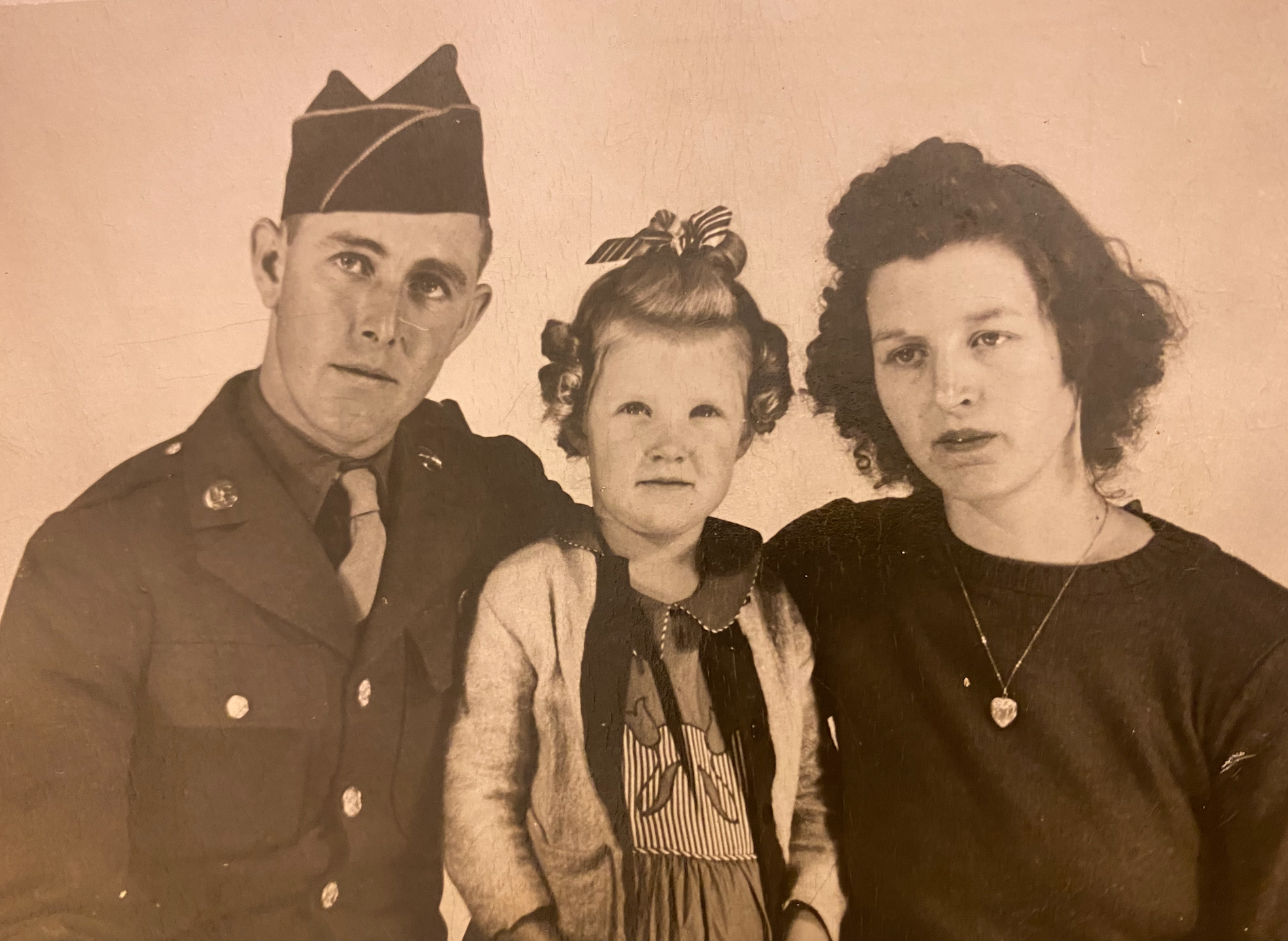
Like many who fought in that literal war of good versus evil, he was never keen on sharing his memories from it, which included being wounded in combat and seeing a Nazi concentration camp with his own eyes. He would attend Veteran's Day programs at my elementary school and family members always told their own versions of the few stories he had been willing to share. But only on a couple of occasions do I remember him throwing out a tidbit of a memory. While it never stopped me from asking, I was always met with reluctance when I wanted to know more.
Knowing what I know now, I don't blame him in the least.
He has been gone now for years, but never once during that time did I not have a desire to know more about his service. Then, as luck would have it, we were cleaning last weekend when we stumbled upon a cassette tape long thought to have been lost to history. It features a candid interview with my Papa Jones giving firsthand accounts of his time in Europe — an absolutely priceless family artifact.
My heart was pounding and my hands trembled as I scribbled down notes from stories I was hearing in his voice for the first time. While the tape was recorded years ago, it remains in pristine condition and provides a lasting account of my family's contributions during one of the most pivotal events in human history.
'That Dadgum French Harp'
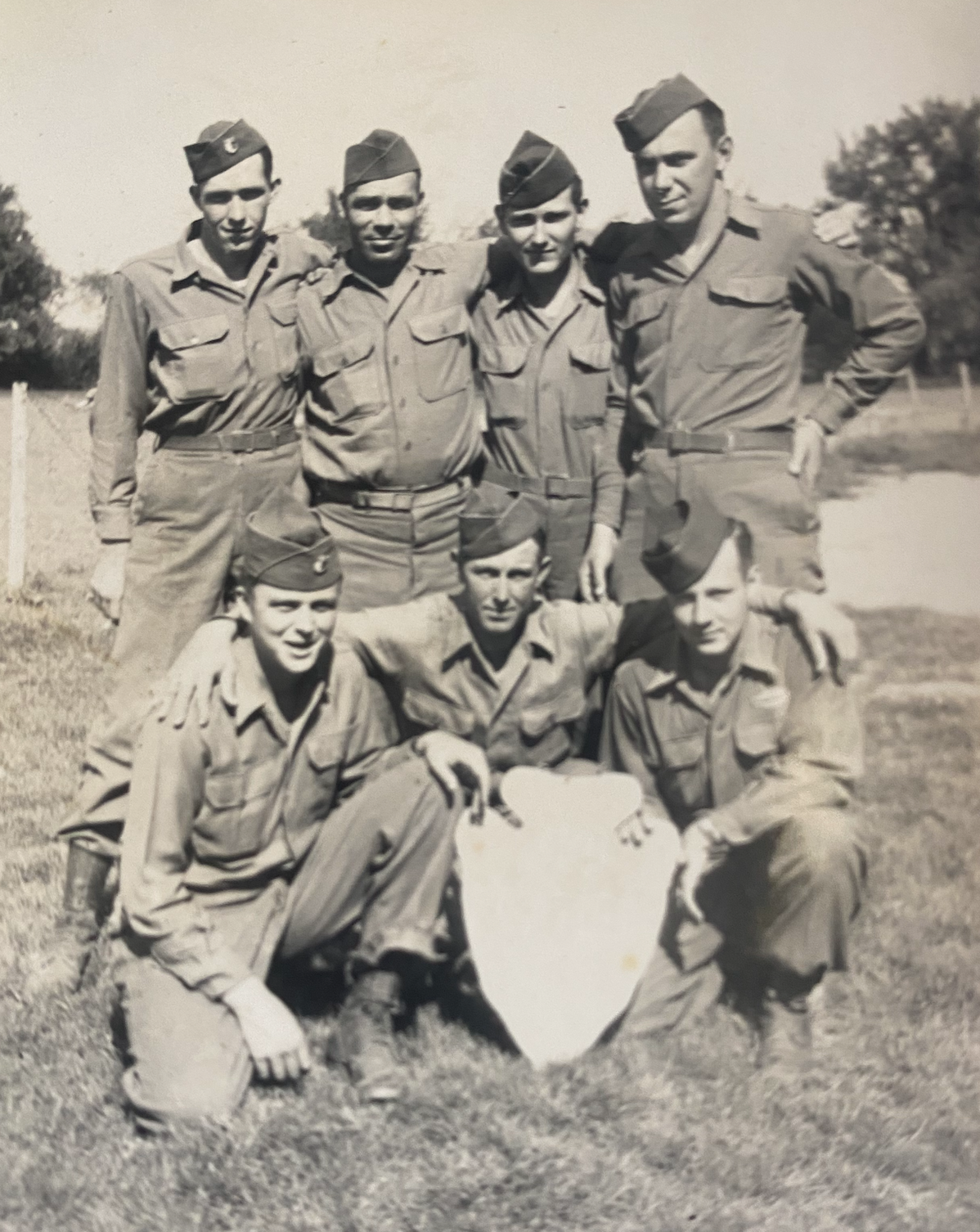
Pfc. Elmo H. Jones can be found on the roster for the 141st Infantry Regiment, 36th Division, B Company. Known as the Texas Division, the 36th Division insignia consists of an olive drab "T" — for Texas — on a blue flint arrowhead.
The old records show Jones' address listed as Route 1 in Berry. He would also later mention he was a Technician fifth grade, or T-5, near the end of the war and would end his service as a sergeant, according to his obituary.
In his recollection of the war, he briefly describes landing in northern Italy in late 1943, before his company fought its way north through France and on into Germany.
"We did some fighting in southern France when we come out of Italy," he said.
But the unidentified man interviewing Papa Jones then asks if he remembered the names of any of the men he served with. He responds by saying no, other than a foxhole buddy he knew only by "Grambell," who was from Tennessee.
In looking through his company's roster, I was able to find a Pfc. Solomon O. Grambell, of Route 5 in Cookeville, Tennessee — the only combination of name and state of origin fitting Papa Jones' description among the thousands of men.
"We called each other by the last name then," he said. "Grambell, he was from up in Tennessee. He come in after I did and I started to shoot him the first night he came in there. He played the French harp and he was in the foxhole all night long on the front lines playing that dadgum French harp and I'm in the foxhole wanting him to shut up ... kept me awake all night and I had to stay on the alert in case [the enemy] started in there. But we wound up being buddies pretty well all the way through the war."
'Village Fighting'
The Texas Military Forces Museum has documented at length the Texas Division's contributions during the war, with firsthand narratives that line up perfectly with the stories relayed by my Papa Jones.
In making their way to the Siegfried Line and on into Germany, he described "village fighting," which saw troops move building to building to take each small town along the way as they continued their advance to Berlin.
"We worked together as a team," he said. "We were going up through there one time, come to a door, we didn’t just open it. One of us got on one side of the door and one on the other. And the one that was on the knob side of the door, he would kick the door in. We didn't bother to open it. We just kicked it in ... we got to be experts at knocking doors down the first time."
He would go on to describe one such instance that underscored not only the brutality of war, but the dangers that aren't discussed in today's grade school history books.
"As we went in, most of the French houses had a big room right here and on the ground floor, there was a door that went to the right and a door that went to the left, and right up the center, a staircase that went upstairs just as we went in," Jones said. "We went up, looked up the stairs and that door closed upstairs. Both of us at the same time, he started on one side and I started on the other and we just cut that door in two [with their guns] and we heard a scream, matter of fact, two of 'em. Well, we went up there. I got on the radio and it was two old women. They were 70, up in their 70s, I know. They were old. They wasn't supposed to be there, they were civilians and we shot them both — one in the shoulder and one in the leg — of course, that held us up a little bit. We turned right around and had to get them to the medics."
What would become known as urban warfare was everyday life for B Company as it moved inch by bloody inch toward Germany. Armed with a Thompson submachine gun and a small carbine rifle, Jones said uncertainty was the only thing that could be counted on during the deadly village sweeps of that cold winter 1944-1945.
He then recalled how he was wounded close to the Siegfried Line — a crucial defensive position for Nazi Germany opposite the French Maginot Line that was fortified by scores of concrete machine gun pillboxes and bunkers. The line represented a key entry point into Germany that, once breached, would spell certain victory for the Allies.
But it would be near Wissembourg that Jones nearly met his end.
"They have fields all around the villages. These folks gather up in villages farming, you know? There was usually a square village, streets and all this stuff, so we hit a street and we worked that street and take it as we came to it and what we were doing was clearing the houses, and our rear echelon people would come on in behind us as we moved out," he said. "We had taken [Wissembourg] and we was fixing to move out headed for the Siegfried Line. Like I said, I was a radio man, so I had to stay close to the captain. We lined up just outside of this place. Before we lined up, the captain and I had walked all the way around this field and scouted it. We done made a circle and come back and we got ready to move out to go to this other town and he told me to call them on the radio and tell them to move out, I called them on the radio and started walking out."
Then, seemingly out of nowhere, the thunderous rattle of German-made MG 42 machine guns echoed through the fields and cobblestone city streets. Jones was hit as he fell to the ground to cover, and for a moment, the world around him went dark.
"We got out there in the middle of that field, and I was told there was 16 machine gun nests around that area and they opened up on us," he said. "I don’t know how many got killed out there, but I was with my outfit, my group. I got wounded, I hit the ground and had that big ol' radio. They called it a 48 radio. They said it weighed 48 pounds, I don't know whether it did or not, it was heavy enough anyway. And I could cover a pretty area good with it. I know the reason so many was killed next to me is they were trying to get that radio and knock out our communication. They had three bullets through our radio ... When it cooled down enough I could check things, I just eased over and looked. Everything was down all the way around me. They said the 11 closest guys to me were dead."
Click here to listen to the full audio of Jones recalling when he was wounded in combat
Trying not to move or draw more attention, he then heard the voice of a nearby Army medic amid the pop of gunfire and bullets cutting through the air now thick with gunpowder smoke. The medic, who could see Jones moving, yelled to see if he was hurt. He responded by saying yes, although he didn't know how bad. The young private had been hit as he threw his arms up to cover his head, but likely in shock and high on adrenaline, he couldn't be certain just how serious he was injured.
"I said 'Don’t you come nowhere about me,'" Jones recalled years later. "'Stay right where you’re at. I don’t want them to know I'm still alive.' But he says 'well, 'I'm gonna come by and give you a morphine shot ... I'll do it on the run, but you just check and make sure I didn’t break the needle off.' He did, he came on a dead run, gave me that shot and just kept a-going. I guess from the time I got wounded, it was 50 minutes to an hour and I got up and went back under my own power when I did."
Click here to read a full expanded narrative of the operation at the Siegfried Line, as compiled by the Texas Military Forces Museum.
A brief stay at a military hospital would see a doctor find the bullet lodged in his shoulder blade after traveling up his arm, leaving a deep scar he would carry for the rest of his life. For that, he would later receive a Purple Heart. But after a few days, he would be crossing a newly-opened route over the Rhine River — after the Allies broke the line — and crossed on into Germany, where even more atrocities had yet to be realized.
'A Pitiful Sight'
One story relayed by Jones during the interview focused on a brief stop in Landsberg, Germany — the same town where an imprisoned Adolf Hitler wrote "Mein Kampf" two decades earlier.
Jones was quick to point out that B Company only passed through Landsberg, but what he saw would be burned into his mind for the rest of his life. That much becomes apparent in hearing the story retold in his own voice so many years later.
The Kaufering concentration camp complex was a network of 11 satellite camps for the notorious Dachau death camp nearby. Kaufering operated as a slave labor camp, with prisoners forced to dig underground bomb-proof bunkers to then be used in the production of Nazi aircrafts.
Roughly 15,000 of the camp's 30,000 prisoners would perish in Kaufering's squalid conditions — among the worst of any concentration camp. They died from disease, starvation and many times, by cold-blooded execution at the hands of the SS. When it was liberated by Allied forces, soldiers forced residents of the villages nearby to see the horrors for themselves before digging graves.
"Lots of that I don’t even remember, I just remember being there," Jones said. "But we went in there and opened the doors, it was a pitiful sight ... They were starved to death. I had taken it to be Russian people in there, you know. But the Germans would take Russians, Jews, anybody they could get in there. These people were in a concentration camp. They put 'em all in there together, treated 'em all alike, starved them to death, gassed them and stacked them in stacks like cordwood."
The piles of emaciated bodies and stench of death no doubt left a lasting impression on Jones, but another anecdote from that stop in Germany stood out. It seemed to give the young soldier even more perspective on what he was fighting for and against.
"These two guys are alive and the gates were open and they take off," Jones said of two liberated prisoners. "There was a chicken yard just across just little piece over from there. They were so hungry they got in that chicken yard and caught them a chicken and pulled it apart and was just eating it raw. Now, that’s hungry ... that's hungry. We didn't have time to mess around, I just got what I could out of it, but it was heartbreaking to go in there."
Click here to listen to the full audio recording of Jones recalling his visit to Kaufering.
A Small World's Massive War
Following the fall of Berlin in 1945, Jones and B Company would make their way back south to Nice, France, to await transport home. These were the easiest days of the war for Jones and the men around him, as they spent much of their leisure time as tourists, stopping through Paris and enjoying the centuries-old sights, before making their way farther south to the French Riviera.
Photos from that time show smiles on their faces and it was a time of light work before finally getting to go home. The war had been won.
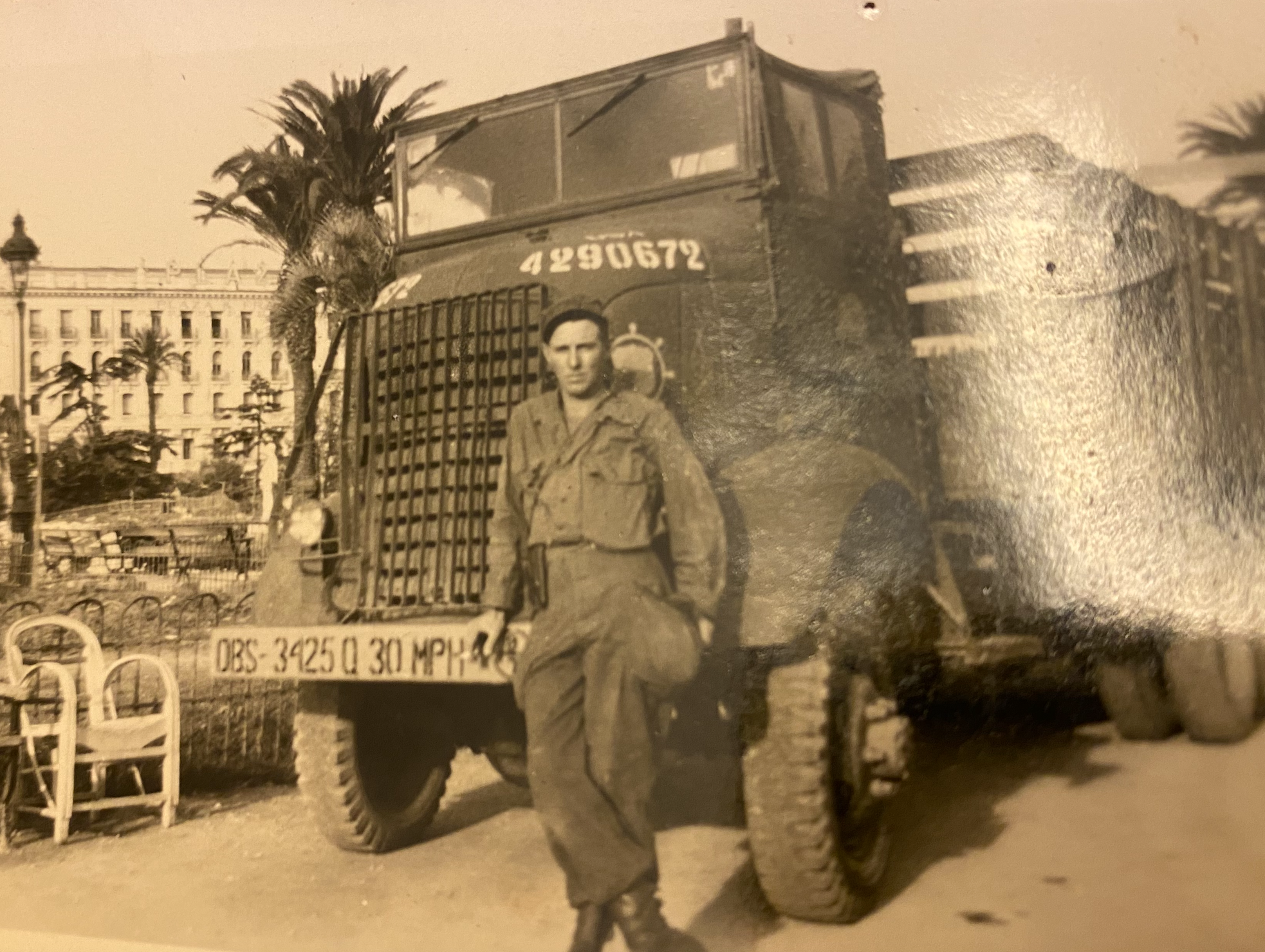
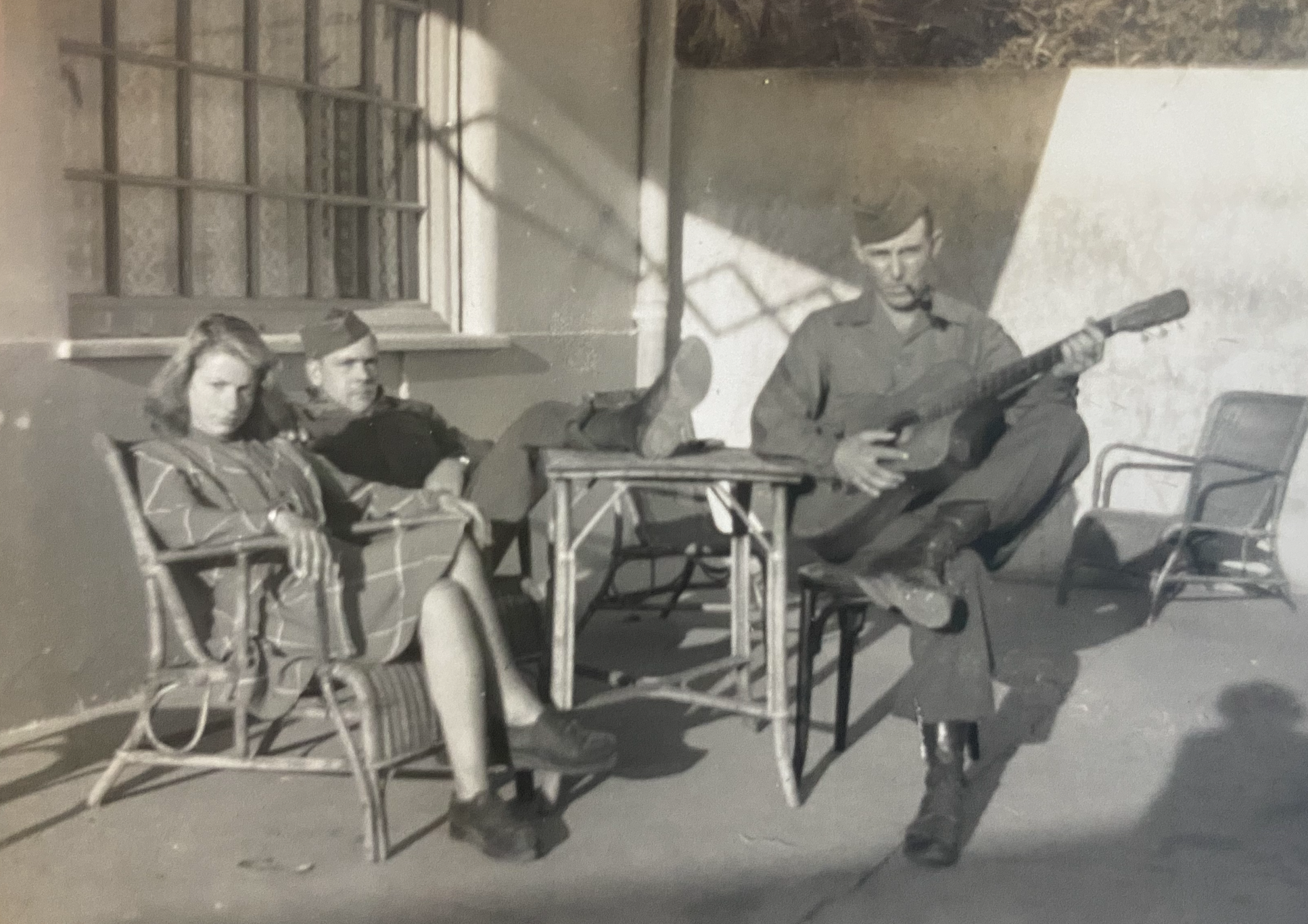
"We got down there, I was working prisoners of war, now these were prisoners," he said. "I would take them out of the compound to build a runway. They were building it and as the old saying goes, I was 'supervising.' On a rainy day, I go pick up prisoners that wanted to come and if they didn’t want to come they could stay in camp and they could come over where we were bivouacked, clean up our rooms and all, do all our washing and stuff like that. But there was this guy when I went back there and had prisoners coming out, probably 15 of them I was working, maybe more. I found out he could speak a little English and we got to talking."
Jones then received a work order to board up an oval door on a hotel's entrance way, which he deferred to the man referred to only as William. He goes on to describe William taking a pencil and measuring out the plywood without a ruler, before sawing it and finishing the job with ease.
"I said 'William you're that good, you’re the foreman now,'" he said with a laugh.
William, who was French, would also become popular with the other American GIs, who used him as a kind of personal assistant instead of subjecting him to manual labor. One particularly wet evening, William was allowed to tag along to a hotel where the American soldiers were staying. There, he cleaned their rooms, made up beds and did laundry.
"It was just a-pouring down rain ... I was eating a bite and come back in there and I went to write letters to home, " Jones said. "He didn’t have nothing else to do, he was just standing over there mumbling his fingers, you know? I had a bunch of pictures like these that I had taken and said 'Hey William, would you like to have some pictures?'"
Jones handed a few off and went back to writing his letters. But as William flipped through the photos, he "let out a whoop" and in a visibly-excited state, asked the young soldier from Alabama where he had gotten one particular photo of a woman and her child.
"He said 'that’s my wife and little boy!' He hadn’t seen them in way over a year, nearly two years," Jones said, his voice warm with nostalgia. "I just sat down and told him all about what happened. He was just tickled to death. All I could tell him was when we left, we left them some food and they were well. And I give him the picture."
Want to know more? Click here to listen to the entire recording.
Have a news tip or suggestion on how I can improve Tuscaloosa Patch? Maybe you're interested in having your business become one of the latest sponsors for Tuscaloosa Patch? Email all inquiries to me at ryan.phillips@patch.com.
Get more local news delivered straight to your inbox. Sign up for free Patch newsletters and alerts.