Crime & Safety
Fresh Testimony Sheds Light On NYT Reporting Ahead Of Story On UA Basketball Player Kai Spears
Here's our in-depth courtroom coverage from the defamation case brought against the New York Times by a former UA basketball player.


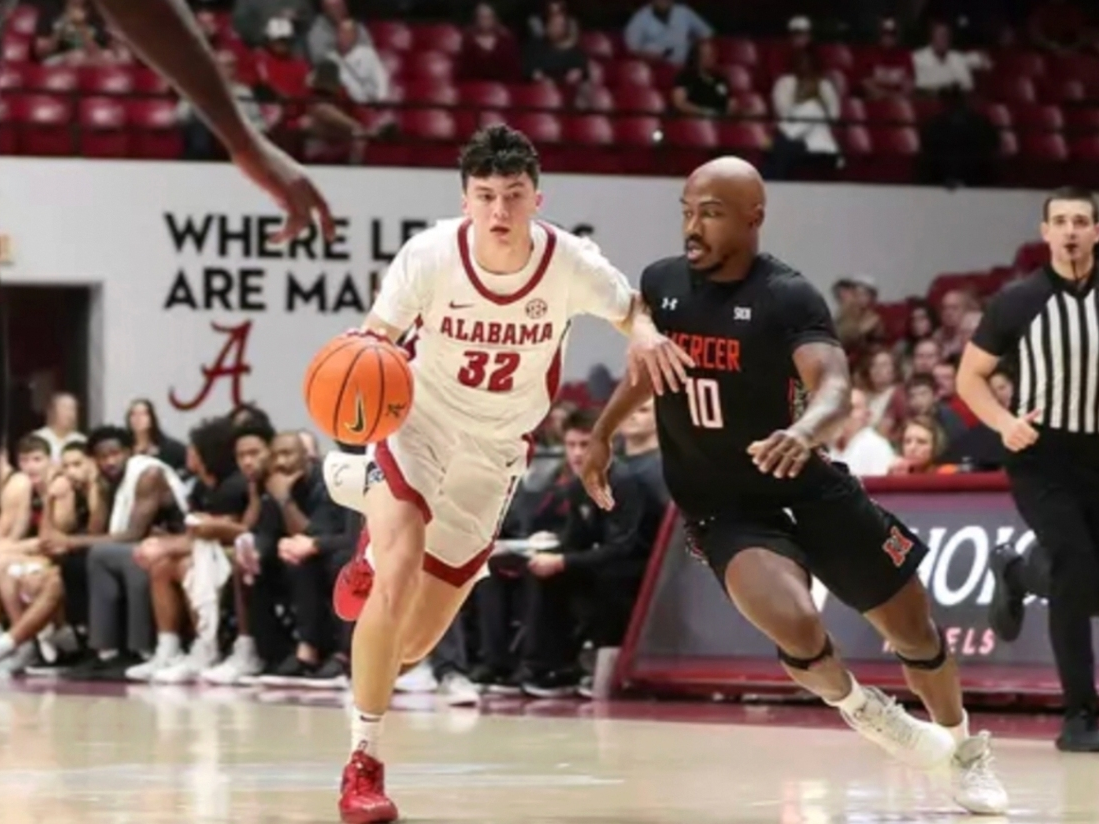
TUSCALOOSA, AL — Following an extended stall in proceedings that lasted over the course of two days, jurors heard a wealth of fresh testimony Wednesday in the defamation trial brought against the New York Times by way of a lawsuit from former University of Alabama basketball player Kai Spears.
Click here to subscribe to our free daily newsletter and breaking news alerts.
Patch reported from the courtroom Tuesday when the pace of the trial drastically slowed as U.S. District Court Judge Annemarie Carney Axon heard arguments from both sides relating to the admissibility of evidence pertaining to the actions of the newspaper's staff following the publication of a story on March 15, 2023, which reported Spears was involved in a fatal shooting earlier that year that resulted in the death of a young mother from Birmingham.
Find out what's happening in Tuscaloosafor free with the latest updates from Patch.
It was later revealed that a Crimson Tide basketball manager had been in the car with Alabama standout Brandon Miller when the vehicle was struck multiple times in the Grace Street shootout that killed 23-year-old Jamea Harris.
Patch previously reported that while the New York Times updated its initial story published on March 15, 2023, following each of the three fresh denials that Spears had been in Miller's car, an official correction was not issued until June 2, despite several updates to the story.
Find out what's happening in Tuscaloosafor free with the latest updates from Patch.
The large legal team representing the New York Times argued for the better part of two days, including countless objections to questions presented from the Spears camp, that the newspaper staff's handling of the story after a certain point was not relevant and shouldn't be admitted as evidence for the eight-person jury to consider during deliberations.
TRIAL DAY 3
Testimony eventually resumed just before the lunch hour Wednesday as Mike Abrams, the deputy editor for Trust at the New York Times, took the witness stand for the third time in as many days to field questions from Spears' legal team.
During questioning by attorney Matt Glover of Tuscaloosa's Prince Glover Hayes, Abrams testified that Billy Witz, the Times sports reporter who wrote the initial story, did not consult the newspaper's standards department prior to the publication of the piece that reported Spears had been in Miller's vehicle when the shooting occurred.
This represented the first of several instances where Spears' attorneys attacked what they view as the Times not following its own established and documented policies, especially as it relates to using anonymous sources.
The first of several relevant digital exchanges shown to the jury was a brief WhatsApp conversation between Witz and another New York Times colleague who had messaged the sports reporter in the immediate aftermath to offer their moral support.
After being asked if he "felt okay about the Alabama stuff," Witz responded that while his anonymous source had been "steadfast," there had been some "equivocation" regarding the accuracy of the information the source's source had passed along that eventually made it to print.
As Patch reported from the courtroom Tuesday, the New York Times has admitted to having one source, identified only as "Source A," who was Witz's primary source of information placing Spears in Miller's car at the time of the shooting.
Another source previously mentioned in our reporting, "Source B," is another source granted anonymity by the newspaper who was allegedly the first individual to inform Witz that there was at least one other person in the vehicle with Miller.
Nevertheless, Abrams testified that Source A informed Witz the day after the article was published that "perhaps my source was wrong."
The jury was also shown an email exchange from editorial leadership at the newspaper when Philip B. Corbett, who has since retired after serving as the associate managing editor for standards at the New York Times, expressed his concerns to former Times sports editor Randal Archibold about the story relying on one anonymous source.
This occurred on the same day as the WhatsApp communication where Witz began to express doubts about the credibility of his lone source used to inform the story.
"To state the painfully obvious, I hope we're right on this," Corbett wrote.
After presenting the jury with a clip of Abrams' deposition filmed prior to the trial, the veteran New York Times employee explained that the newspaper's correction saying it "regretted" the error was tantamount to a formal apology to Spears for its erroneous reporting.
Nevertheless, Abrams offered his personal sentiments to Spears, sitting without expression at the plaintiff's table in a white polo shirt and khaki pants.
"I'll say it again here, I'm sorry Mr. Spears," he said.
During cross examination by New York Times attorney JT Thompson of Birmingham's Lightfoot, Franklin & White, Abrams was given the chance to tell the jury about his extensive three-decade career in journalism and with the New York Times, before some illuminating metrics were presented to show just how much engagement the story received online.
According to the newspaper's web traffic metrics, the story received approximately 258,000 page views — with about a third coming on social media — from the publication date on March 15, 2023, until the official correction was issued on June 2 of that year.
During redirect by Spears' legal team, however, it was shown that the brunt of the web traffic came on March 16, 2023, the day after the story was published, when it received around 159,000 page views.
Abrams also testified that there was no way of putting an accurate figure on the number of times the initial story had been read in the Times' print edition.
After Abrams was excused from the stand, the court was played a video deposition of former NYT Deputy Sports Editor Oskar Garcia that was taken in July 2024.
Garcia insisted under oath that the Times vetted its sources, followed the newspaper's established policies and published the story in question under its guidelines.
"We did get the story wrong," he conceded. "We corrected it and still did a tremendous amount of reporting, and were confident when we published it."
He also corroborated previous testimony from earlier Wednesday that while Witz and others working on the story did not consult the newspaper's standards department, the sports editor at the time was made aware that the upcoming story relied upon anonymous sources.
Perhaps the most illuminating part of Garcia's testimony, though, as it relates to the lead-up to the publication of the story, came when he discussed the planning of what would become the article in question.
Following the fatal Grace Street shooting, the Crimson Tide basketball team managed to carve out one of the most successful seasons in program history and, with its first-round NCAA Tournament appearance coming up that had Alabama as the No. 1 overall seed for the first time ever, Witz began laying the foundation for a story.
Garcia said the soft deadline for the story was planned for before the Crimson Tide's first-round matchup with Texas A&M Corpus Christi on March 15 at Legacy Arena in Birmingham. He was quick to point out during questioning that there was never a "hard deadline" set for the story relating to Alabama basketball before the opening round.
Instead, Garcia testified Witz had initially set out working on a story about two basketball fans who wore custom T-shirts that read "Killin’ our way through the SEC in ’23" during the 2023 Southeastern Conference Tournament earlier that month.
However, as prior testimony showed, Witz first made contact with Source A roughly a week before the Kai Spears story was published and the focus of the planned article on the eve of the tournament shifted to exposing the university for hiding the fact that one of its student-athletes — apart from Miles, Miller and Jaden Bradley — had been been at the scene of the shooting.
It should also be pointed out that Spears' legal team contends Witz "threatened" UA athletic staff during an open locker room media availability at Legacy Arena on March 15 when he was denied a private meeting with Crimson Tide head coach Nate Oats.
An audio recording played for the jury this week depicts Witz telling staffers that if he wasn't able to meet privately with Oats about "sensitive information," he would ask him during a nationally televised press conference following the Crimson Tide's upcoming game.
"Yes, we got a fact wrong but that doesn't mean we did anything wrong before publishing the story," Garcia said.
Testimony wrapped Wednesday after the father of the plaintiff, former Marshall University Athletic Director Christian Spears, took the stand.
Christian Spears is no longer the athletic director at Marshall and is currently the CEO of the AiAthletics Company in Huntington, West Virginia.
After providing the jury some insight into his background in collegiate athletics, Christian Spears reflected on the morning of Jan. 15, 2023, when he received a call from Coach Oats around 9 a.m. to inform him there had been an incident and to inquire if he had talked to his son, who was an 18-year-old freshman walk-on on the Crimson Tide basketball team.
The worried father then called his son, only to learn that the younger Spears did not understand the full extent of what had happened earlier that morning on a narrow side street near the University of Alabama campus.
Christian Spears testified about encouraging his son to establish a concrete timeline of events and to cooperate with police, so long as he was represented by the university when speaking with authorities.
During cross-examination by the New York Times legal team, the court was also shown a still photo of Spears in his UA athletic wear sitting in an interrogation room at the Tuscaloosa Violent Crimes Unit (VCU) speaking with the lead investigator on the case, Branden Culpepper.
Attorneys for the newspaper pointed out Spears had been driven to the Violent Crimes Unit at the Tuscaloosa County Sheriff's Office downtown by fellow Crimson Tide walk-on Max Scharnowski — a fact corroborated by Christian Spears under cross-examination, who said his son did not have a car at the time.
Christian Spears testified he'd never seen the photo of his son in the VCU interrogation room until he was sitting on the witness stand Wednesday.
Confident his son had been cleared of any wrongdoing, Christian Spears said he continued on for the next couple of months in his ever-busy role as a Division I athletic director.
Indeed, on the day the article in question was published, Christian Spears testified he had been dealing with the duties of the job and had to travel to nearby Charleston, West Virginia, for a much-anticipated baseball matchup in a minor league stadium between the Thundering Herd and The Ohio State Buckeyes.
But after once being told by an aide prior to setting off for Charleston for the early afternoon game that a New York Times reporter had requested to speak with him, Christian Spears testified he informed the aide he would deal with it later, only to be met with a more urgent second request when he returned to Huntington around 6 p.m. that night.
This was later disputed during cross-examination by attorneys for the New York Times, who insisted Christian Spears contradicted himself with the timing of when he knew that the request from the newspaper regarded his son.
To that end, the former Marshall University AD said that the New York Times used an intentionally vague mention of his son to "create a sense of urgency" that would prompt him into a swift response.
Still, Christian Spears testified Wednesday that his wife was the first to tell him about the article after she had been shown the story by a family member.
"I don't know if I've ever been as angry," he recalled on the stand. "It's really hard to see your son or daughter put through something so wrong. ... It appeared made up."
He then spoke to the effect the erroneous story had on his son, whom he described as hard-working, inclusive and strong in his faith.
"[Kai Spears] was shocked as well," he said. "You could start to see it was wearing on him. ... He was shaken."
Christian Spears also spoke to how the entire situation had both changed his son in a positive way but also robbed him of his innocence at such a young age — despite any lack of involvement in the fatal shooting.
"He is a better man but he will never be the same."
Christian Spears will resume his testimony Thursday morning at the Richard Shelby Federal Building and Courthouse.
Have a news tip or suggestion on how I can improve Tuscaloosa Patch? Maybe you're interested in having your business become one of the latest sponsors for Tuscaloosa Patch? Email all inquiries to me at ryan.phillips@patch.com
Get more local news delivered straight to your inbox. Sign up for free Patch newsletters and alerts.