Sports
A History Of Violence: The Life & Battles Of Edgar 'Mad Dog' Ross
Patch took a deep dive into the life of the Tuscaloosa boxer after news of his posthumous induction into the Alabama Boxing Hall of Fame.


"In the clearing stands a boxer and a fighter by his trade and he carries the reminders of every glove that laid him down and cut him 'til he cried out, in his anger and his shame 'I am leaving, I am leaving,' but the fighter still remains"
- "The Boxer" by Simon and Garfunkel (1969)
TUSCALOOSA, AL — North American Junior Middleweight Champion Edgar "Mad Dog" Ross took a series of devastating left hooks in the seventh and eighth rounds of his boxing match with Kansas-born Tony Chiaverni.
Find out what's happening in Tuscaloosafor free with the latest updates from Patch.
But it would be a particularly strong and well-placed couple of punches in the 10th round that put Ross — and his career — on the canvas for good. After a decade of fighting, he was finally down for the count.
Click here to subscribe to our free Tuscaloosa Daily newsletter and breaking news alerts
Find out what's happening in Tuscaloosafor free with the latest updates from Patch.
The Salina (Kansas) Journal summed up the 1979 fight in Kansas City by saying "there were no claims of foul, no claims of being victimized by a hometown decision, no claims of favoritism."
Ross, a 31-year-old from Tuscaloosa fighting out of Orlando, also saw his streak of victories in the ring snapped at 50 on that fateful March night. Shortly thereafter, he wrote a letter to the Tuscaloosa News announcing his retirement from the sport.
While he never achieved the fame and notoriety of the most-beloved Tuscaloosa-born boxer — Deontay Wilder — his star arguably shined as bright as anyone else in the sport from his hometown other than the Bronze Bomber during his prime in the 1970s.
Ross died in relative obscurity in Dale County in 2012 at the age of 64, but his accomplishments are far from forgotten and recently earned him a posthumous induction into the Alabama Boxing Hall of Fame for its class of 2022.
To honor his legacy and remember the man known as "Mad Dog" before his enshrinement alongside past inductees like Evander Holyfield and Joe Louis, Patch set out to dig deeper into who the man was and what his time in the ring meant to him.
The Portrait Of The Fighter As A Young Man

There's a lengthy May 1979 feature in Sports Illustrated that gives a colorful portrayal of Ross as part of a larger story about his longtime manager and promoter, Pete Ashlock.
Entitled "Losing Search For A Winner," the unnamed author of the story describes how Ross made his way to Orlando to Ashlock's gym after growing up in Alabama. Training briefly under Tuscaloosa boxing legend Charlie Hutchinson, Ross developed his skills to the point that he won Alabama's Golden Gloves competition before turning pro.
"You talk about a wild, rank bum," Ashlock said of the first impression he had of Ross. "[Ross] didn't give a damn for nothing. He was just tough."
Despite often shaking off the "tough guy" label and insisting that his passion for fisticuffs was misunderstood by the public, Ross seemed to have been destined to fight.
Edgar Cyrus Ross was born in Tuscaloosa in 1947 to Cyrus William Ross — a WWII veteran and farmer, according to Census records — and his wife, Frances Mae Price Ross.
Little is known about his early years and time at Tuscaloosa High School, apart from a few black and white yearbook photos.
However, a 2012 letter to the editor submitted to the Tuscaloosa News by Key West, Florida native Mike Sawyer reflected on the boxer after his death, focusing mainly on his early years.
Sawyer wrote that, in the mid-1960s, Ross split time between living in Tuscaloosa and with his grandmother in Dale County.
"Many after-school days, Edgar and his friend would come to catch water moccasins in the nearby farm pond," he said. "Courage or crazy, I thought."
But Ross was also candid with Sports Illustrated about his youth and teenage years, which included staging fights in the parking lot of the old McDonald's across from Tuscaloosa High or in Bowers Park.
"Back home in Tuscaloosa, when other kids were shooting baskets and kicking footballs and batting balls, I was looking for kids to fight," Ross once said. "Boxing is something I always wanted to do."
These were the halcyon days for the Sweet Science, when boxing was one of the most popular sports in the world — decades before Mixed Martial Arts (MMA) and the likes of UFC saw the timeless sport faced with a sharp decline in popularity.
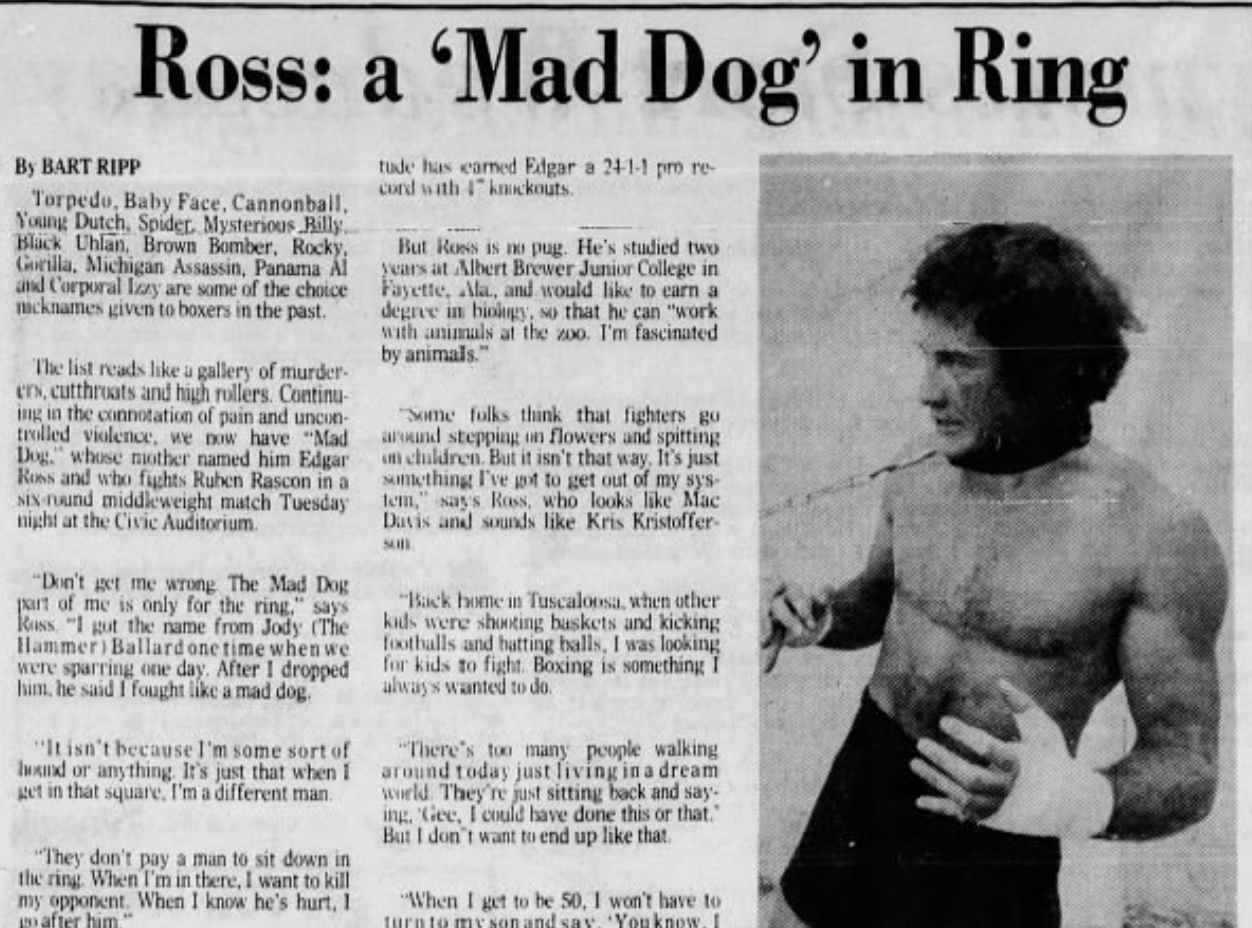
"Don't get me wrong. The Mad Dog part of me is only for the ring," Ross told Bart Ripp of the Albuquerque Journal in 1976. "I got the name from Jody (The Hammer) Ballard one time when we were sparring one day. After I dropped him, he said I fought like a mad dog. It isn't because I'm some sort of hound or anything. It's just that when I get in that square, I'm a different man."
Ross also reflected back on those gritty fights, painting a picture that many in today's world of coddled professional athletes would probably have a difficult time believing, had they not seen it themselves or knew people who did. He remembered people showing up to the events with weapons like knives or guns and, sometimes, tire tools.
"I'd fight and the war would be on," Ross told Sports Illustrated. "Several people would always be carried off to the hospital. Worst of all, sometimes it was me. I tell you, fear makes you fight like hell. Once a guy raised his pistol at me and fired it point-blank. I knew he couldn't miss me, and when the gun went off I figured I was so excited that I just didn't feel it."
Luckily, Ross avoided that bullet, but, like many other boxers of his era, earned a reputation as a rough-and-tumble kid always looking for a fight.
This makes even more sense when considering why he decided to enlist in the U.S. Navy during the Vietnam War, where he was a gunman aboard a destroyer ship.
But after the war, he returned to Tuscaloosa in 1970 and fell back into his old ways — bar fights and parking lot brawls. Ross also said he developed an addiction to the pills he would buy in bulk at a local truck stop.
"I couldn't see where I was going, but that was only because I wasn't going anywhere," he told Sports Illustrated, setting up the story of how he made his way to Orlando and joined the stable of fighters managed by Asklock.
"Mad Dog has now become a solid citizen, even to the point of attending college," the Sports Illustrated reporter wrote. "He rents a small house with orange trees in the backyard. He barbecues chicken for neighbor kids (in turn, they rake his yard), plays Scrabble and lives with his two dogs."
Indeed, as one profile of the fighter pointed out, Ross studied for two years at Albert Brewer Community College — now Bevill State Community College in Fayette — in the hopes of earning a biology degree. During this interview, he told the reporter he was doing so because he had a goal of one day working with zoo animals.
"I'm fascinated by animals," Ross said.
A Long, Violent History
Mad Dog's professional boxing debut came on July 30, 1973 at the municipal auditorium in Mobile. His opponent, Walter Hayes, only logged four career professional fights and would never secure a victory in the ring.
On that summer night in Mobile, Hayes was on the receiving end of a sound beating by his 24-year-old opponent. The fight would go to decision, however, which saw Ross earn the first of 57 career wins.
"They don't pay a man to sit down in the ring," Ross once told a reporter when asked about his intense persona in the ring. "When I'm in there, I want to kill my opponent. When I know he's hurt, I go after him."
Described by one sportswriter as looking "like Mac Davis and sounding like Kris Kristofferson," Ross went on to win his next seven fights, which were hosted in places like Mobile, New Orleans and Orlando. He fully embraced the "Mad Dog" persona during this time, even being led to the ring wearing a dog collar and chain.
This immensely successful stretch also included his first career knockout in the professional ranks, which was at the expense of Grover "Torpedo" Robinson when he was dropped in the third round of their 1974 fight at the municipal auditorium in New Orleans.
"Some folks think that fighters go around stepping on flowers and spitting on children," Ross said in an interview in the 1970s. "But it isn't that way. It's just something I've got to get out of my system."
There's no doubt Mad Dog was tougher than most. But, as is the case with all fighters, he wasn't invincible. Indeed, Ross was dealt the first of two career losses by a fighter named Charlie Grimmett on Feb. 20, 1975.
Grimmett, a native of Jamaica, was making his professional debut in a six-round undercard fight against an 8-0 Ross on his home turf at the Orlando Sports Stadium. The Super Middleweight contest lasted the full six rounds and saw Grimmett awarded the decision by scorekeepers.
We'll likely never know just what was going through Mad Dog's head following that loss, but it would be the starting point for a streak that ultimately led to a Hall of Fame career.
Winning his next eight fights over obscure but colorful names like Cephus Bowe and Saw Pretty, Ross was hungry for a rematch with the one guy who had gotten the better of him. And he would get his chance later that summer, on the night of June 20, 1975.
As a side note, it's important to point out that Ross added a total of 17 fights — 16 wins, one loss — to his record just in 1975.
To compare to today's standards, look at current WBC heavyweight champ Tyson Fury. The most fights the Gypsy King has participated in during a single year came early in his career, when he had eight fights in 2009. Fury's longtime rival, former heavyweight champ Deontay Wilder, never fought more than six times in a single year during his professional career.
But for Mad Dog, vengeance was sweet on that night, as the two went the full eight rounds in a rematch that ultimately saw Ross named the winner by unanimous decision.
While the names of the men he defeated in those years after have been largely forgotten — among them Leon Futch, Victor 'Taco' Perez and Max Hord — Ross dominated the rest of the 1970s in the super welterweight/junior middleweight divisions.
This streak of success also included several fights at Foster Auditorium in Tuscaloosa and a third bout with Grimmett two weeks before Christmas in 1978.
Ross scored his first and only knockout of Grimmett in that third meeting, putting his rival on the mat halfway through the 10-round bout that ended up becoming the first of the last three fights for both boxing careers.
But the final appearance of Edgar "Mad Dog" Ross came against arguably the best competition he had faced since earning his nickname in that Tuscaloosa parking lot fight against a much bigger opponent more than a decade earlier. Ross even said so himself.
Tony Chiaverini, a 26-year-old southpaw from Kansas City, Missouri, came into the fight with a 24-7 record and matched up evenly with Ross in terms of size and reach, with both men standing 5'8" and weighing in around 175 pounds.
It's unclear exactly why Ross decided to accept the invitation to fight the up-and-comer in front of 7,500 fans in his hometown of Kansas City, although money likely dictated the final decision. After all, the fight represented the largest purse Ross had ever seen — $17,000, according to Sports Illustrated — while his biggest payday for a single fight prior to his match with Chiaverini was reported to be $1,600.
Still, before the fight, Mad Dog was confident all the details wouldn't make much of a difference, saying the night before that "He's not going to throw anything I haven't seen before."
The controversy swirling around the match is also worth noting, as the bout was promoted locally as a North American Boxing Federation World Middleweight Title Fight. However, Ross came into the fight as the North American champ and ranked No. 2 or No. 3 — depending on the source — among junior middleweights worldwide, while Chiaverini was ranked No. 8.
"The fight has not been approved," said North American Boxing Federation President Bob Busse prior to the fight. "If Chiaverini wins, the title does not change hands, Ross has to meet the number one contender, Roxey Mosely, within a year. We did have a (title) request from Peyton Sher (Kansas City matchmaker), but for whatever reason, Sher went ahead with staging the fight."
While it appears that no film footage exists of that main event featuring the two fighters, it had to have been something to watch, as the two slogged through 10 rounds of a brutal 12-round bout.
Ross managed to win the fourth and fifth rounds of the fight, but his younger opponent dealt him a beating in the seventh and eighth rounds. Still, it would be a hard blow in the ninth that put the Mad Dog down for the first time that evening.
Ross managed to survive the late round, taking the mandatory eight-count before getting to his feet just before the bell, according to a report in the Garden City (Kansas) Telegram.
The following is the local newspaper account of that decisive round:
"Chiaverini sent Ross to the canvas again with a left uppercut in the 10th round. Ross returned to his feet at the count of nine from referee Lou Eskwin and nodded that he could keep on fighting. But when Eskwin backed away, Chiaverini delivered a staggering left hook and then sent Ross to the canvas for a final time with a right hook to claim the TKO at 1:55 of the round."
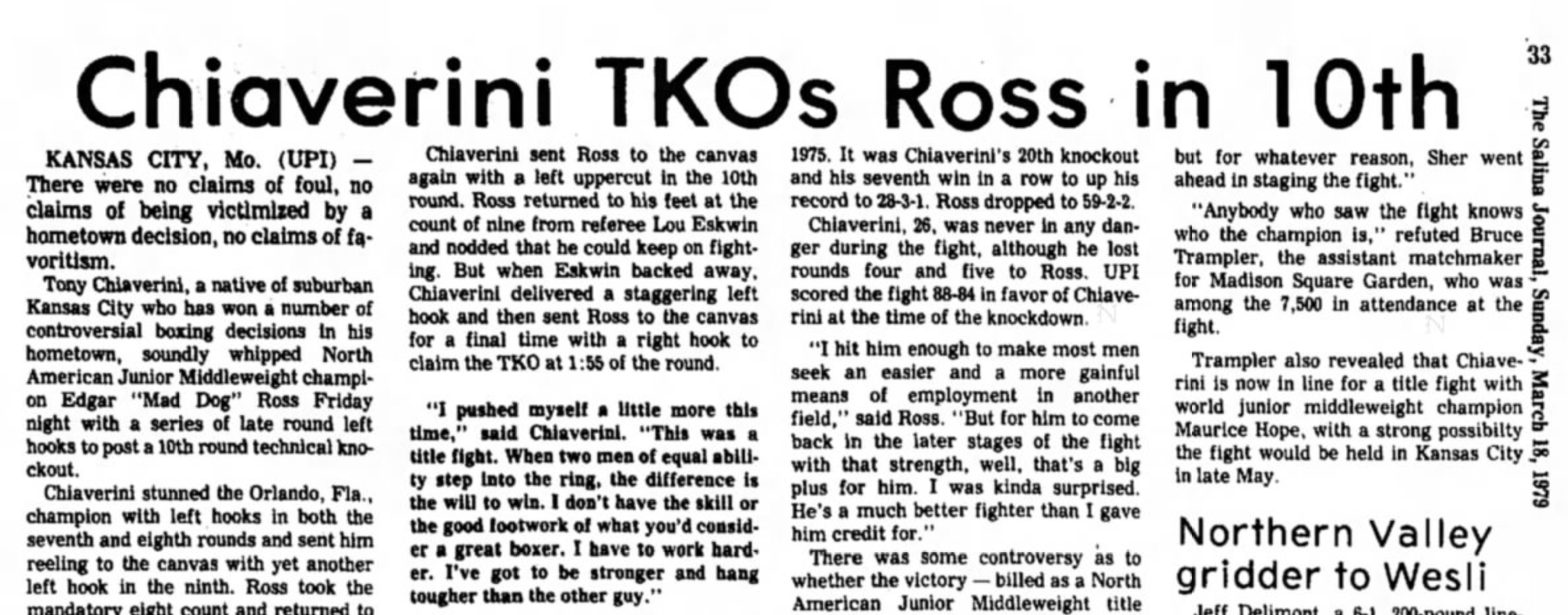
Ross was no doubt deflated after the upset loss, but seemed to take defeat in stride as his streak in the ring ended at 50 straight wins.
"I hit him enough to make most men seek an easier and a more gainful means of employment in another field," Ross told a Kansas newspaper reporter following the fight. "But for him to come back in the later stages of the fight with that strength, well, that's a big plus for him. I was kinda surprised. He's a much better fighter than I gave him credit for."
While Chiaverini went on to fight until 1983, including a brutal four-round loss to Sugar Ray Leonard, Ross never entered the ring again, turning down thousands of dollars and multiple offers for fights. Most famously, the head trauma sustained over the years and during his final loss prompted him to turn down the biggest payday of his career in the amount of $75,000 to fight Wilfred Benítez in Madison Square Garden.
According to a 2012 story written after his death by Tommy Deas of the Tuscaloosa News, life after boxing for Ross was much like his life prior to entering the ring for the first time.
In those last decades, Ross reportedly fell back into his old ways as his mental and physical health rapidly declined. He struggled financially and was homeless at times, the Tuscaloosa News reported, in addition to suffering from seizures and memory loss as a result of his violent life and profession. Ross also retained his penchant for violence, but wasn't the fighter he once had been and often found himself on the losing end of inconsequential scuffles.
His brother, the late Ronnie Ross, was a former Auburn football player who looked out for Mad Dog in those days. After receiving a substantial inheritance following his brother's death, a friend helped Ross by reportedly clearing some land on his property where the retired boxer lived out the rest of his days in a mobile home.
In his letter to the editor in 2012, Mike Sawyer remembered being a student at the University of Alabama in 1974 when Ross and his father entered an old gym with another boxer for a day of sparring. The image constructed of Ross in the letter stands in stark contrast to the reputation of a man known for his brutality inside — and outside — of the ring.
"Several years later, Edgar stopped by to visit as he was driving from Florida to Tuscaloosa," Sawyer recalled. "I regret reading his recent obituary and will always remember him as a gentle human, with difficulty seeing him as 'Mad Dog,' the professional boxer."
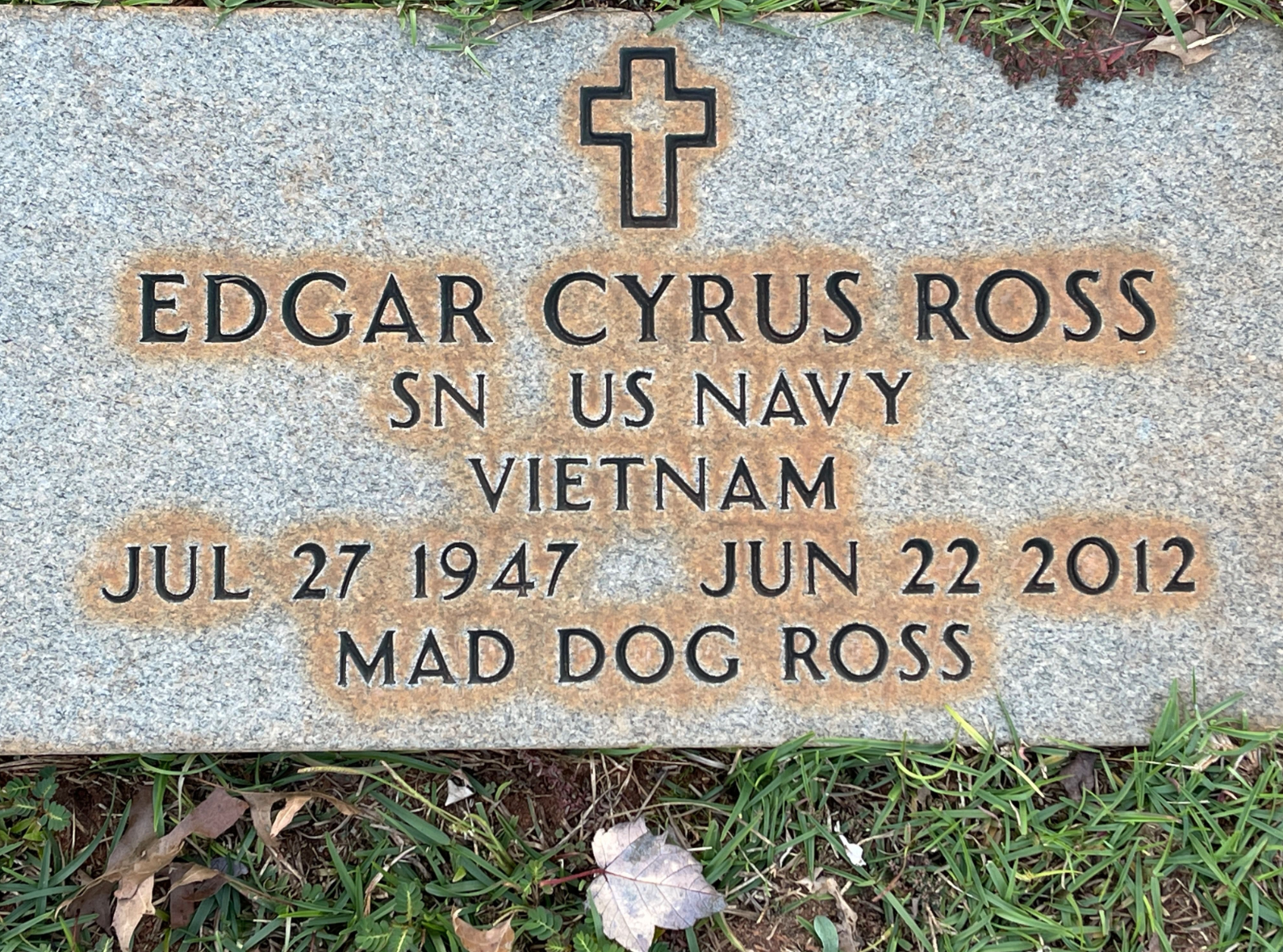
Edgar "Mad Dog" Ross died in that Dale County trailer in 2012 and was buried in Sunset Memorial Park in Midland City. His obituary did not list any spouse or children, saying only that he was survived by an aunt, uncle and cast of cousins.
His modest headstone references his service in Vietnam and includes his famous nickname.
"There's too many people walking around today just living in a dream world," Ross told a reporter during the height of his career. "They're just sitting back and saying, 'Gee, I could have done this or that.' But I don't want to end up like that ... When I get to be 50, I won't have to turn to my son and say 'You know, I could have been a fighter if I wanted to.' I can look at myself and say I did what I wanted to. I won't have any excuses."
Have a news tip or suggestion on how I can improve Tuscaloosa Patch? Maybe you're interested in having your business become one of the latest sponsors for Tuscaloosa Patch? Email all inquiries to me at ryan.phillips@patch.com.
Get more local news delivered straight to your inbox. Sign up for free Patch newsletters and alerts.