Politics & Government
The Killer Tossie King: Tuscaloosa's Most Prolific Murderer
Here's the story of Tossie King, the most prolific gunslinger and murderer in the history of the City of Tuscaloosa.


TUSCALOOSA, AL — As far as this reporter could dig up, there are no existing photographs or paintings of Earnest "Tossie" King.
Tossie King's story is a violent and captivating one — providing fascinating insight into how cheap life was at the turn of the 20th Century and how politics were conducted by a small group of the planter elite, whose families were intertwined as far back as could be traced.
It's a fascinating portrait of yet another fabled, but real, character in Tuscaloosa's complicated history who's been seemingly lost to time. After all, Tuscaloosa has at least one documented serial killer, Michael Hayes, and I've reported extensively on the "Tuscaloosa Ripper" murders that occurred in 1888 at the same time as the carnage in London's White Chapel District.
Find out what's happening in Tuscaloosafor free with the latest updates from Patch.
But in a hapless search for a historical topic for National Police Week, this reporter stumbled on the story of the man responsible for the first two line-of-duty law enforcement deaths in the city of Tuscaloosa.
He died a free man and, weirdly enough, became a kind of folk hero to those who remembered him. To others, he was a bloodthirsty killer who loved to play with his gun.
Find out what's happening in Tuscaloosafor free with the latest updates from Patch.
Indeed, as recently as 2003, an album of remastered songs by blues icon Big Joe Williams — "I Got Wild" — gives mention during one of the interview tracks to the bootlegger Tossie King and the yellow gut rot whiskey he peddled in Tuscaloosa.
"Didn't have no revenue men down there," the legendary blues guitarist jokes, referring to the liquor they would boil up in bathtubs in the backrooms of Tuscaloosa and other places during prohibition.
Still, it may surprise many to know that King was documented as the assailant of the first two Tuscaloosa Police Department officers to be killed in the line of duty and at least one widely documented lynching. He was also apparently a sometimes-lawman and closely tied to one of the most prominent families in Tuscaloosa County business and politics.
Born in 1878 the son of Edmund Rush King and Mellie Foster King, young Tossie lived among the white planter elite of the Reconstruction Era and Jim Crow South — a time when political power at the local and county level allowed one to get in on the redistribution of power and wealth following the Civil War
Tossie's mother's family, in fact, are the same people whose name was given to the community of Fosters.
A Killer Is Born
In tracing the life and times of this murderous figure, an early formative experience could be found with the untimely death of his father in November 1900.
Edmund Rush King, in an obituary circulated around the region, was referred to as a "popular citizen," after serving as the City of Tuscaloosa's police chief, one term as Tuscaloosa County sheriff and briefly as the Tuscaloosa County circuit clerk.
Just 44 years old, Rush King had reportedly suffered from some type of chest cold and newspapers of the time said he was noticeably sick when he set out from Tuscaloosa for his plantation on Sunday, Nov. 18 — about 10 miles outside the city limits toward Fosters.
Rush King died five days later from pneumonia. At the time of his death, his brother — Henry James King — was also the chief of police for the City of Tuscaloosa and served in the position for years before also dying of pneumonia in 1919.
"This disease did its dread work swiftly and the great strong man, in his prime, the picture of stalwart health, could not withstand the attack," Rush King's obituary read. "He died at four o'clock yesterday morning. He was in full possession of his faculties before the end and his death was the triumphant passage over the river of the Christian whose faith is firmly fixed."
Tossie was the middle of five children and the oldest male heir. And suddenly, he found himself the head of the King Dynasty. In those crucial formative years, little is known about his position in the family, but what did become apparent was his affinity for violence.
It was a little more than a year after the death of his father — in December 1901 — that Tossie would take his first life.
The Ben Knox Lynching
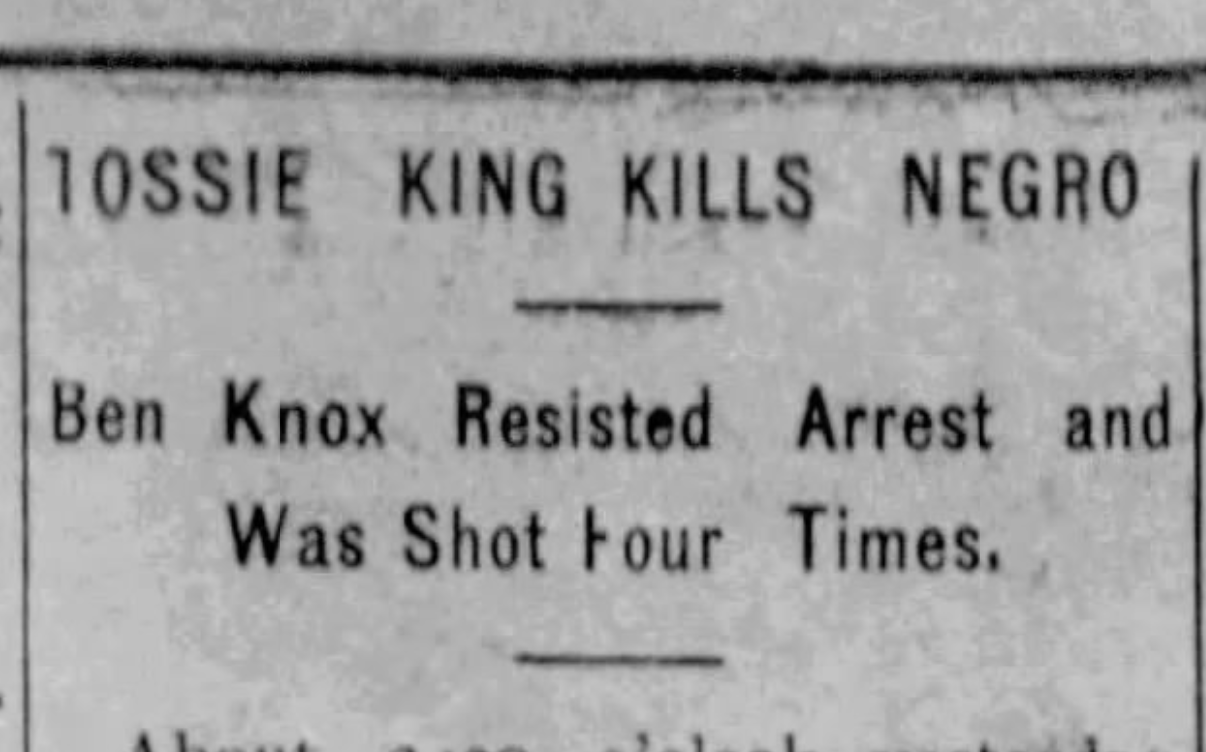
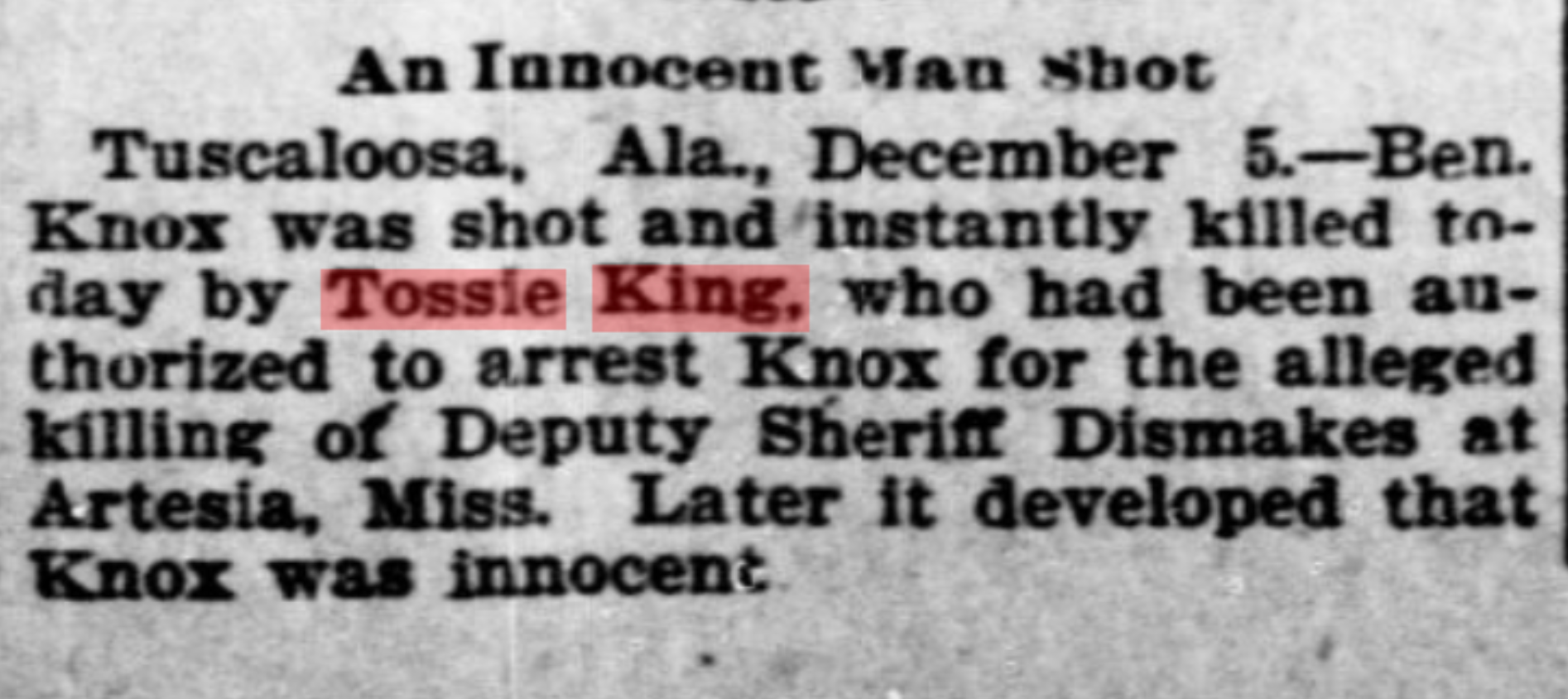
Ben Knox, a Black man from Knoxville, Alabama, was accused of killing a Lowndes County sheriff's deputy in Artesia, Mississippi, and was on the run from the law. With little to no evidence presented against him, numerous newspaper accounts insisted, after the fact, of course, that Knox was innocent of the charges.
Nevertheless, Tossie King, in his early 20s, was one of the men deputized by the Tuscaloosa Police Department to bring Knox to justice.
The Tuscaloosa Gazette reported the next day that King and a Tuscaloosa policeman located Knox at the Tuscaloosa Oil Mill and King pursued him into a boiler room of the plant. Testimony from the other officer said King ordered Knox to throw up his hands and give up, but the man appeared to reach for a gun or weapon and King shot him four times, killing Knox where he stood.
The fatal shooting was widely reported and later referred to as a lynching, due in part to King being a private citizen deputized by the Tuscaloosa Police Department after more than one Black man at the mill had allegedly threatened police with guns during their investigation.
Indeed, a few days later, one newspaper account flatly said "Later it was developed that Knox was innocent."
But given his familial connections to local law enforcement and the courts, it should come as no surprise that Tossie King never faced charges for his first documented killing.
From everything that can be gathered by Patch, Tossie then turned to a life of crime in a firm departure from his family's history of law enforcement and public service. This, despite his uncle still being chief of police in Tuscaloosa and his brother, Foster, going on to become a decorated detective with the Tuscaloosa Police Department.
Indeed, Tossie made a name for himself as a back alley baron, listing his profession on one U.S. Census as "collector" — at a time when many could claim to be little more than dirt farmers on rented land. The liquor business is where Tossie made his money and earned a reputation as a kind of crime boss in Tuscaloosa's mostly Black Peanut Hill neighborhood.
Apart from the publicity around his illegal trade, little is known about Tossie in between his first two publicly documented acts of violence.
But according to a 1982 history of the Tuscaloosa Police Department, written by TPD Patrolman David K. Hartman, it would be King responsible for the first line-of-duty death in the city's history.
The Mansfield Murder
Officer James A. Mansfield was a two-year veteran of the Tuscaloosa Police force and had previously worked as a carpenter before taking the oath. He had also been causing trouble for local moonshiners in his brief tenure behind the badge.
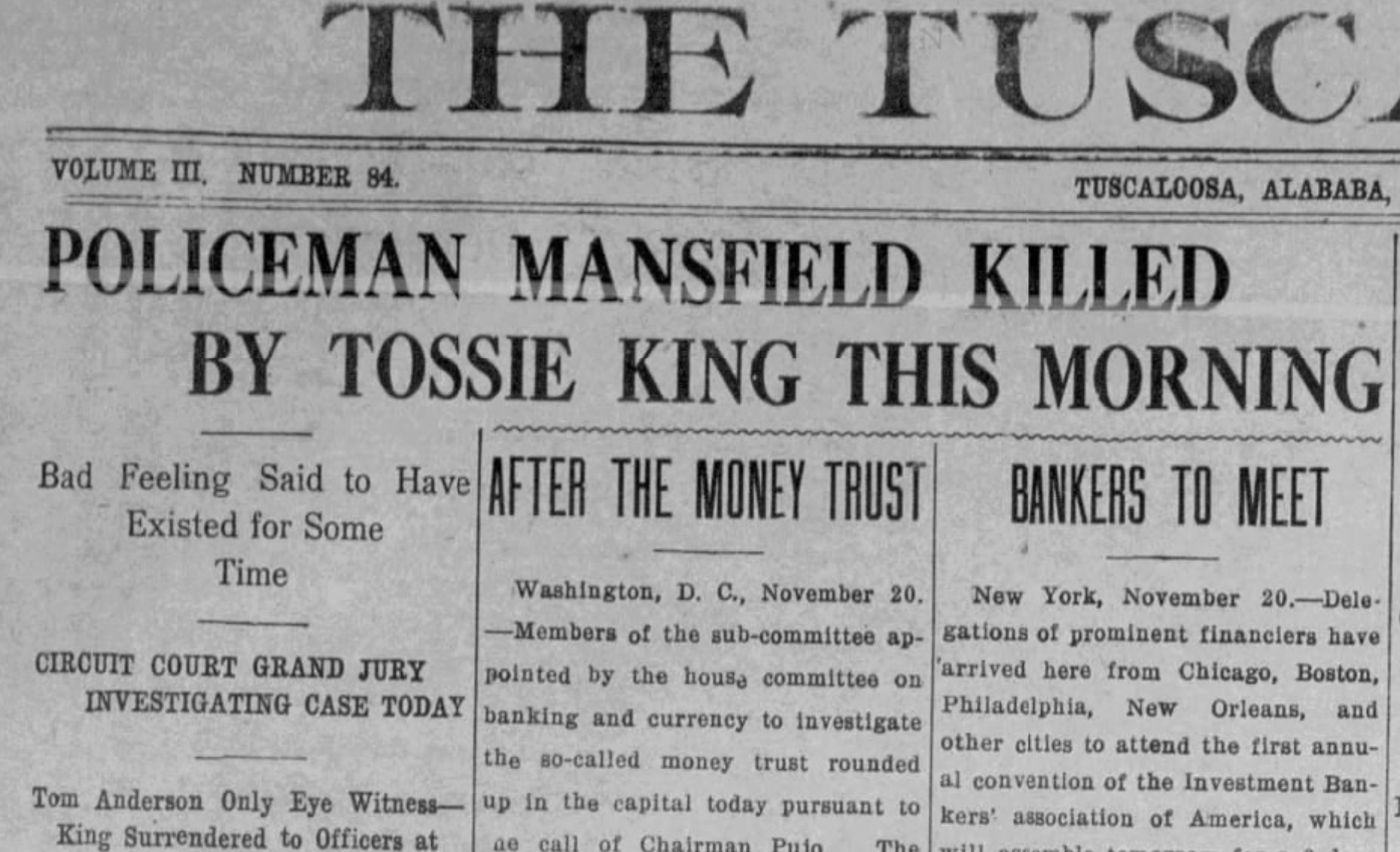
Mansfield was on his beat and had stopped at around 10:40 a.m. the morning of Nov. 20, 1912, to speak with Tom Anderson at the restaurant Anderson owned near the A.G.S. Depot.
In a story published the next day in the Tuscaloosa News, it was reported that "King and his friends" had made formal requests that the city remove Mansfield from his beat, with public speculation mentioning that his brother, Foster King, was set to be furloughed when there was a reduction in manpower for the police force at the end of the calendar year.
Mind you, this also came after their uncle, Henry James King, was no longer chief of police, and murmurs of political retaliation were prevalent even in the columns of local papers.
Indeed, despite the reported pleas of other merchants on Tuscaloosa's south side, Mansfield was praised for his commitment to the beat, most notably his "energetic pursuit of those who violated the liquor ordinance," according to the 1982 History of the Tuscaloosa Police Department.
Still, the fatal dispute seemed to spur from when King entered Anderson's restaurant and happened upon the two men talking. It was during this unexpected meeting that King and Mansfield reportedly had words, with Mansfield bringing up a closed case where King had accused another man of stealing one of his dogs.
Newspapers reported that Mansfield served as a witness for the defendant in that theft of property case, with the judge ultimately ruling against King. In the hours immediately following the shooting, Anderson told police and the grand jury that the two men began to curse one another before Mansfield appeared to make a move for his gun.
Similar to the lynching death of Ben Knox, King drew his .38 revolver and emptied it into the young officer, striking him four times in the chest and once in the leg.
Mansfield managed to hobble a few feet around to the back of the restaurant before collapsing on his backside in a stable behind the restaurant — his chin resting above his bleeding chest.
The wounded officer was found by a group of men and carried into the restaurant, but died without uttering a word.
Tossie King, after slaying James Mansfield, immediately called the county sheriff's office and turned himself in. This set up one of the most high-profile murder trials in the state at the time after King was indicted for murder by a grand jury and denied bond.
The trial saw numerous witnesses take the stand, many of whom spoke in support of the narrative pushed by King's defense attorney — that Mansfield had been the aggressor and King acted in self-defense. Indeed, the overwhelming sentiment in the courtroom that day, as reported by the Tuscaloosa News, was squarely in King's corner.
Much of the courtroom debate centered on if Mansfield's coat was still buttoned when he was found bleeding out and dying in the stable. Witness testimony on the subject was contradictory at times, but nothing conclusive was given to show he had been shot in cold blood, apart from the fact that all five bullets remained in the chambers of his service revolver, while all five of King's rounds struck Mansfield.
"There were only about one hundred people in the court room when the report was received that the jury had reached a decision, but there was an intense feeling of suppressed excitement when the jurors filed into the court room and handed their report to the clerk," the Tuscaloosa News from Dec. 22, 1912 said. "When the report was read, it was greeted with loud applause and cheering and Judge Harwood was forced to call the crowd to order. The defendant shook hands with the members of the jury and was greeted by a number of his friends in the court room."
Tossie King was found not guilty of capital murder. And it was apparently a cause for celebration.
Despite being on record as having killed two men without either of them firing a single shot at him, he was once again a free man just 33 days after shooting and killing Mansfield.
Even the 1982 History of the Tuscaloosa Police Department casts doubt on the final ruling of self-defense for King and speculated the verdict was likely the result of King's connections to the power brokers of the local courts in Tuscaloosa.
Tossie's trouble was far from over, though.
After all, the lawman who had been giving him so much trouble — particularly for his moonshining business — was dead and he seemed to have the community's blessing to continue on peddling his yellow whiskey, mainly to those on the Black south side.
The Killing of Will Thrower
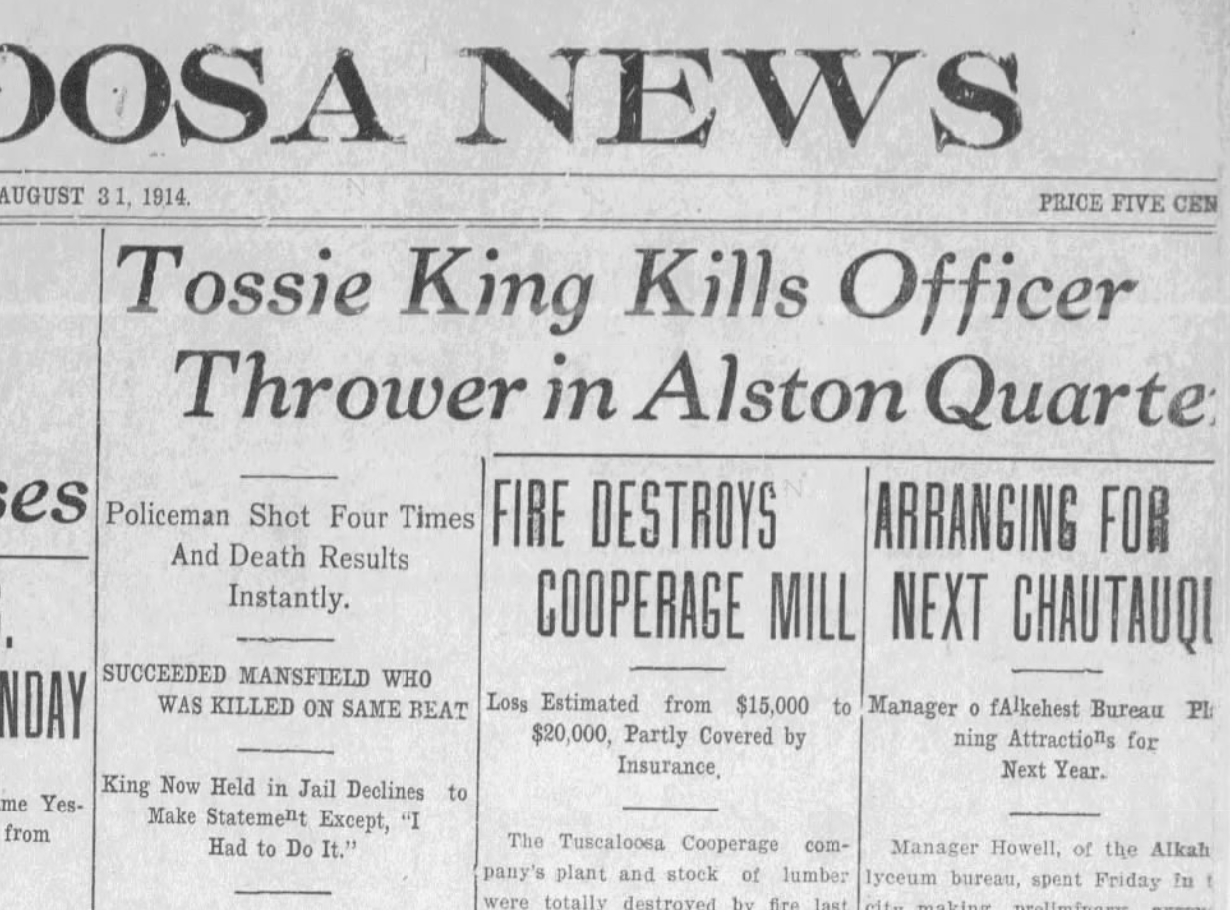
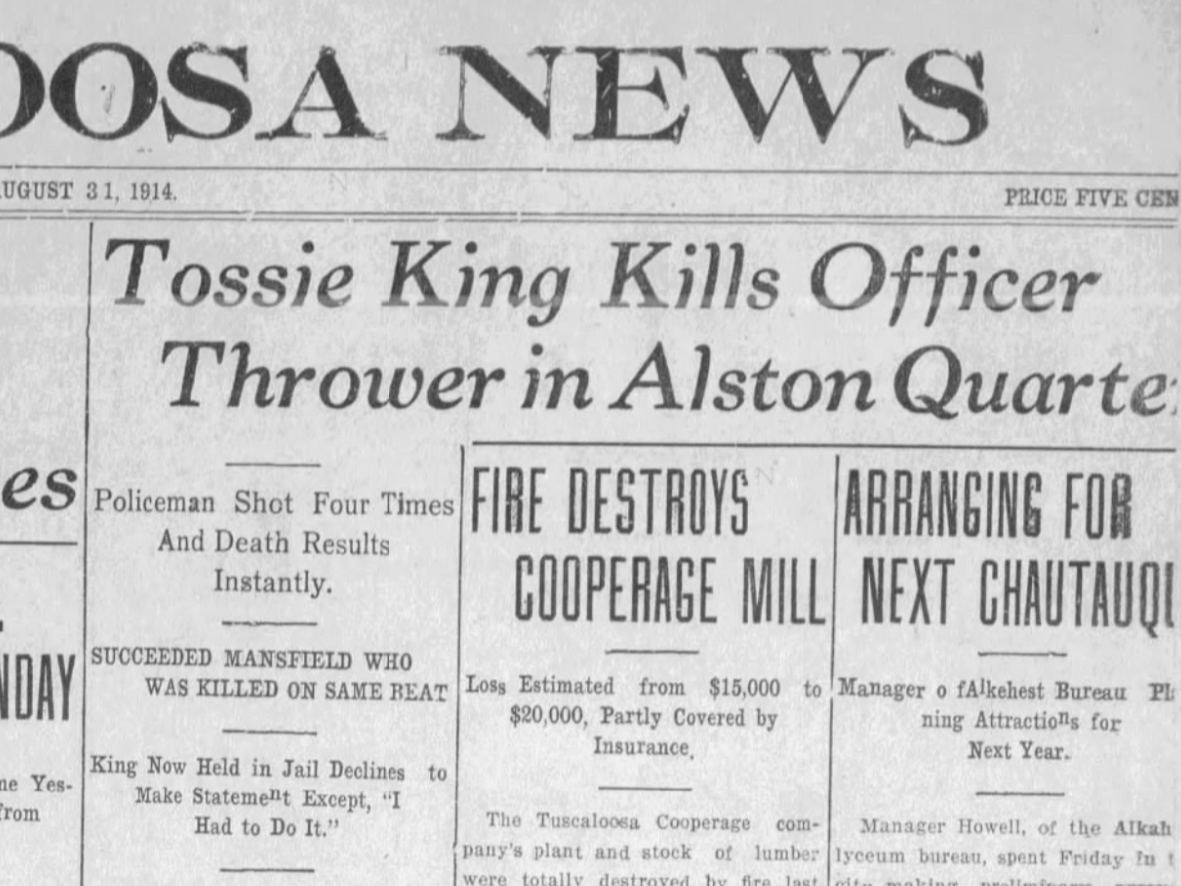
Tuscaloosa County Sheriff's Office Chief Deputy R.C. Connell was at home reading the evening of Aug. 30, 1914, when he heard someone calling him from outside. It was Tossie King — the man he had been called on to arrest less than two years prior for the shooting death of James Mansfield.
It's unclear what kind of relationship the two men had, but King apparently had some degree of respect for the seasoned lawman, while expressing outright contempt for others.
"I have just killed Will Thrower," King told Connell. "I had to do it."
King then lawyered up, hiring John D. McQueen, and refused to release any statement ahead of trial after turning himself in.
Tuscaloosa Police Officer Will Thrower was making the rounds near Alston Quarters off of what is now 15th Street. Described as "one of the toughest joints in town," Lula Meriwhether's Dance Hall was along Thrower's beat that fateful night.
Thrower was reportedly a young and well-liked officer. It was a quiet night by all accounts the evening of Aug. 30, 1914 and Thrower sat on a bench outside the dance hall talking with another man as the revelry of the evening could be heard behind them.
Meanwhile, Tossie King and a friend were drinking inside after King had come to the business reportedly to cash a check. Depending on the account you read, the drunk man with King was either W.F. Bonifay (History of TPD 1982) or A.F. Boniface (Tuscaloosa News, Aug. 31, 1941).
At any rate, King and his friend stumbled out of the business and started up the sidewalk when their paths crossed with Officer Thrower sitting on the bench.
The 1982 History of the Tuscaloosa Police Department — in an account that Patch cannot independently verify in newspaper reports from the day — state that Thrower made the comment to King's drunk companion, "You ought to be home instead of out here staggering drunk."
The comment appears to have been made as the two men walked past, but King returned seconds later with the other man and asked Thrower if the man did indeed look drunk to him.
"Yes," Thrower replied. That would be his last word.
It's at this time that Thrower was reported to have put his hand beside him to push himself up from the bench to stand when facing Tossie King and the other man, but he never made it to his feet.
Instead, like he had done to his first two victims, King's draw was faster than his victim's and he unloaded the .38 revolver into the chest of the young officer as he tried to rise from his seat. Later at trial, the 1982 History of TPD states that a doctor testified one shot was fired so close that it set the cloth of Thrower's uniform on fire.
Four of the five shots fired by King struck Thrower in the chest, while a fifth shot struck an innocent bystander — Blanch Donthrill — in the left leg below the knee. And like King's previous two victims, when Thrower was found, his service revolver was at his feet, with five unspent rounds in the cylinder.
A chilling account from one eyewitness says that after putting four bullets into Thrower, King calmly broke open his revolver and reloaded it — all while Thrower bled to death in front of him.
As he had done after killing Mansfield, King then sought out Chief Deputy Connell and turned himself in, once again portraying a victim claiming self-defense.
And, once again, King found himself charged with first degree murder — and of a lawman, no less.
In this early chapter of Tuscaloosa history, Tossie King now had the first two killings of Tuscaloosa city police officers to his name.
Newspapers at the time immediately pounced on the similar killings and the public reception was a far-cry from when King slayed Mansfield. Like the Mansfield murder, the papers immediately focused on disagreements between King and Thrower as the officer worked his beat and established a violent pattern of behavior.
The A.G.S Depot beat, as it was called in those days, was widely considered the most dangerous and active with criminal activity. And after Mansfield was gunned down at Tom Anderson's restaurant in 1912, it was Thrower assigned to the south side beat.
The president of the Tuscaloosa City Commission, a man by the name of Sprott, publicly mourned the death of the young officer, saying: "the best and most diligent officers I have ever known. No more conscientious man ever worked on the local force. He was brave and fearless and did his duty as he saw it without fear or favor. Tuscaloosa has lost a good citizen and the police force one of its best officers."
Another city commissioner commented: "I am deeply grieved over the tragic death of Mr. Thrower. I have watched his work for the city for the past several years and I appreciate his loyal efforts for the enforcement of the law. He was a man absolutely fearless in the discharge of his duty, his one idea as an officer being to do what he thought was right."
Indeed, the killing of Thrower spurred a visible outpouring of concern from those in the Tuscaloosa community, with the Tuscaloosa News reporting on large groups of men gathering on street corners for hours discussing the shooting.
In a tactic since discarded by the ethics of modern crime reporting, Thrower's wife was described as "prostrate" and hysterical. The couple had one son, a six year old, and Mrs. Thrower had reportedly been in ill health prior to the murder of her husband.
Thrower was buried in a little cemetery off Jug Factory Road immediately after the shooting.
Six members of the Tuscaloosa Police Department served as pallbearers and the funeral was attended by a large delegation of important individuals.
It must also be noted that Thrower's younger brother John followed in his brother's footsteps in law enforcement, working as a deputy for the Tuscaloosa County Sheriff's Office.
Like his brother, Deputy John Thrower was shot and killed in the line of duty while responding to a disturbance call in the Kellerman community on Aug. 17, 1920. His killer was never brought to justice.
But after the killing of Will Thrower, Tossie King was widely believed to be guilty as charged and expected to finally have justice catch up with his for his long history of violent deeds.
Or so it would seem.
The widely publicized case stretched out over the next decade and saw juries fail to reach verdicts on four different occasions — even allowing for Tossie King to run for constable for his district and to get arrested in 1916 for obstructing an officer attempting to make an arrest on the same beat once walked by Mansfield and Thrower.
Ultimately, King was found guilty of manslaughter and given eight years in prison — a sentence he fought bitterly in the appeals court. At one point during his appeals, even the publisher of the Tuscaloosa News spoke to the board of appeals advocating for his release.
Tossie King would go on to serve three years in prison for killing Thrower, with the story of his sentencing appearing above a front page story in the June 2, 1920 edition of the Tuscaloosa News that mentioned a two-home run game by Babe Ruth.
King apparently served the sentence and went on to die a free man in 1950 at Druid City Hospital.
He left behind four daughters and two grandsons, with nary a word of his violent history mentioned in his obituary, which only referred to him as a "widely known citizen."
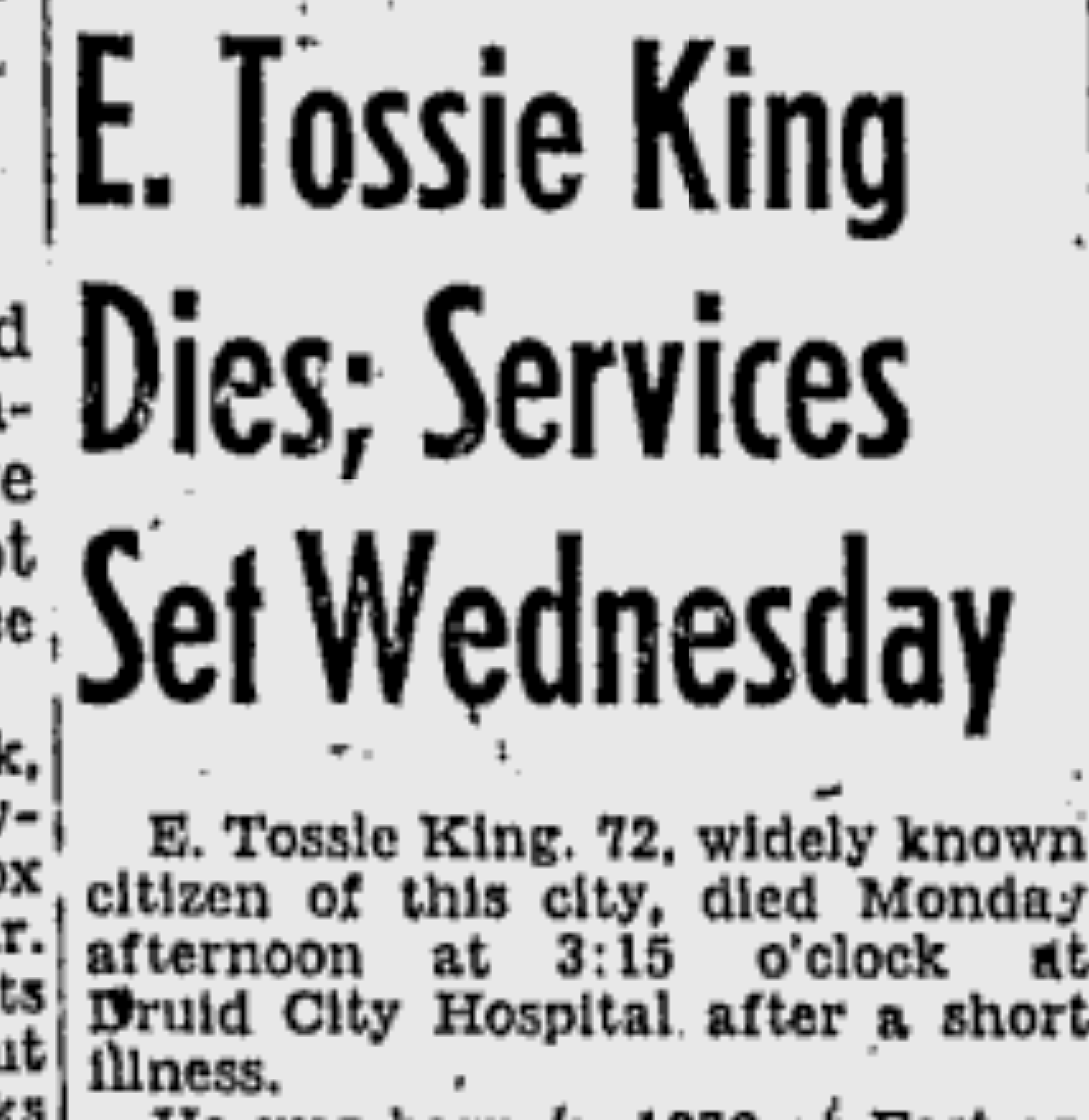
At the conclusion of a life of violence, King was survived by his younger brother Foster King — named for their maternal grandfather, Judge Foster.
Foster King seemed to be one of the few people his brother would listen to, and, in one account mentioned in the 1982 History of the Tuscaloosa Police Department, is said to have stopped his brother from at least one act of violence.
Indeed, a witness for one incident named Fred Robertson recalled that Tossie King had gotten into an altercation with a "carnival man" one evening.
During the spat, Foster noticed his brother reach for his back pocket where he normally kept his revolver. Before Tossie could unload the cylinder into the carnival worker, Foster bear-hugged his brother and dragged him away before any shots could be fired.
Foster could then be heard telling his brother to go home.
"Had Foster not arrived, the carnival would probably have been missing an employee and Tossie would have had another victim to add to his long list," Hartin wrote.
Despite the good he seemed to offer that balanced out his brother, a tragic twist of fate saw Tuscaloosa Police Detective J. Foster King, 68 years old at the time, and TPD Officer Homer Hubbard both gunned down on May 10, 1952.
While his brother's memory was forgotten by many, J. Foster King and Hubbard remain two of the dozen line-of-duty deaths observed by the Tuscaloosa Police Department, along with the first two victims whose lives were taken by the killer, Tossie King.
Have a news tip or suggestion on how I can improve Tuscaloosa Patch? Maybe you're interested in having your business become one of the latest sponsors for Tuscaloosa Patch? Email all inquiries to me at ryan.phillips@patch.com.
Get more local news delivered straight to your inbox. Sign up for free Patch newsletters and alerts.