Crime & Safety
Who Failed Greyson Gray? | Tuscaloosa Patch Special Investigation
Tuscaloosa Patch takes an in-depth look at the 2022 death of a 3-month-old infant and the circumstances surrounding his care.


Editor's Note: This story has been updated to include a response from the Alabama Department of Human Resources.
TUSCALOOSA, AL — A neglected plot in northern Tuscaloosa County's Bone Camp Cemetery is easy to miss for those not knowing what to look for.
Click here to subscribe to our free daily newsletter and breaking news alerts.
Find out what's happening in Tuscaloosafor free with the latest updates from Patch.
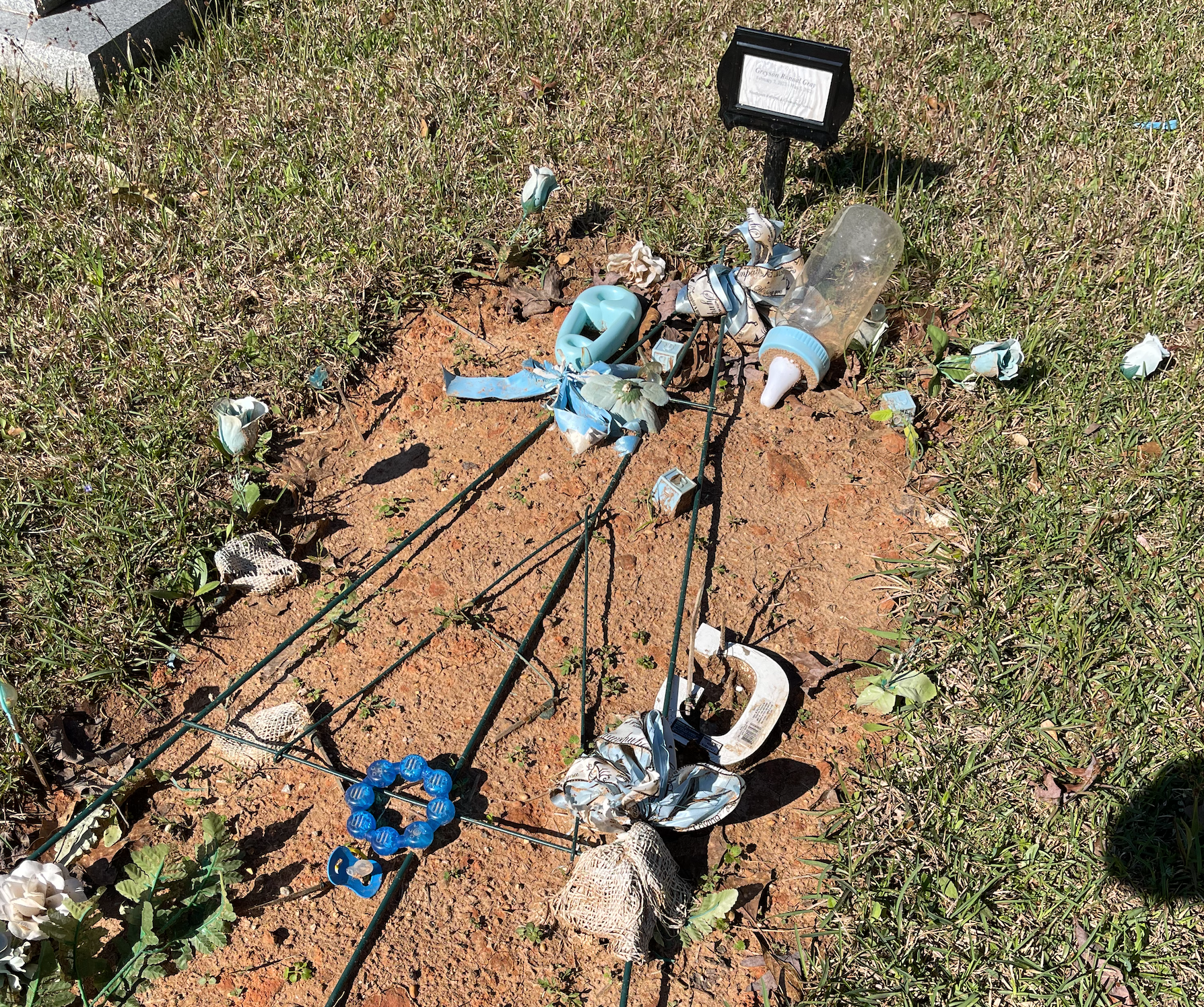
While nearly a year has passed since the death of 3-month-old Greyson Randal Gray, the red dirt is still visible on the surface of the infant's final resting place and there's no headstone.
Instead, only a small temporary marker bears his name, birth and death dates, and the name of the funeral home that handled the arrangements.
Find out what's happening in Tuscaloosafor free with the latest updates from Patch.
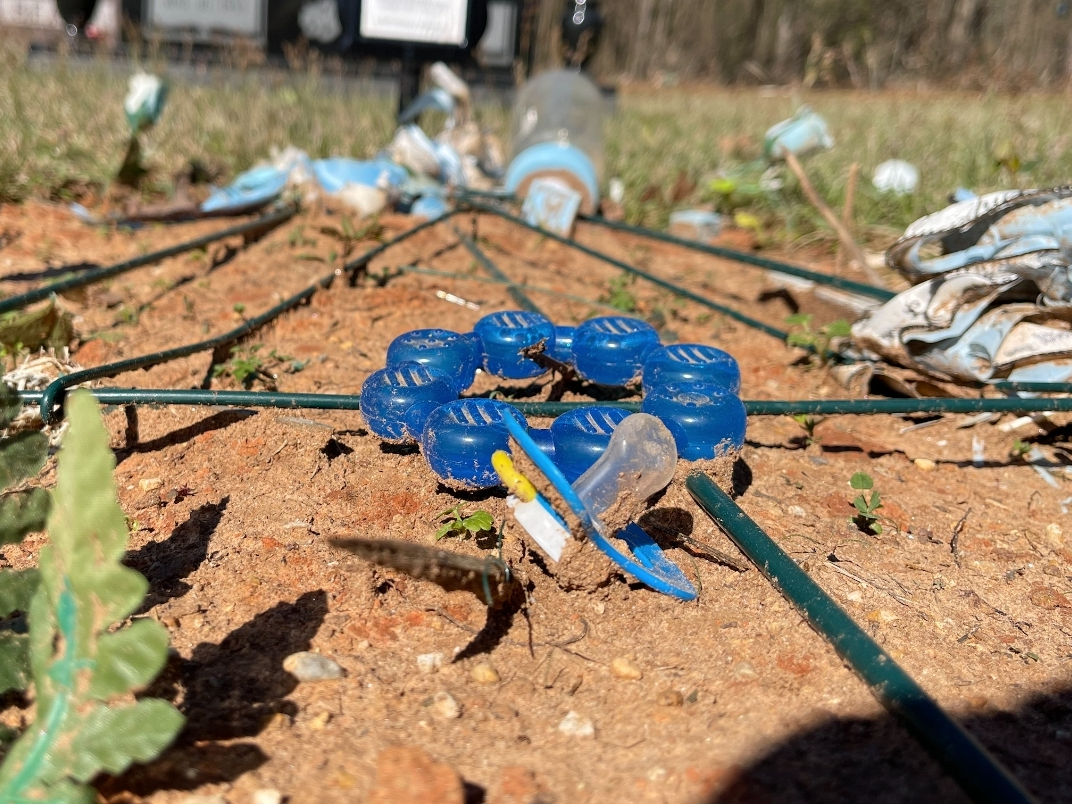
The grave is also scattered with weathered effects denoting an infant is buried there — a teething ring, a pacifier, a few baby blocks, a large plastic baby bottle. A wire frame that once held a flower arrangement was bare and laid across the length of the grave, visibly untouched for some time, with the flowers long-since scattered to the wind.
In death as it was in life for Greyson, his grave exists as a lasting reminder of the negligence and series of alleged failures that led to his death in May 2022.
As Patch previously reported, Greyson's parents — Jessica Nicole Minor and Randal Chester Gray II — have been indicted for chemical endangerment of a child resulting in death after a state medical examiner's autopsy found that Greyson died of methamphetamine toxicity.
It's worth noting that Minor was charged with chemical endangerment of a child when Greyson was born and court records obtained by Patch indicate that she informed law enforcement of her substance abuse while she was pregnant.
Still, Minor and Gray were in handcuffs and led down the steps at the Tuscaloosa County Sheriff's Office headquarters Friday to be transported to the county jail.
Despite many in the public and on social media rushing to condemn both parents, a detailed investigation by Tuscaloosa Patch revealed a complex case that not only highlights the harsh realities of child abuse and addiction, but one that raises questions from an institutional standpoint over what measures could have been taken to prevent Greyson's death.
THE CIRCUMSTANCES

Greyson Randal Gray was born on Feb. 7, 2022, at DCH Regional Medical Center in Tuscaloosa and his brief life proved to be a tragic one from his first moments in a cruel world, after hospital staff found the child and mother both tested positive for methamphetamine.
DCH Health System officials immediately contacted the Alabama Department of Human Resources (DHR) and Minor eventually told social workers and police that she had used meth a few days before giving birth.
After Minor was charged with chemical endangerment of a child — a Class C felony — Patch found that temporary custody of the newborn was then granted to Greyson's father, Randal Gray.
Despite having a criminal record with drug and alcohol offenses, Gray purportedly passed DHR-mandated drug screenings and some sources indicated that he had been clean for some time — a fact that has not been fully verified by Patch and is disputed by several sources on background.
The same sources close to the situation claimed that hospital staff cautioned DHR against granting Gray custody due to various circumstances regarding his living situation and his history of substance abuse.
However, Gray was granted temporary custody and took the child to live with him on property owned by a family member in the 14000 block of Shady Woods Lane in Coker. The property, which includes a single-wide mobile home, is on a craggy red dirt road that connects to Gray Drive.
In the short interim period after Greyson's birth, he is said to have stayed mostly with his father in a camper on Shady Woods Lane, while Minor was out on bond from her most recent arrest and living on Bud Drive in Buhl. Gray's family members also reportedly provided an adequate support system and helped care for the child while his father was at work.
It is unclear at this time if Minor was allowed unsupervised visits, but sources say the father permitted Minor to see Greyson on certain occasions — including the night before the child was found unresponsive.
Captain Jack Kennedy, commander of the Tuscaloosa Violent Crimes Unit, told local media on Friday that following Minor's initial arrest for chemical endangerment, DHR implemented a standard Plan of Safe Care to ensure the child was being cared for.
The Plan of Safe Care, as you will learn more about later in this story, is a basic approach by the agency, but one consisting of a long list of guidelines geared primarily toward preservation of a family unit and the safety of the child.
However, on May 5, 2022 — three months after Greyson was brought home — Tuscaloosa County Sheriff's deputies responded to a call on Shady Woods Lane involving an unresponsive infant.
Kennedy said first responders attempted lifesaving procedures, including CPR, until an ambulance arrived to transport Greyson to DCH Regional Medical Center. Sadly, the infant was pronounced dead shortly thereafter.
Investigators with the Tuscaloosa Violent Crimes Unit found no visible signs of physical trauma on the infant, yet interviews with Greyson's parents did not produce a cause of death. That is until the autopsy results were returned, which confirmed that the child died from methamphetamine toxicity.
After medical records confirmed the child had been born with meth in his system, Minor, 35, was arrested once again on Aug. 17, 2022, and charged with an elevated count of chemical endangerment of a child resulting in death — a Class A felony.
Evidence in the case was then presented to a Grand Jury, which handed down new felony indictments for both Minor and Gray.
According to a deposition and charge sheet obtained by Tuscaloosa Patch, Tuscaloosa Violent Crimes Unit investigators on Friday, March 10, served felony arrest warrants on the residence on Bud Drive in Buhl.
While processing the scene, investigators found two plastic baggies on Minor's person that contained a crystalized substance and also located a digital scale and glass pipes with white residue sitting out in the open.
Upon this discovery, investigators obtained a search warrant for the residence and found additional drug paraphernalia and multiple plastic baggies of methamphetamine in a shed that Minor and Gray reportedly resided in. The substances were field tested and came back positive for meth, with roughly 11 grams of the highly addictive drug recovered.
Following the search warrant and in addition to the chemical endangerment indictment, Gray was subsequently charged with unlawful possession of a controlled substance with intent to distribute, failure to affix a tax stamp and unlawful possession of drug paraphernalia.
Minor was also charged with trafficking methamphetamine, resulting in her bond being revoked on her previous charges. Total bond for Gray was set at $150,000 on the four charges, according to Tuscaloosa County Jail records, and both of them remain behind bars as of the publication of this story.

As previously stated, both parents had extensive criminal records relating mostly to drug and alcohol offenses. However, Minor's record details a long battle with substance abuse issues that, even prior to Greyson's death, left heartbreak in its wake for many.
Indeed, Minor's first major trouble with the law came on July 5, 2008. Court records say she was driving along Sipsey Valley Road in Tuscaloosa County, just south of Alabama Highway 140, when her vehicle crashed, resulting in the death of a passenger — 27-year-old Derick Templeton of Gordo, who went by the nickname D-BO.
The Tuscaloosa News reported that Minor, just 21 years old at the time, was indicted by a Grand Jury on the following charges: murder, manslaughter, vehicular homicide, driving under the influence, speeding, driving with a suspended license, improper lane usage and third-degree receiving stolen property.
Records from the Alabama Bureau of Pardons and Paroles show this tragic incident seems to have been a formative one for Minor, who went on to develop a pattern of dodging court hearings and parole officers, before eventually ending up back in jail with her bond revoked after a 2015 drug arrest at a Northport gas station.
Parole Officer Matthew S. Parker wrote in his delinquent probationer report of the fatal car wreck: "It appears that Minor has not learned from that significant mistake and is now back to putting innocent lives in danger while driving under the influence."
In 2015, Minor was sentenced to four years in prison and five years probation for her probation delinquency and less than a decade later was back behind bars accused of her child's death.
Despite several sources close to the situation placing blame for Greyson Gray's death squarely on the parents, an array of concerns persist relating to allegations that DHR failed to adequately protect the child from the circumstances that led to such a tragedy.
A FAILED SYSTEM
Sources claimed on background to Tuscaloosa Patch that immediately after Greyson was born, numerous attempts were made to urge DHR to step in and do a better job of ensuring the child was in a safe environment.
At the same time, Patch has also learned that discussions had been underway for a possible adoption agreement with a family member that never had the chance to come to fruition.
It's worth noting that DHR supervision and custody issues are among the most complex in the legal system. After all, custody cases and individualized Plans of Safe Care are sealed in court and social workers tasked with working the ground level in such cases are granted immunity to protect them from litigation.
Birmingham attorney Tommy James is a noted courtroom advocate involved in numerous wrongful death lawsuits against DHR and told Patch that caseworkers are entitled to state agency immunity, but there are exceptions relating to certain actions or inactions of employees.
"If they fail to follow specific written policy and procedure or do something intentional and with malice or act beyond their authority, then they could lose their entitlement to state agency immunity," James told Patch.
Alabama Department of Human Resources Director of Communications Dominic Binkley said the agency cannot confirm or deny any information about a particular case due to confidentiality laws.
Captain Jack Kennedy, commander of the Tuscaloosa Violent Crimes Unit, explained that the actual transference of legal custody is a court-ordered process, with DHR being the responsible agency for overseeing child welfare.
"When law enforcement has a case where child welfare is a concern, DHR is called, oftentimes directly to the scene, and they make decisions regarding the placement of children," he said. "DHR and law enforcement oftentimes work together, but are different types of agencies with different responsibilities under the law."
According to the protocols laid out by the Alabama Department of Human Resources, DHR child welfare staff is required to notify the appropriate law enforcement agency of only criminal or other illegal activity — such as "drug use, production/distribution of illegal drugs, production of child pornography, etc." — that is contributing to the abuse/neglect of the child or directly affects child safety.
Conversely, social workers are prohibited from providing police and other law enforcement with any information that aids in an investigation of any matter other than child abuse and neglect.
On the law enforcement side, Kennedy said the Violent Crimes Unit typically only involves itself in child abuses cases when a death occurs as a result. Instead, each law enforcement agency's Criminal Investigations Division is tasked with handling physical abuse cases.
In the last year, Kennedy said the Violent Crimes Unit has worked one child death case — Greyson Gray — while the Tuscaloosa Police Department's Criminal Investigation Division has also worked another.
Still, DHR protocols are clear in their directives to social workers and administrators, with a Plan of Safe Care required for infants affected by substance abuse. What's more, The Comprehensive Addiction and Recovery Act (CARA) requires county departments working with substance affected/exposed children to have procedures in place for immediate screening, risk and safety assessment, and prompt investigation of such reports.
Those close to the situation involving Greyson Gray claim that DHR's efforts fell well short of meeting the agency's basic standards.
When examining said standards, questions are immediately raised as to how DHR handled Greyson's case, including requirements for an in-home visit within 12 hours after the infant is discharged from the hospital. Sources claim this required visit protocol was conducted as mandated, both at Minor's residence in Buhl and the property on Shady Woods Lane where Gray lived in a camper.
Other requirements include documenting the presence of any other individuals — such as family, household members or friends — who may also be abusing illegal substances that impact caregiving knowledge and parental skills.
DHR guidelines say that children can only be removed from parental custody by the state if conditions in the home are deemed to be dangerous or detrimental to the child’s immediate physical, mental, or emotional well-being and a workable safety plan can not be obtained.
The latest figures from DHR show that approximately 6,000 children are in foster care in Alabama — a number that has remained fairly consistent over the last few years. However, the number of children placed in foster care in Alabama due to parental drug addiction has risen dramatically.
For instance, AL.com reported that there were 1,050 children in DHR custody because of parental drug abuse in 2015, which rose to 1,736 only a couple of years later.
In Alabama, state data suggests 36.7% of children enter foster care as a result of parental substance abuse, while an estimated 5% of children are born with prenatal exposure to illicit drugs — children like Greyson Gray.
Despite the issues relating to foster care and the prevalence of child abuse, the problems are much more broad and tragic.
Tuscaloosa Patch has identified numerous wrongful death lawsuits filed against the Alabama Department of Human Resources just in the last few years, with some of the stories presenting gut-wrenching similarities to the death of Greyson Gray.
Birmingham attorney Tommy James is the foremost advocate for legal issues involving children in Alabama and has filed numerous wrongful death lawsuits against DHR on behalf of the victims.
Consider the case of 19-month-old Davena Hinton in Tuscaloosa, who died at Children's Hospital in Birmingham from physical injuries in July 2020. The long list of traumatic injuries were allegedly caused at the hands of her mother's boyfriend.
Following Davena's death, the Tuscaloosa News reported that James filed a wrongful death lawsuit against DHR and several other related parties claiming that DHR failed to take appropriate action after the child was found to have injuries to her face and hand, along with severe second-degree burns after she had been left alone with her mother's boyfriend.
James argues that the injuries were reported to DHR by DCH Regional Medical Center employees, yet the agency still allowed the toddler to live with her mother. What's more, the lawsuit alleges that numerous family members voiced concerns to DHR, saying Davena should not have been allowed to remain in the care of her mother because of her unexplained injuries.
The mother's boyfriend, Felix Tabb, eventually saw his charges elevated to capital murder.
"At some point, when there's threats of future abuse and neglect, they have to step in and do something," James told Patch in a phone interview. "They don't seem to be doing anything."
Sound familiar?
Now look at the case of Demetric Hampton, Jr. — a two-year-old who DHR returned to his father and stepmother after they had been arrested for child endangerment and various other charges in April 2020.
WBRC FOX 6 News reported that deputies were called out to a home in Center Point on a report of a small child who wasn’t breathing. The child's parents told police that Demetric choked while eating, but the child was found by investigators to have suffered multiple physical injuries.
Sadly, Demetric died at UAB Hospital in Birmingham and his father was later indicted for capital murder and child abuse.
Then there's the heartbreaking neglect case of 8-year-old LeBrawn Rankin, who had cerebral palsy and weighed less than 30 pounds at the time of his 2018 death in Mobile County, according to a report from WPMI NBC 15 News.
Rankin's mother was charged with aggravated child abuse amid accusations that she neglected to provide food and basic care for the little boy. With respect to LeBrawn's death, officials at his school claimed to have informed DHR that the child suffered from bedsores, severe dehydration and poor hygiene — including unchanged diapers. Yet, despite raising alarm bells with the appropriate authorities, nothing was done and the child died.
Story after story and the list goes on. And for many of those instances, James has been the most vocal champion for justice and accountability.
Speaking in the general sense, James cited DHR's wide scope of discretion in allowing the agency to fail so many of the state's abused and neglected children. This unchecked authority then becomes much more troubling when considering the amount of turnover for caseworkers and the low pay offered to those entering such an important field.
"[Caseworkers] don't have enough time to learn policies and procedures and are overworked," James explained. "We're talking about children. These are our most vulnerable children and oftentimes they are relying on DHR for their safety and when there's future potential maltreatment, [DHR] ought to step in."
James then mentioned that, in many cases, DHR operates outside of its own policies and procedures, along with the agency pushing back against calls for transparency with respect to access to its records.
This is noted in another case for James in Limestone County involving the mother of a 13-month-old infant who was charged with capital murder in 2019 after leaving her baby boy in a hot car for seven or eight hours, resulting in his death.
James once again filed a wrongful death lawsuit against DHR, claiming the agency's investigators failed to act on numerous reports of abuse and neglect that had previously been filed relating to the mother.
He explained the mother was also a known drug addict and had been looking through dumpsters for food at the time she left the child alone in the hot car.
"It is extremely difficult to obtain records from DHR," James lamented. "I get calls with horror stories from clients and potential clients and DHR won’t give these folks their own records. The only way you can get them is to file a lawsuit. It took two years to get the records in my case where an infant was left to die in a hot car. When a child dies, those records should be open to the public, so we can know what happened, in hopes of preventing more children from dying.”
Despite the facts surrounding the death of Greyson Gray, there remains more questions than answers with respect to how DHR handled the case.
What policies weren't followed?
How many of these cases don't make it in the news?
Why was the child allowed to be in the custody of a parent with a known history of substance abuse?
How was the infant's case handled by DHR in the three months between his birth and death?
What could have been done differently?
Why are there so many similar instances where DHR is warned of abuse and negligence, but do nothing until after a child has died?
Most importantly, though, the question remains: who failed Greyson Gray?
Have a news tip or suggestion on how I can improve Tuscaloosa Patch? Maybe you're interested in having your business become one of the latest sponsors for Tuscaloosa Patch? Email all inquiries to me at ryan.phillips@patch.com
Get more local news delivered straight to your inbox. Sign up for free Patch newsletters and alerts.