Schools
Alameda Students Bring Two School Gardens Back to Life
Students have revitalized the gardens at Woodstock Child Development Center and Ruby Bridges Elementary during the spring and summer.




Announcement, photos submitted by Alameda Unified School District:
When he was a young boy, DaMariy’a Compton, 18, used to do some farming with family members in Oakland. Since then, DaMariy’a (pronounced Da-MAR-ee-yah) has sustained an interest in gardening and the culinary arts. So when he learned that Project Eat — an Alameda County Office of Education program that promotes growing, cooking, and eating healthy food — was offering internships to high school students to work in school gardens this summer, he leapt at the chance.
“I’m interested in food, farming, nature, animals, the environment — all that,” he says. “So I really wanted to apply for this.”
Find out what's happening in Alamedafor free with the latest updates from Patch.
Thanks to the efforts of Project Eat’s “Get Fresh! Stay Healthy!” internship, about a dozen AUSD high school students helped to revitalize school gardens at Woodstock Child Development Center (WCDC) and Ruby Bridges Elementary School this spring and summer. In the course of clearing, preparing, and planting the gardens, these high schoolers learned how collective action can transform a derelict site and developed skills that can translate into work opportunities later on.
“Our program is evolving from a garden-based nutrition education program into a workforce development program for health and agriculture,” says Kate Casale, a youth development specialist with Project Eat. “And these internships are perfect examples of that work.”
Find out what's happening in Alamedafor free with the latest updates from Patch.
Bringing Order to Chaos
Casale, who lives in Alameda and helped create the farm at Alameda Point Collaborative, noticed a tangled corner plot at WCDC just a few months ago. The garden had been planted in May 2011, when “Curb Appeal,” an HGTV program that makes over residential properties, coordinated a volunteer landscaping effort for the Alameda Multicultural Center, then located on the former Longfellow Elementary School campus. Over time, however, volunteers for this “Longfellow Children’s Garden” had moved on, and invasive plants had moved in. When Casale approached Island High School with the idea of letting students reclaim the garden, the administration readily agreed.
“I applied for the internship because I wanted to learn more about eating healthy and growing plants,” explains Savannah Sands, an Island High senior who also worked at WCDC this summer. “And I like to do things for the community.”
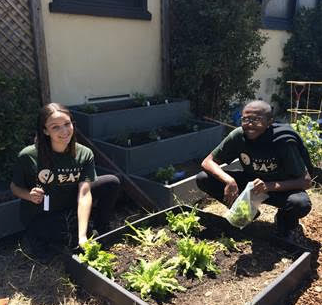
When Sands and Compton started their work earlier this month, the plot was “disorganized and filled with weeds and Bermuda grass,” Sands says. “The planter boxes were totally covered up.” Within a few weeks, however, Casale and the students had pulled the weeds, liberated the planter boxes, amended the soil, and planted lettuce, strawberries, cucumbers, tomatoes, peppers, parsley, and arugula.
In the course of revitalizing the garden, the interns discovered a lot about hard work, nutrition, and tools. They also got hands-on lessons in what makes a garden grow.
Notes Sands, “I learned a lot about insects and spiders! But also about cultivating plants from seeds.” DaMariy’a agrees. “I’ve learned a lot about helping plants grow – the soil they need, the sun they need. It’s been good,” he says.
“The Vibration of Life”
Students with Project Eat have also been working in the school garden at Ruby Bridges Elementary School. Dedicated in honor of former AUSD teacher Paulette Cormack in 2006, the rectangular courtyard plot fell into neglect when Ruby Bridges lost its gardening grant three years ago. As a result, the garden grew into tangle of raspberry vines, crab grass, and shoulder-high weeds.
For Robbie Wilson, program manager of BACR/LEAPS for AUSD (an afterschool program at three AUSD schools), this seemed like the perfect opportunity to not only teach children about food, nutrition, and the environment, but also to feed them. “We have so many kids who are hungry,” she says, “and we have this big plot of land. Why not use the land to help feed the children?”
A huge work day sponsored by Project Eat last February helped get the ball rolling. Project Peace sent 50 volunteers. California Native Gardens donated 15 cubic yards of mulch. Ploughshares Nursery gave discounts on plants. Walking Tree Essentials — an Oakland-based organization that provides gardening, irrigation, and nutrition consulting, as well as drumming and music instruction — worked on the water supply and helped with labor and lessons in the garden. And 10 teens from across AUSD worked in the garden and with the LEAPs program throughout the spring.
“We helped plant, played games with the kids, and taught them about gardening,” says Meilani Markin, an entering 9th grader at Encinal High School. “I would love to do it again. I had fun with the kids. There was a lot of laughter!”
Alleona Elopre, who is about to become a 10th grader at Alameda High School, worked with Afia Walking Tree in teaching LEAPs children about drumming and nutrition.
“It was such a great and amazing experience working with the kids,” she says, “and I learned so many things that I can take home with me, like about healthy eating and a lot about genetically modified organisms.”
By mid-July, the garden was bursting with kale, tomatoes, celery, strawberries, and chard, and LEAPS children were sampling early harvests. “
I’ve never seen so many kids eating and enjoying kale,” Wilson says. “And it’s giving us an opportunity to introduce both the kids and their families to a wide range of produce they may not have tried before.”
“Gardening is about life,” she adds. “It’s the vibration of life. Some kids say, ‘I don’t want to get dirty!’ when they’re first brought to the garden. But then they start to dig. They feel it. It gives them voice. That’s what this garden brings to kids.”
Notes Superintendent Sean McPhetridge, “I really love how this program offers hands-on training in real-world skills while also teaming older students up with younger ones. I am grateful to the interns for helping to uncover the potential of our school gardens. And I am grateful to the adults who have mentored these interns, too. I think this multi-generational team has planted the seeds for something bigger in our future.”
Photo 1: Savannah Sands and DaMariy’a Compton harvest lettuce from the WCDC garden they rejuvenated this summer.
Photos 3 & 4: The Ruby Bridges garden before work began (above) and after, with Robbie Wilson, AUSD’s BACR/LEAPS program manager
Get more local news delivered straight to your inbox. Sign up for free Patch newsletters and alerts.