Community Corner
Pros and Cons of Proposed Medical and Respite Center on McKay
Although everyone agrees that APC's heart is in the right place, some neighborhood citizens have concerns about the project.

I live in Crown Harbor. "Crown Harbor is a small gated community of 76 townhomes nestled along Ballena Bay, Crab Cove, and Crown Beach. Crown Harbor is a quiet, well-kept community on the San Francisco Bay, close to downtown Alameda's Historic Webster Street shopping, restaurants, post office, twice-weekly Farmers' Market, and much-anticipated seasonal events such as Concerts at Crab Cove, 4th of July Parade, and Neptune Beach Community Celebration. Alameda Hospital is less than two miles away. Crown Harbor is only ten minutes away from Oakland's world-famous Jack London Square. San Francisco is a fifteen minute ferry ride away. World-renown wineries in Napa Valley and Sonoma County are less than an hour away with award-winning Rock Wall winery less than ten minutes from Crown Harbor."
Alameda Point Collaborative (APC) is a supportive housing community that uses all its resources to help families and individuals break the cycle of homelessness and poverty. They are the largest supportive housing provider for homeless families in Alameda County, and their wide range of services give residents the tools they need for long-term success. APC plans to develop the Alameda Medical Respite and Wellness Center on the Federal property adjacent to Crown Harbor.
"When any act of charity or of gratitude is presented to our sight or imagination, we are deeply impressed with its beauty or feel a strong desire in ourselves of doing charitable or grateful acts also."
— Thomas Jefferson*
Crown Harbor will not take a position as a homeowner association. Instead, the individual owners and residents will be given information, and each can act individually. As the sentinment in the community is not unanimous, the Crown Harbor members can choose to support or oppose the project.
Find out what's happening in Alamedafor free with the latest updates from Patch.
McKay Avenue Site
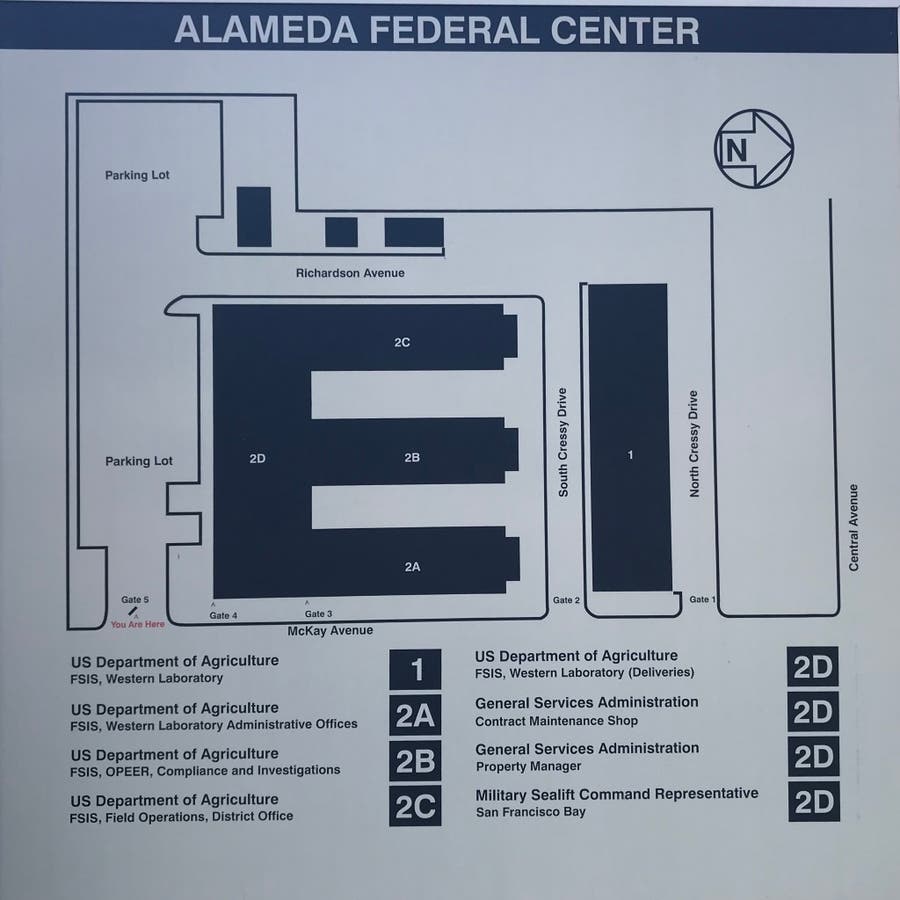
The Federal property originally consisted of 6 buildings. One building has been razed as part of the Crab Cove Expansion that is proceeding as planned. The APC project includes the renovation and adaptive re-use of the 5 remaining buildings at the site, located on McKay Avenue next to Crab Cove.
Find out what's happening in Alamedafor free with the latest updates from Patch.
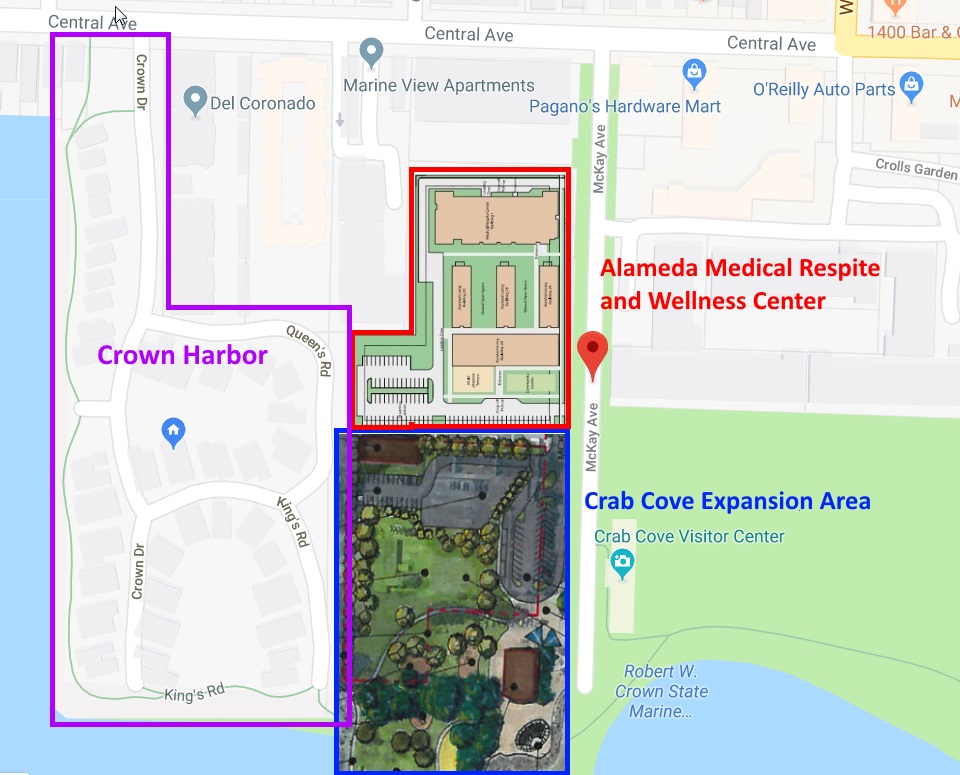
McKay Avenue Project
- Population Served
The Center will serve persons experiencing homelessness in Alameda County, with an emphasis of serving seniors, persons with complex health challenges, and high users of the health care system.
- This facility will benefit Alameda County, not just the City of Alameda.
- The County of Alameda has in excess of 5,500 homeless individuals.
- The City of Alameda has approximately 200 homeless individuals.
Hospital patients are referred by hospitals, health providers, and the Community Paramedics program. For medical, it is not a drop-in service. There are no plans to operate an outpatient drug clinic at the site.
As a resource center for the homeless, APC estimates 7 to 10 clients per day.
APC selected the site because that is where the Federal buildings are located. Federal law also dictates that surplus properties be made available to those serving the homeless.
- The Federal General Services Administration (GSA) has issued a Combined Notice of Determination of Homeless Suitability and Availability and Notice of Surplus Determination.
- The Department of Health and Human Services (HHS) has conditionally approved the no-fee public conveyance of 3.65 acres and 5 buildings to APC to develop as a homeless accommodation project.
APC didn't choose the location, the location chose APC, via the Federal homeless determination process. APC considers it an ideal location to provide homeless elders and others with acute medical and end of life conditions with a dignified place to live out their days or to recuperate after hospitalization. APC notes that the site is within reasonable distance of a number of hospitals, including Alameda Hospital, that see homeless patients in their Emergency Room on a frequent and repeated basis, and it is well-served by public transit. In addition, APC will also have vans and other transport to get clients to and from appointments.
National Health Care for the Homeless is providing technical assistance to APC to develop the program.
The Center will provide 24/7 on-site health care, trauma-informed case management, integrative care, and safe housing placements:
- 90 units of supportive housing living for aging, homeless and medically vulnerable individuals in Alameda County
- 50-bed Medical Respite program for homeless individuals with medically complex conditions departing from hospitals or undergoing intensive medical treatment
- Federally Qualified Health Clinic (FQHC) for on-site medical and behavioral health care for residents and clients
- Resource Center to serve Alameda County residents experiencing a housing crisis or homelessness.
There will be no drop-in overnight stay opportunities at the center. All intakes will come from hospitals or other medical providers such as the Alameda community paramedics programs, and all discharges will be into housing or shelter. The typical stay will be 1-3 months followed by discharge to transitional or permanent housing.
The complete staffing for the project is still to be worked out, and depends on the medical acuity of the clients (higher acuity = more staff) but APC expects 50 FTE on site:
- 24/7 medical and behavioral health staff, kitchen, 24/7 security, drivers, etc.
- local college and university interns to assist in activities of daily living
- APC's intention is to have security for inside the facility.
- APC would only be responsible for issues inside the gates of the facility and not on McKay and the crucial 500 feet surrounding where most incidents happen at these types of centers.
- The surrounding neighborhood will gain an enhanced physical environment with the transformation of vacant buildings into well designed, landscaped and attractive facilities.
- A number of new employment opportunities will be created.
- The City of Alameda and Alameda County will expand resources for vulnerable residents and attain cost savings across systems (police, ambulance, mental health, hospital and long-term care).
- APC is preparing a financial plan to show that the project is feasible.
- The Federal government needs to accept APC's proposal.
- An Environmental Analysis (EA) should be available in May 2018. If the EA has a Finding of No Significant Impact (FONSI) [the expected outcome], a full Environmental Impact Assessment/Report (EIR) is not required.
- The property will be conveyed by Quitclaim Deed, after further review of APC's financial plan, City zoning changes, and the Environmental Assessment.
- The City Council needs to approve a zoning change for McKay Avenue to remove the government (G) designation.
- APC will select a Developer for the project.
- APC has 3 years to complete any rehab and begin operations.
- There will be numerous public hearings and community meetings to go over the plans in detail.
- APC will be establishing Stakeholder Advisory Groups to guide the project and ensure that the project enhances client well-being as well as strengthens the surrounding Alameda community. The Groups will be comprised of residents, small businesses, health care partners, public agencies, and nonprofit service providers.
Issues for Crown Harbor
Though Crown Harbor residents are not unanimous with regard to the project, the issues for those in opposition include:
- Reduction of Property Values
According to Realtor.com, homeless shelters tend to appear in lower-priced neighborhoods:
"Homeless shelter
The drag: 12.7%
Homeless shelters can be unloved and unwanted misfits in residential areas. Even though there's no rule that homeless shelters are usually accompanied by higher rates of crime, shelters do certainly attract motley groups of people, necessitate emergency calls, and require more police in otherwise quiet, safe neighborhoods. Shelter locations, listed on homelessshelterdirectory.org, are often limited to less prime areas in the city where home values are about 13% less."
The plans for a warming center have been dropped. Even without the warming center, APC's community presentation notes that the facility will be a "Resource and Drop-in Center for Alameda [County] residents at risk for homelessness or newly homeless."
In contrast to Realtor.com, according to CityLimits.org:
"A study released by NYU's Furman Center in 2008 found that supportive housing in New York City does not have a negative impact on nearby property values. In fact, the authors found that, five years after a supportive development opens, nearby property values tend to have risen more than in similar areas with no such facility."
According to a study that included the National Association of REALTORS®:
"Myth: My property value will decline if you build supportive housing nearby.
Fact: Property values do not decline when supportive housing is built nearby."
As the Realtor.com article points out, supportive housing tends to be located in poorer areas where property values are declining, so it is no wonder that the CityLimits.org article (as well as The Urban Institute) noted an increase in property values in areas where facilities were established as this was an improvement in what existed prior.
Unlike the areas in the studies, Crown Harbor property values are not currently in decline. Recently, units in Crown Harbor have sold for ~$1.2M. A 12.7% drop in value is $154,200. With 76 units, that a loss of $11,582,400 for Crown Harbor owners and valuation for assessment of property taxes for the City of Alameda.
Would establishment of this facility cause realtors to consider Crown Harbor as a low income area where buyers can submit a lower offering price?
"In this hyper real estate market, I'm not even sure you can do a fair assessment of the impact of a facility on the surrounding neighborhood. For example, Shinsei Gardens, a supportive housing project, was built after Bayport was opened, and home values in Bayport have skyrocketed after its construction, but likely not due to Shinsei Gardens being built. I've actually reached out to Saint Mary's College (we have a strong partnership with them) to see if one of their grad programs would be interested in taking on this research."
— Doug Biggs, Executive Director for APC
According to ValleyNews.com:
"Statistically speaking, an individual who is homeless is much more likely to be a victim of a violent crime than actually commit a violent crime," explained Mark Heinert, Homeless Program Manager for Youthworks, a statewide agency aiding young people in need of assistance.
According to The Guardian:
"Crime can play a big part in rough sleepers' lives. Nearly 30% admitted to committing a 'minor crime such as shoplifting or anti-social behavior' in the hope of being taken into custody for the night."
According to a study conducted by the National Center for Biotechnology Information:
"Violent crime associated with drug treatment centers is similar to that associated with liquor stores and is less frequent than that associated with convenience stores and corner stores."
According to The Furman Center of New York University:
"Myth: Crime will go up in my neighborhood if you build supportive housing nearby.
Fact: Crime does not increase when supportive housing is built."
Studies aside, concern about crime is backed up by a Crown Harbor resident with observations and experience of working in San Francisco. This is often not the result of the homeless but a criminal element that invades the area to prey on the homeless. As is the case in San Francisco, the concern is that the Alameda Police Department will be inundated with calls that they cannot respond to.
According to Research Gate:
"Harmful hospital wastes composed of waste group of infectious, pathological, cutter-piercing, genotoxic, pharmaceutical, chemical, heavy metal and radioactive waste... can cause hepatitis A-B-C, AIDS, typhoid, bronchitis, anthrax, infection diseases, and allergy etc. As well as the wastes spoil the appearance of environment, they have come into question with features such as chemical, radioactive, and clinical waste, because of threatening people and environmental health too."
The Federal property adjacent to Crown Harbor has an easement where drainage from that property flows into Crown Harbor drains, so anything that flows from the facility directly impacts Crown Harbor.
From NextDoor.com:
"The residents of this area probably have good reason to be concerned about drawing this population to that site. I live adjacent to what is now becoming the Jean Sweeney Park, and that site was a draw to a homeless population, with major consequences to safety and quality of life. There was a stabbing, there were multiple accidental fires set, and used needles left all over. There was fighting and screaming, day and night, sometimes for hours at a time (that's not hyperbole, for example, someone yelled "I will beat your f^%$ing ass!" over and over again for 4 hours on one occasion. That kind of thing was common). There were large breed, off leash, unattended dogs. There were incidents of one kind or another almost daily. I understand people camping out in the field is different then what would hopefully go on at this proposed facility, but some of the chaos I saw here could certainly start happening at Crab Cove if enough people struggling with those types of problems were drawn to the area. Perhaps this facility is a worthy project, but IMO the discussion about the potential consequences should be honest and consider all the possibilities."
— Matt Bruun, Middle Alameda
Persons with serious health, drug, or mental issues sometimes create noise of shouting, fighting, and screaming.
According to The Mercury News, only Solano County ranks behind Alameda County in open space:
"When counties are ranked by the acres they have permanently protected in parks, wildlife refuges, and open space preserves, the Bay Area's largest county, Santa Clara County, is first, with 229,800 acres... Next is Marin, with 185,400 acres; Sonoma with 171,200; Napa with 122,700; Contra Costa with 119,100; San Mateo with 111,000; Alameda with 106,000; and Solano, with 57,000 acres."
Crown Harbor residents have the expectation that 7.5 acres of surplus Federal properties are designated for the East Bay Regional Parks District (EBRPD) based on the passage of Measure WW in 2008 by 72% of the Contra Costa and Alameda County voters. To date, only 3.89 acres have been used for Crab Cove expansion. There are differing opinions if Measure WW or the homeless suitability/surplus designation takes legal precedence. Even if courts ruled in favor of Measure WW, EBRPD may not have the resources to acquire the property and factor it into their Crab Cove expansion plans.
The parcel map attached to Measure WW clearly includes the land that GSA is handing over to APC.

Though APC notes that the facility is not a homeless shelter but a respite center, here is a Google Map image of the Phillip Dorn Respite Center in Concord, CA:
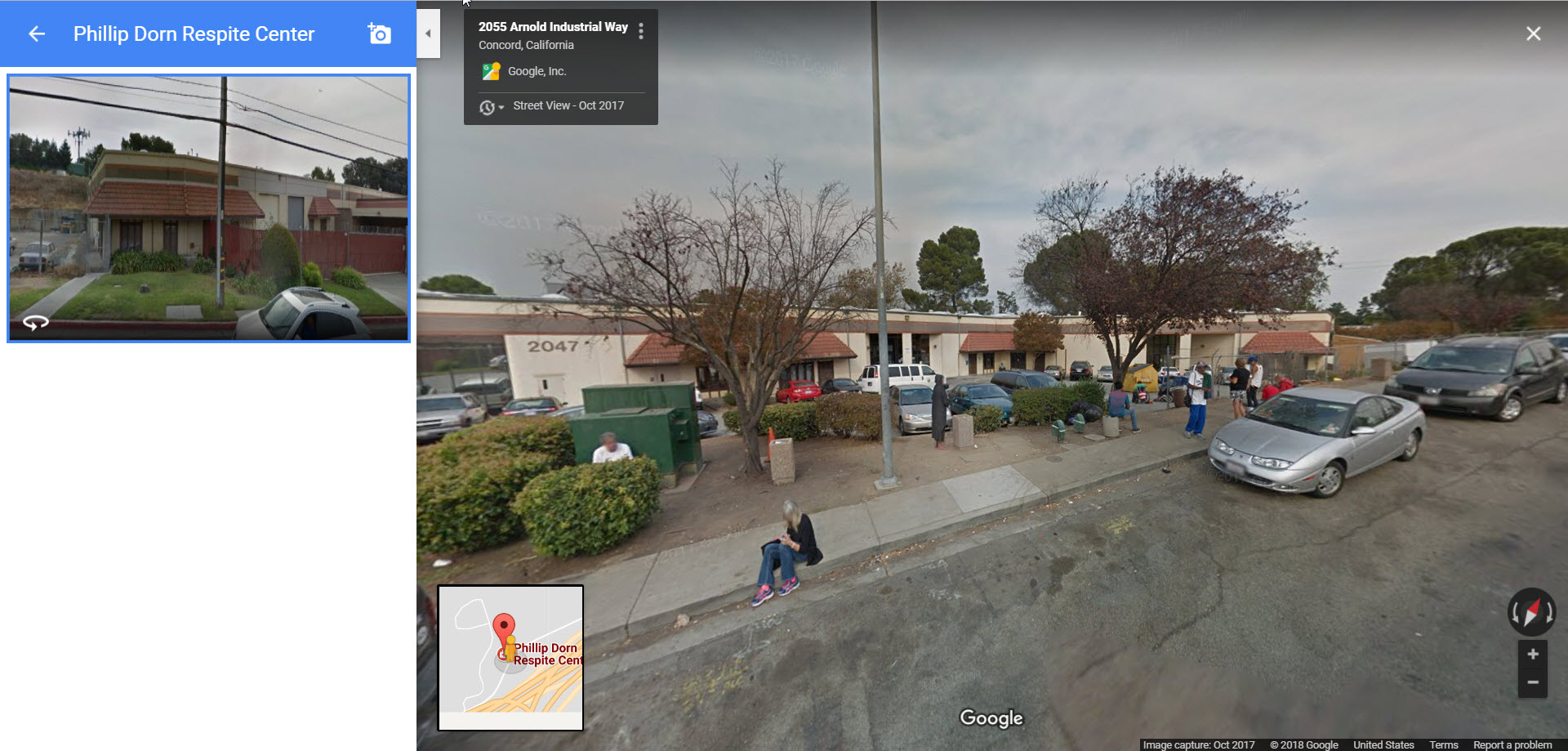
People are congregating outside of the Concord facility.
Although APC claims that this would never happen at Crab Cove, here are images from Crab Cove, April 2018 posted on NextDoor.com:

Homeless are already camping and sleeping at Crab Cove. Discarded needles litter the path. The concern is that the facility will attract more of this, not from patients being treated by the medical facility, but those waiting to make use of the resource center. It is quite possible that even APC recognizes this as plans for a warming center were removed from the facility. APC expects only 7-10 clients per day, but what is the remedy if that is not the reality?
The Crab Cove Visitor Center connects school children of all ages with the marine and shoreline life, as well as Alameda history. Mixing children with persons with serious health, drug, or mental issues is ill-advised. In addition, the facility would be located near Montessori, Paden Elementary, and Encinal High schools.
From NextDoor.com:
"8:00 AM. Just finished walking my dogs at Crab Cove, turquoise tent pitched behind the Park Webster apartments, Lower Washington bathrooms next to the low income housing. Then at the beach, 200 feet away, a young man with two toddlers had a fishing pole stuck in sand, line in the water. He was reading to the two youngsters from a book while waiting for a catch."
— Barbara Thomas, Gold Coast
Many of Alameda County's homeless are veterans who have served our country. Alameda Point is slated to have a Veterans Hospital. In appreciation of their service, closer proximity of the facility to the Veterans Hospital would offer symbiotic benefits.
McKay Avenue, its sidewalks, and its trees are in poor condition — not up to City code. APC reports that the road is currently owned and maintained by the state, and there are a variety of access easements under and across the road that need to be sorted out. Some of the utilities such as water and sewer are shared with EBRP and need to be separated out. The pump station is also part of the Federal property and needs to be better maintained and upgraded. APC thinks the long term maintenance and disposition of the infrastructure is a topic for all of the property owners on that avenue to work on.
To date, the City of Alameda has not claimed any responsibility for the avenue. Recently, the City would not even install a stop sign at the intersection of McKay and Central Avenues.
In addition to the infrastructure, long term, APC will be responsible for the upkeep of the facility. GSA is currently providing minimal upkeep. APC is discussing with GSA taking over maintenance and insurance for the site as soon as possible to avoid any deterioration of the facility. If APC lacks funds to even maintain the facility, how can they maintain the infrastructure?
The Department of Health and Human Services (HHS) has conditionally approved the project, and the Environmental Impact Report is already in progress yet opportunities for public comment have not been available. Nothing is on record with the Environmental Protection Agency (EPA) or the National Environmental Protection Act (NEPA). Public involvement in the National Environmental Policy Act (NEPA) and California Environmental Policy Act (CEQA) review process is critical for the overall framework of informed decision making. Public review serves as a check on accuracy in analysis. Public comments inform agencies about public opinions and values.
This is reminiscent of the process used in the allocation of the immediately adjacent Federal Property that was slated for developer Tim Lewis where voter outcry resulted in the property being allocated to the East Bay Regional Park District (EBRPD) for Crab Cove expansion.
Previous experience with the City of Alameda and "stakeholder input" on projects such as the Central Avenue lane reduction have been ineffective in mitigating issues that Crown Harbor faces. There is no guarantee that advisory group feedback will be considered in a deliberative manner and timeframe.
Although it is estimated that the City of Alameda has a few hundred homeless people, the City has designated 34 acres to APC on the former Naval Air Station to serve the homeless. With a few thousand homeless people estimated for Alameda County, what are the cities of Fremont, Hayward, San Leandro, Livermore, Pleasanton, Union City, Dublin, Newark, Albany, Emeryville, and Piedmont doing to provide wellness and respite for the homeless? Isn't the City of Alameda already providing its fair share? If no amount is too much, shouldn't the City's service locations be centralized on the former Naval Air Station?
Share Your Thoughts In Favor or Concern
- Provide Feedback to APC and GSA
Alameda residents are encouraged to ask questions and provide feedback.
- Review the Project Summary.
- Read the Community Presentation.
- Contact APC Executive Director, Doug Biggs (volunteered to answer any questions or concerns) at (510) 898-7849 or dbiggs@apccollaborative.org.
- Email GSA Program Manager of the Federal Real Property Assistance Program, Theresa Ritta.
At this point, in a settlement agreement between the State, EBRP, and the Federal government, the State and EBRP agreed that they will not interfere with the use or transfer of this property, and that GSA can develop transfer or convey the property as they see fit, which GSA has done.
- Contact the City
Alameda residents can email the City Council to express their support or objection to the project:
- Email Mayor Trish Spenser.
- Email Vice Mayor Maria Vella.
- Email Councilmember Marilyn Ezzy Ashcraft.
- Email Councilmember Frank Matarrese.
- Email Councilmember Jim Oddie.
- Contact the State
Alameda residents can email State officials to express their support or objection to the project:
- Contact Senator Kamala Harris.
- Contact Senator Dianne Feinstein. Use Government Affairs as the subject.
- Contact Representative Barbara Lee.
Crown Harbor community members can email EBRPD to inquire about the district's support or objection to the project:
As part of the settlement between the City, Tim Lewis Communities, and EBRPD, EBRPD agreed not to interfere in the disposition of the remaining Federal property in exchange for receiving the 3.89 acre parcel for Crab Cove expansion.
I, along with other concerned Crown Harbor residents, look forward to working with APC and other Alameda residents to address the issues while still bringing badly needed services to the homeless.