Politics & Government
Part 2: Decision-Makers' Revealing Questions About CV Growth Plans
A controversial new land use designation called "public facilities" would place new restrictions on Castro Valley schools and EBMUD.

This is Part 2 of a story published on Tuesday. To see the first story, click .
A park or houses? Open space or public buildings?
As Castro Valley grows over the next 15 to 20 years, the proportion of open space to development will in part be determined by decisions made this year by the Alameda County Planning Commission.
Find out what's happening in Castro Valleyfor free with the latest updates from Patch.
In dispute are lands owned by the and East Bay Municipal Utility District.
Neither district has immediate plans to sell land to housing developers or sell any land at all to anyone, officials of both districts say, though EMBUD had a high-end housing developer on the hook in 2006, before the housing market crashed.
Find out what's happening in Castro Valleyfor free with the latest updates from Patch.
But times change, and when they do, the Castro Valley Municipal Advisory Council wants the county to have a say in how those districts sell their land, if that occurs.
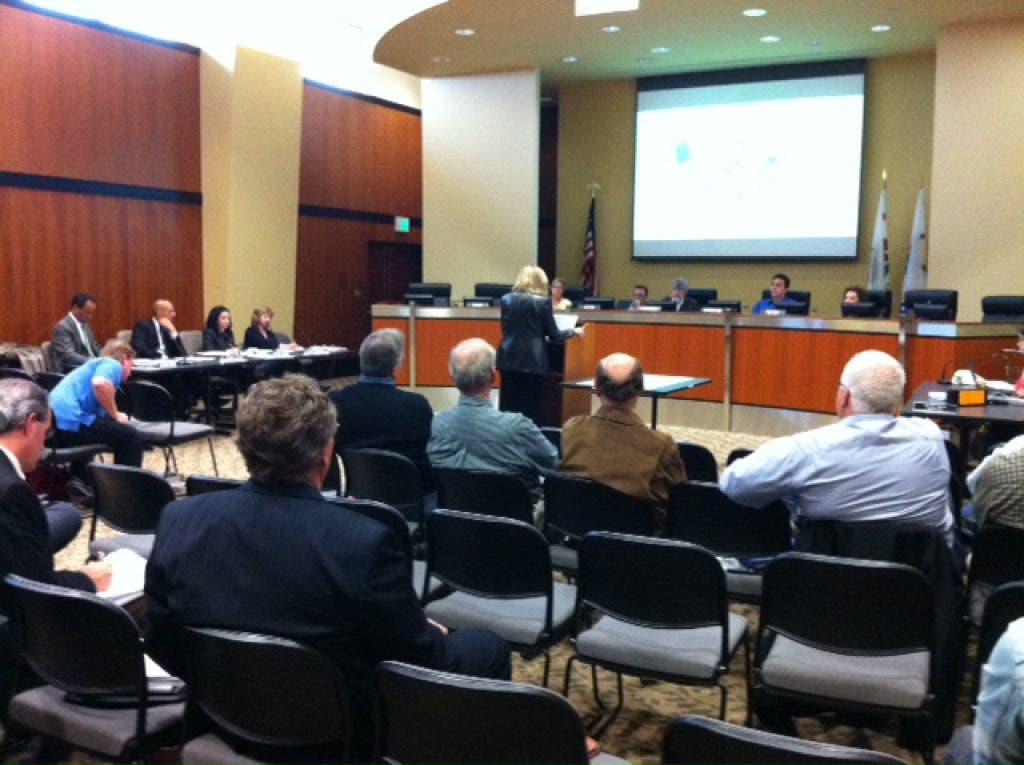
In effect, the mediators of this dispute are members of the Alameda County Planning Commission, four men and two women whose approval is needed before Castro Valley's blueprint for growth can move on for final approval by the Alameda County Board of Supervisors.
Questions raised after a public hearing on Monday night in Hayward revealed the thought processes of all but one of these commissioners in attandance and, in two cases, left clues about the direction they might be leaning at this point in time.
Here are a few highlights from the commissioners' comments and questions, mostly paraphrased but with some direct quotations:
Ken Carbone, one of two Castro Valley residents on the commission, appeared ready to back the MAC proposal without changes to accommodate requests from CVUSD and EBMUD. He spoke of decisions in the past that resulted in Castro Valley's losing school property when attendance was low and the district sold some of its land.
"MAC has spent a tremendous amount of time on this document," Carbone said, adding that it is a reflection of the community's preferences.
"This is coming from the community," Carbone said.
After the meeting, Carbone said the commission is nowhere near making a decision because too many questions remain unanswered.
Three of his fellow commissioners asked most of the questions on Monday.
Richard Rhodes, the other Castro Valley resident on the commission, asked Planning Director Albert Lopez about MAC member Cheryl Miraglia's comment in the public hearing. She said the proposed new "public facilities" category of land use had been described by county planning staff as "a new trend."
The proposed new "PF designation" would be applied for the first time to the schools and EBMUD, placing new restrictions on their land use decisions.
Lopez answered: "A lot of cities and counties are using the public facilities designation ... to allow additional community input on land when it goes out of the public realm into the private realm."
"It would put another step in their process, not take anything away from them," Lopez said.
After further questions, Senior Planner Sonia Urzua said: "The intent is not to create more open space as to preserve more public properties."
Rhodes commented that adding an extra step to the school district's or EBMUD's process "comes with a cost" and pointed out that this cost could be borne by the county, since it would be the countythat was requiring the extra steps.
Unrelated to the new PF designation, Rhodes raised another of the school district's objections, saying that one particular passage of the proposed plan that would give the county more say over school boundaries is "overkill."
Alane Loisel of Fremont was the commissioner who appeared least likely to approve the plan in its current form.
"You've devalued their land without them agreeing to it," Loisel said.
The PF designation would reduce the market value of any land that the schools or EBMUD might choose to sell.
In the school district's case, lowering the market value of the land could also lower the amount of money the schools can raise in a bond measure because schools often use property as collateral, even if they have no plans to actually sell the land.
The highest price for the land would come from a housing developer, as opposed to selling it to a county entity or to a park district (although it's common for cities and counties to require parks be built along with the houses).
"It's not going to have the same value," Loisel said.
"You can't do that," she said.
Her questions were about Measure Q ("What was that intended to do?") and how EBMUD acquired the Castro Valley land that would get the new PF designation.
Steve Boeri, real estate manager for EBMUD, said the district assembled the site by acquiring 25 properties one by one throughout the 1950s, through the threat of eminent domain.
Mike Jacobs of Oakland asked the most pointed questions and said he was "playing devil's advocate."
Like Rhodes, in addition to asking about the PF designation, he asked about proposed new language related to drawing school boundaries.
"Do we need this?" he asked of the same passage Rhodes described as "overkill."
About the PF designation, Jacobs said, "To plan on who owns property instead of land use is where it gets tricky" and "could be problematic."
Looking at comparisons of old and new plans, he said: "Almost all of these changes are either PF or open space."
"What's deficient in our current plan?" he asked. "What am I missing here? What's changed that makes this (previous plan without PF) deficient to us?"
Lopez, the planning director, said the new PF designation represents a "philosophical approach to community process." Lopez later said of the PF designation: "It's legal. It's community-driven. It has some merit."
Jacobs said that since the school board and EBMUD directors are elected, there already is public input that holds these bodies accountable to the public.
Jacobs asked for balance, rather than having "the county substitute its judgment for how the school district disposes of land." He said past experience shows that "where the planning is forced on other people," there are usually empty lots with weeds.
Jacobs pointed out a passage unrelated to the PF designation where he saw "no reason the county should be consulted."
Kathie Ready, the commissioner from San Lorenzo, did not speak during the meeting. Frank Imhof of unincorporated Pleasanton (Happy Valley) was absent. Glenn Kirby's term ended last year; a new commissioner will be appointed.
Get more local news delivered straight to your inbox. Sign up for free Patch newsletters and alerts.