Community Corner
Exploring Mysteries From El Toro History
When pursuing historical research, serendipity and a full tank of gas are always helpful.

Confession time: In my quest for El Toro & More topics, I’ve come across several that continue to be works in progress ... and might remain that way for some time.
It doesn’t take much to find the fixins for a month’s worth of columns. Filling in the gaps, however, can be quite another thing.
For example, not long after writing about , I came across a brief reference to a murder at one of the Community Hall dances. So, for weeks I combed through local publications and spent long hours trolling the Internet for more information ... to no avail.
Find out what's happening in Lake Forestfor free with the latest updates from Patch.
Needles In a Haystack
Conceding temporary defeat, I came up with a new topic and returned to the Saddleback Area Historical Society’s library at Heritage Hill Park. Within minutes, and quite by accident, I came across two mimeographed pages regarding one of El Toro’s pioneer families. So, being a curious sort, I had to take a look.
Find out what's happening in Lake Forestfor free with the latest updates from Patch.
And a good thing I did, for at the end of the first page, and embedded within a rather lengthy paragraph, was mention of the dance murder, the victim’s name, and the eventual fate of the man who pulled the trigger.
Rearmed with those details, new Internet research turned up a few more factoids. All the same, I’ve yet to find what brought about the tragedy, the name of the murder suspect, and whether he went to trial.
Another mystery? The exact date of Dwight Whiting’s ill-fated Second Real Estate Sale. According to both Clara Mason Fox and Joe Osterman, it was supposed to be the turning point in El Toro’s history ... the event that would turn a hamlet into a city. Honored speakers would be present, as well as an abundance of food and many other celebratory features.
Finally the Great Day arrived. Along with a sudden drop in temperature.
“It was so cold,” Osterman says in his Old El Toro Reader “that water dripping from the railroad depot’s water tank formed huge icicles, from the tank to the ground, ten feet long.” And Fox refers to it as “The Big Freeze.” But neither she nor Osterman include the date. Only a map from the Reader provides a clue, mentioning El Toro’s less-than-red-letter-day occurred in 1889.
My challenge, then, was to find the month and day. But after a great deal of browsing at the aforementioned SAHS library, as well as the El Toro Public Library, county libraries in Laguna Beach and San Juan Capistrano, and Mission Viejo’s city library, I came up with ... nothing.
On to Santa Ana
Obviously, desperate times call for desperate measures. And so last week I filled up my car’s gas tank and headed off to Santa Ana’s public library at 26 Civic Center Plaza.
Long ago, I’d used the library’s terrific history room to research what turned out to be a prize-winning essay about Santa Ana’s long-defunct Chinatown. But having moved out of that part of Orange County more than 15 years ago, I hadn’t been back to the Santa Ana library in ages. So, of course, there were changes.
Among them, the history room is now on the first floor rather than the second, and it’s open just three days a week. But the fabulous collection of books, directories, maps, and other documents remains accessible, although understandably for in-room use only.
And, by the way, those directories? They fill several shelves. Some are phone directories, but many are not, for the great majority of folks living here in the late 1890s and early 1900s had yet to purchase an Alexander Graham Bell. All the same, upon browsing a 1901 edition, I quickly found the El Toro section, containing many familiar names and addresses of families such as and . (Although the directory, alas, spells it “Prethero”!)
Another find—strictly for my own satisfaction—included a 1920s edition listing my own maternal grandparents, who at the time lived on a citrus ranch near El Modena, now a part of the city of Orange.
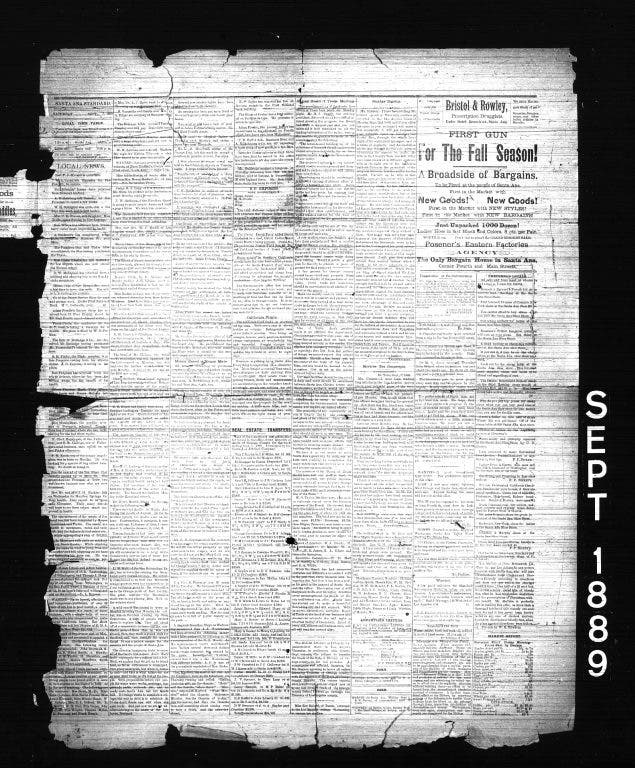
My objective, however, had been to research newspaper records. So I tore myself away from the directories and began searching through 1889 newspapers for any reference I could find to The Big Freeze.
Everything, of course, is on microfilm, because paper oxidizes and even the photographed versions are ragged and show signs of wear. But that was the least of my worries, for soon it became apparent that the 1889 collection, when filmed, very likely hadn’t been complete. Moreover, what was there would take hours to examine—and the library was closing in just half an hour.
Lemonade Out of Lemons
To quote a 1970 Stephen Stills song, “If you can’t be with the one you love, honey, love the one you’re with.”
With that philosophy in mind, I reviewed pages from the Sept. 7, 1889, Santa Ana Standard—one of five or six newspapers published in the city at that time—and found, among many other things, the following: a daily train schedule; lists of real estate transactions; reports of who was out of town and who had just returned; two deaths: one consumption, the other dropsy; an ad featuring "Ladies Hose in fast Black and Colors, 8 cents per Pair"; a wedding notice; mention of the previous week’s earthquake; a citizens’ pursuit of “Morales the Desperado”—he had supposedly boarded the train at Capistrano, a rumor that turned out to be false—plus the following optimistic report, under the headline “California Fruits”:
The California fruit trade is growing all the time. With every year it about trebles in volume. Refrigerator cars alone make it possible. They bring us oranges, lemons, peaches, pears, apricots, plums and grapes, all wonderfully big and beautiful. Freight charges run from three to four hundred dollars a car, and the trip is made in seven to eight days.
Business is picking up in Santa Ana. Everything is improving. More freight is coming than usual, more strangers are daily arriving than for months past. Real estate trade is getting brisker, deeds and conveyances are accumulating on the recorders hands amazingly, people are settling up old debts and accounts, and some are actually paying these debts in cash. In fact the outlook is cheerful and we feel encouraged over the prospect for the next six months. A little more time, and a little more patience, and Santa Ana will again ride on the right waves of prosperity.
Aha. Proof positive that, as the old truism goes, “The more things change, the more things stay the same.”
So stay tuned. I’m not sure how many more Santa Ana History Room sessions it will take. But sooner or later, I’ll sleuth out the information and bring you as much as I can find about the Community Hall Murder and the 1889 Big Freeze.