Politics & Government
Lake Forest Animal Network. Part 9 - More Errors
Errors, more errors, half-truths - is there something else going on here?

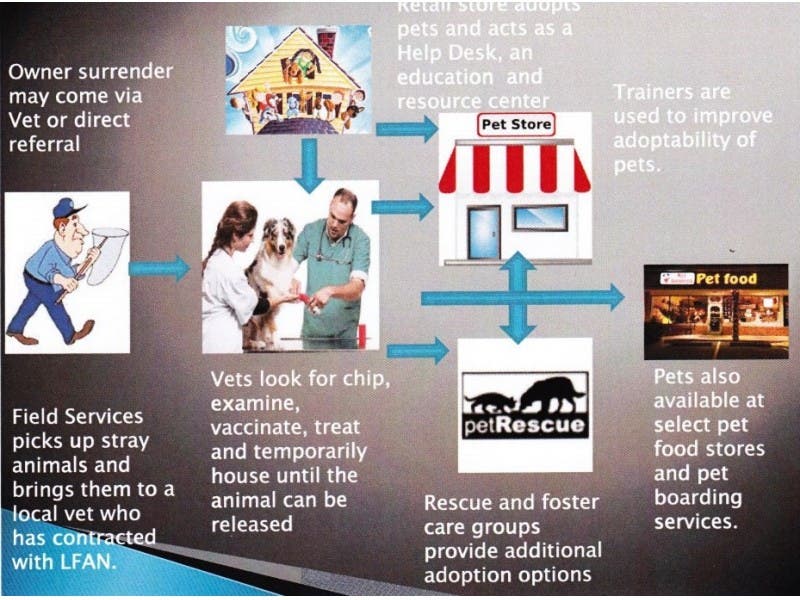
Sunday I showed where the discrepancies in data between the staff report and our proposal came from, and I identified several major errors which staff made in capacity analysis, which in turn, impacted their budgetary and functional analyses. Today I’ll focus on more errors made in projecting revenues and expenses, and then address the staff’s conclusions.
TRANSITIONAL AND START UP COSTS
The City estimates that “transitional and start-up costs” will be somewhere between $296,000 and $363,000. They contrast this with the $152,000 estimate used in the original proposal, although the more recent versions estimated start-up costs at $208,000 and transition costs at $203,250.
Find out what's happening in Lake Forestfor free with the latest updates from Patch.
But there are many errors in the staff report -
- · Staff label this section of their report as “Transitional and Start-up Costs” but in fact they have only looked at Start-up Costs. If they can’t get this right, imagine what else they got wrong. Read on!
- · Staff claims that “tenant improvements…are likely to be higher than initially anticipated” but this does not coincide with the experience of the Pet Adoption Center recently opened in Laguna Hills. Volunteer help can do a great deal to reduce tenant improvements, and tax deductions can also be used to induce a landlord to lower the costs. Their estimates ($40,000 to $60,000) are, to be kind, way out of line. In fact our estimates ($25,000) may be on the high side due to donated labor and materials. In any event, remove $15,000 to $35,000 from their figures.
- · Staff lists $30,000 to $50,000 in consulting costs. This is so ridiculous that it hardly warrants mention. Many of the finest consultants in the country are available at a minimal costs, and many would do it for free. We have several close to home who would do it for free. If you absolutely needed to put this in as a budget item, $5000 would be more than enough to cover the expenses. Remove $45,000 from their estimate.
- · Cage costs – I estimated dog cages at $100 each and cat cages at $75 each. The staff doubled this figure. Click here for the price of dog cages and Click here for cat cages to get the true estimates which are even less than I quoted. Doubling my prices is just indefensible, unless you are trying to distort the figures. Now bear in mind that it is probably possible to get all the dog and cat cages we will need donated for free. Because there is no guarantee, I listed retail prices. Reduce the staff estimates by $7,000.
- · Marketing materials – by mistake I listed them twice. I corrected it in the latest version, but staff continued the error. This added $5000 to their estimates. Take it off.
- · Washer/Dryer – This is a good item. I’m almost 100% cartain this item would be donated and hence would cost $0. But if you wanted to add in a washer/dryer you’re looking at about $2000 (Click here). Why you would spend $15,000 for a commercial washer/dryer when you are going to handle the needs of 6 to 10 animals per day? Perhaps because you wrongly estimated the capacity? Reduce their figures by $13,000.
The bottom line is that this entire section provides nothing useful. The cost estimates in the proposal stand. $208,000 is about how much the start-up will cost.
Find out what's happening in Lake Forestfor free with the latest updates from Patch.
SECTION 12 – CONCLUSIONS
ALL INCLUSIVE
The report says – “The proposed program is unique in that it suggests a contract with a non-profit agency for virtually all animal care services without a traditional shelter.” (Page 51)
Although that was true of the original proposal, after discussions with staff shortly after submitting the proposal we all agreed that a better model was to keep animal control and licensing within the City and provide animal care through the nonprofit. Why this comment even appears is questionable, along with many other questionable comments.
This model has been successfully used in various agencies, as the staff report indicates.
Conclusion – reject the comment because it isn’t true.
ECONOMIES OF SCALE
The report says – “Given the program’s decentralized nature, it likely lacks the economies of scale of a larger countywide or multi-city program formed through a JPA. Consequently, because the costs are borne entirely by one agency, the program becomes relatively less cost-effective.” (Page 51)
This comment reminds me of the report the City did a few years ago and only talked about the costs of a shelter, ignoring completely the revenues. Just as the expenses are borne by one agency, so too the revenues come to the one agency. There is no need to contribute to the enormous overhead that keeps OCAC functioning, so there are enormous savings in this regard. There is also an incentive to maximize revenues, something OCAC lacks because any shortfall on revenues must be made up by the cities.
Economies of scale are not necessarily the best model to use, and in industries where quality of product or service is at a premium, it can be a detriment. Think of your very favorite places to eat when you want a really good meal. How many of them are part of a major chain? Think about whom you call when you want quality home repairs. How many of them work for a major chain?
If all you want is a cheap and fast hamburger, McDonald’s and other companies that have economies of scale are the place to go. When the issue is quality of product or service, economies of scale are not the best differentiator.
Conclusion – reject comment because it is incomplete (doesn’t discuss revenues) and does not apply to issues of quality and service.
REVENUE STREAM
The report says - “Although staff spent a considerable amount of time researching the potential estimated range of revenues and expenditures, a more precise estimate would require, at some point, a systematic fee study to understand actual potential revenue streams if the Proposal is advanced.” (Page 51)
This is true, a “more precise estimate” would be great, if it were possible. I’m pretty confident that the revenue stream (as well as the expenses) has been delineated so that a final “fee study” will come in close to the projections. In a similar fashion, when the staff independently analyzed my conclusions about intake, outcome, and capacity, the agreement was sufficiently high enough to say that they were compatible.
What the staff report does not mention, to the City’s detriment, is that the revenue stream for OCAC is also unknown. No one knows what they are going to charge us. In fact, if we know anything, we know that OCAC’s projections are inaccurate - they just charged us $60,000 because their revenue stream projections were in error.
Why should LFAN be punished because the revenue stream is not “known” when, in fact, the revenue stream cannot be known for OCAC or anyone else?
Conclusion – accept the comment that a “final fee” study would be nice, but reject the conclusion that this issue penalizes LFAN when compared to OCAC.
SUMMARY
The City report is disappointing, but it isn’t the first time the City delivered a subpar report. Perhaps my standards are just too high. I like valid and reliable data analysis and conclusions that are based on the data. I like supporting documentation that justifies, to the extent possible, the facts being presented. For example, if staff tell me it’s going to cost $200 for a dog cage (page 50), I get upset when I find prices under $100 and when I know that many times dog cages will be donated. If staff tells me that capacity is going to be as high as 20 animals per day (page 29), I get upset when I see that the animals being counted include animals in quarantine, animals waiting to be returned to their owners, etc. When they claim we will have 10 dogs at the adoption center (page 35) but the data says there will never be more than 8, I wonder what’s going on.
Conclusions based on bad math, errors in analysis, errors in cost estimations, incomplete analyses, one-sided views, etc. are conclusions that help no one. It’s great to see that the staff spent so much time on their report, but it adds very little to the proposal.
As a conceptual model, the proposal to be complete still requires modification by the staff, meetings with potential participants, updates with 2015 data which still isn’t available from the County, legal opinions with regard to liability, suggestions from our two neighbors who manage successful shelters, etc. There is probably a month’s work of work to be done before RFPs could be issued. That being said, the model itself is valid. The data being used is far more extensive than data used in almost any other needs assessment study (e.g., Harvey Rose 2007 study of Upland, Silver Petrucelli 2014 study of Central Naugatuck, Citygate 2014 study of San Marcos, Oceanside, and Escondido), and the projected expenses and revenues suggest that a higher quality service and far better care can be provided at a comparable cost to what we are now spending.
ABOUT THE AUTHOR
Dr. Jim Gardner is on the City Council for Lake Forest. You can check him out on LinkedIn and/or Facebook and you can share your thoughts about the City at Lake Forest Town Square on Facebook. His comments are not meant to reflect official City Policy.
Dr. Gardner has office hours every Tuesday from 4 pm to 6 pm at the City Hall. In addition, he holds a Town Hall meeting every quarter. The next meeting will be on March 26 at 2 pm at the Foothill Ranch Public Library.
n_���@�