Politics & Government
OC Animal Control - Death and Distance - Part 2
Studying the relationship between distance and death

Last week I discussed the fact that I was working on the RFP for animal care in Lake Forest and came upon what looked like a large number of animals who arrived at the OC shelter dead.
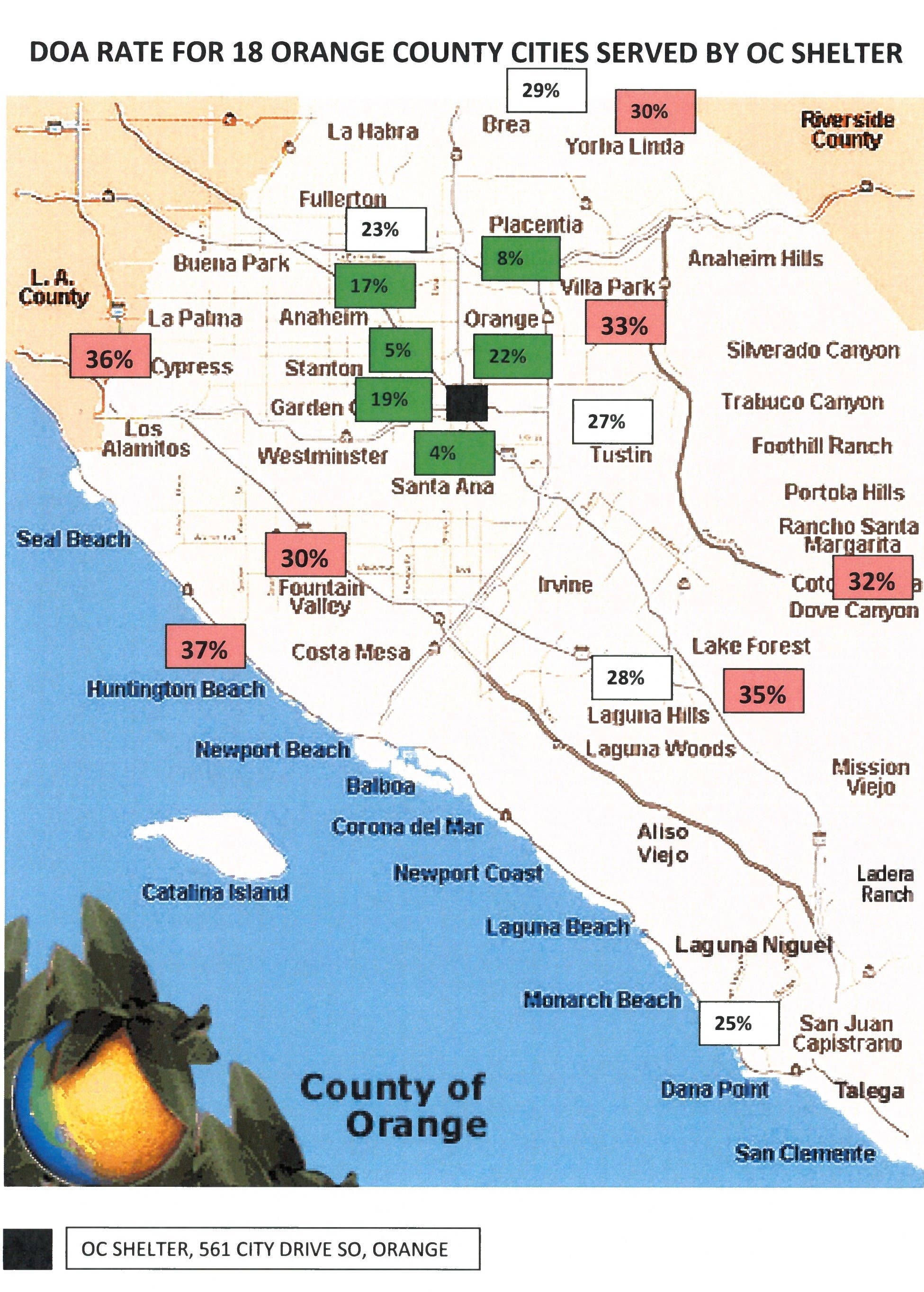
The finding of so many animals Dead on Arrival (DOA) led to a study of the DOA rate by distance, for all 18 cities managed by the County. (See map accompanying this article) Distance was measured from the individual City center to the OC shelter. DOA rate was calculated by taking the total number of animals admitted (“Total Intake”) divided by the number who arrived dead (i.e., “Deceased Animal Impound”). Click Here to see the original document from which the figures were taken.
Here are the results -
Find out what's happening in Lake Forestfor free with the latest updates from Patch.
- · For the half of the 18 cities closest to the shelter, the average distance was 5.7 miles and the average DOA rate was 16.3%
- · For the half that were farthest away from the shelter, the average distance was 16.4 miles and the average DOA rate was 33.9%
The chances of an animal arriving dead were more than twice as high for cities farthest away from the shelter.
Taking the 6 closest and the 6 farthest cities (in other words, the top 1/3 and the bottom 1/3) the differences were even greater. The distances were 4.6 vs. 19.1 miles and the DOA rate was 15.1% vs. 34%. In this comparison the furthest cities had a DOA rate 2.3 times higher.
Find out what's happening in Lake Forestfor free with the latest updates from Patch.
These unfortunate cities are
- · San Juan Capistrano – 26 miles, 25% death rate
- · RSM – 24.9 miles, 32% death rate
- · Laguna Hills – 19.2 miles, 28% death rate
- · Lake Forest – 17.2 miles, 35% death rate
- · Huntington Beach – 14 miles, 37% death rate
- · Yorba Linda – 13.6 miles, 30% death rate
For the County as a whole, the DOA numbers in 2013 were 1,169 dogs, 2,171 cats, and 3,682 "other " for a total of 7022 out of 35,399 or 20% overall.
It’s bad enough when the largest single way of being released from the Orange County shelter is to be killed. In 2014 (the latest figures available on the County website), 9,982 animals who entered Orange County shelter were killed - 3,498 of them were killed because they were “too young”, which means that the staff did not have the resources to care for them. Only 7,951 got adopted, which is the second most likely way to leave the OC shelter.
Now we learn that many more die before they can even reach the shelter, either in the field waiting for Animal Control to arrive or were picked up alive and died in transit. Though that might be expected to some degree, the farther away your home is from the one single shelter, the more your beloved pet’s chances of dying before they reach them or dying in the truck.
Some of the animals picked up by animal control were already dead, and some were dead even though someone thought they were alive when they called. This would be no fault of animal control, yet if this factor accounted for a substantial number of animals, we would not find the high correlation between distance and DOA.
It can also be argued that some of the animals were alive when the County was called, but died before the animal control truck got there. That’s indeed possible since animal control sometimes has to cover vast areas and their response time is slow as a result. This can account for the high correlation but it reinforces the need for local shelters that are closer to cities, rather than the single shelter that the Supervisors are trying to build with one animal control officer handling South Orange County.
Needless to say other variables (e.g., population, ethnicity, density, proximity to open spaces) may be at play as well as distance. South Orange County where the DOA levels are particularly high differs not only in distance but in ethnicity and in proximity to open space. Yet if you eliminate South OC from the analysis, the relationship remains similar. Those cities farther away from the single shelter in Orange (i.e., Huntington Beach, Cypress, Fountain Valley, Tustin, and Villa Park) still have the highest DOA rates.
The bottom line is that there is a very disturbing trend that the further away your City is from the single shelter, the more likely your animals are to arrive dead. The only plausible explanation for this is that the ability of animal control to respond quickly and the long time it takes to get an injured animal from distant areas to the single shelter are the causal factors. Alone, in a dark truck where the a/c may be inoperable, the long trip to the County shelter constitutes the last few minutes for the lives of hundreds of animals. This is shameful.
The County Supervisors are hell bent on building a new single shelter which will do nothing to end this tragedy. Along with every other piece of evidence put before the Supervisors, this latest study strongly suggests that the people of Orange County are better served with regional shelters, something every other County of our size has.
ABOUT THE AUTHOR
Dr. Jim Gardner is on the City Council for Lake Forest. You can check him out on LinkedIn and/or Facebook and you can share your thoughts about the City at Lake Forest Town Square on Facebook. His comments are not meant to reflect official City Policy.
Dr. Gardner has office hours every Tuesday from 4 pm to 6 pm at the City Hall. In addition, he holds a Town Hall meeting every quarter. The next meeting will be on August 13 at 2 pm at the Foothill Ranch Public Library