Neighbor News
The Sky Over Eastern US and Canada Is Burning—And That’s a Warning for All of Us
One would think the Santa Ana Winds existed in the East Coast of the US if one is not careful on the context

The Sky Over New York Is Burning—And That’s a Warning for All of Us
I remember the first time I saw wildfire smoke turn the sun the color of blood. I was visiting friends in California during the October 2020 firestorms, watching the Santa Ana winds whip embers across canyons like malevolent fireflies. Back then, wildfires felt like a Western problem—something that happened to people who lived in drought-parched hillsides, not to those of us in the humid East. That comforting illusion shattered this week.
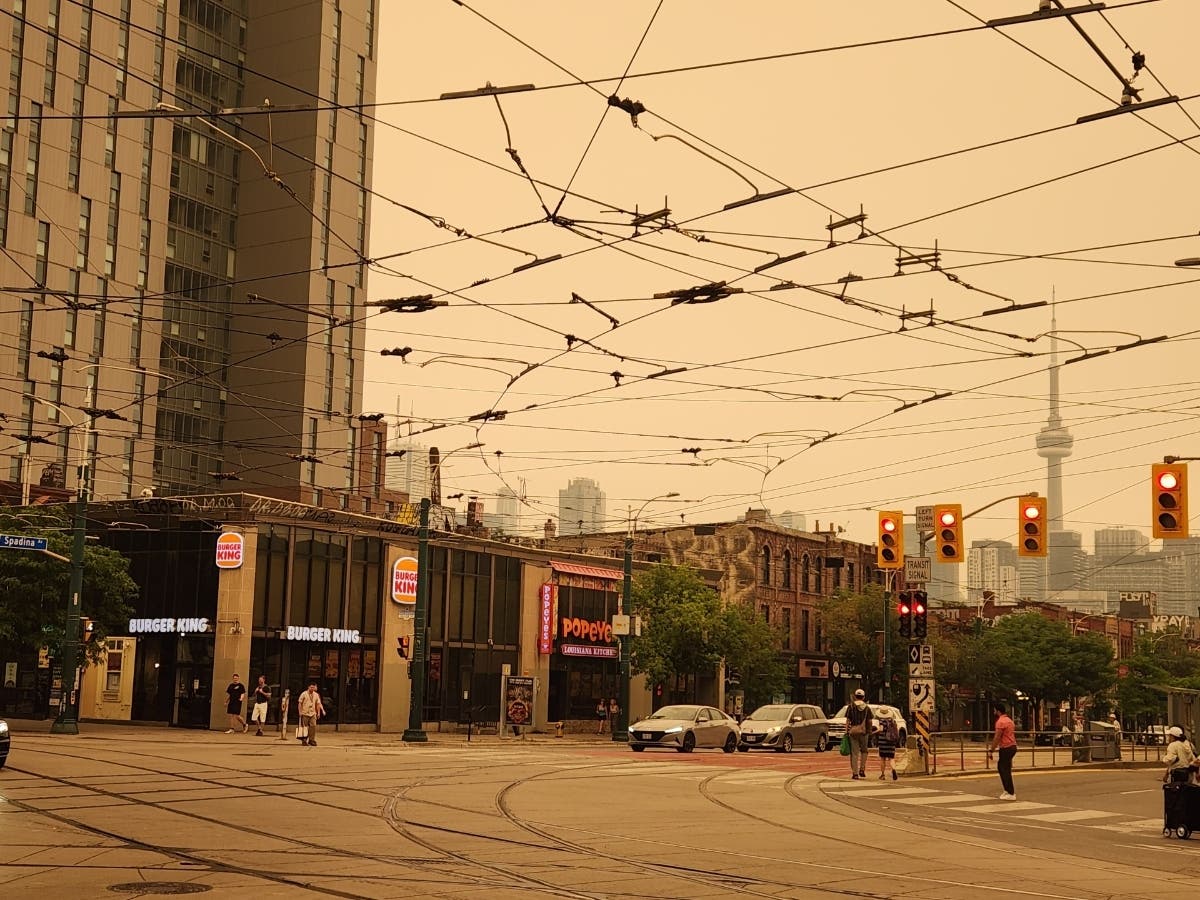
On July 15, 2026, I looked up at the sky over New York City and saw something that should have been impossible. The sky wasn't blue. It wasn't gray with ordinary clouds. It was a sickly, apocalyptic yellow-orange—the kind of color you expect to see in a science fiction film about ecological collapse. The sun was a dull copper coin hanging in a murky haze. And yet, there were no fires anywhere near New York. The nearest flames were more than a thousand miles away, burning through the boreal forests of northwestern Ontario.
Find out what's happening in Los Angelesfor free with the latest updates from Patch.
That smoke had traveled more than 1,000 miles to reach me. According to NASA satellite imagery, the plume stretched from western Canada all the way to coastal North Carolina—a swath measuring more than 5,000 kilometers, or 3,100 miles. By Thursday, more than 100 million Americans from the Great Lakes to the East Coast were under air quality alerts. In Detroit, the air quality was ranked the worst in the world. In Cleveland, fine-particle pollution hit 452 micrograms per cubic meter—nearly 13 times the level considered unhealthy. Visibility in some places dropped to half a mile.
This is not a California issue. This is not a Western issue. This is a North American issue, and anyone who thinks they are safe from wildfires because they don't live near a forest fire zone is dangerously mistaken.
Find out what's happening in Los Angelesfor free with the latest updates from Patch.
## The Sky Is Not the Limit
What stunned me most about this week's smoke invasion wasn't just the distance—it was the altitude. Wildfire smoke doesn't simply drift lazily across the border like fog rolling in from the ocean. It rises. It rises thousands of feet into the atmosphere, where the jet stream grabs it and hurtles it across the continent at speeds that would make a Santa Ana wind blush.
The science is remarkably simple and terrifyingly effective. When a wildfire burns hot enough, it creates its own weather. Pyrocumulonimbus clouds—fire thunderstorms—can punch smoke particles all the way into the stratosphere, 13 to 17 kilometers above the Earth's surface. Once there, the smoke is caught in the planetary-scale river of air that circumnavigates the globe. Smoke from Canadian fires has been tracked crossing the North Atlantic to Spain, France, and central Europe. What we experienced this week wasn't an anomaly—it was a preview.
In Northeast Ohio, this week's smoke event set off what experts described as "one of the region's most severe air-pollution events on record". Bryan Sokolowski, chief of monitoring with the Cleveland Division of Air Quality, noted that while Canadian wildfire smoke has wafted into the region before, "it has never been this bad". The smoke didn't just dim the sun—it sent fine-particle pollution soaring to levels that pose serious health risks for everyone, not just sensitive groups.
The Santa Ana Wind of the East
Californians know the Santa Ana winds intimately. These hot, dry, downslope winds howl out of the desert toward the coast, turning ordinary brush fires into infernos that consume entire neighborhoods. They are the signature weather phenomenon of California's fire season—the reason why the state's wildfires are so notoriously destructive.
But here's what I realized watching that yellow sky over New York: the Santa Ana winds are not the only wind pattern that matters. They are just the most famous one. The winds that matter for the rest of North America are the upper-level jet streams—the same winds that carry weather systems from the Pacific to the Atlantic. And this week, those winds aligned almost perfectly to carry a plume of smoke more than a thousand miles from Ontario directly into New England. The jet stream didn't fan the flames—it fanned the smoke, turning a regional disaster into a continental one.
This is the overlooked danger that the eastern United States faces. When a wildfire burns in California, the smoke often gets pushed out over the Pacific Ocean or trapped against the mountains. But when a wildfire burns in Canada's boreal forest—where more than 850 fires were actively burning this week, including more than 180 in Ontario alone—the smoke has a direct pipeline into the heart of the continent. The jet stream carries it southeast over the Great Lakes, through the Midwest, and down the Eastern Seaboard. It's a fire-smoke conveyor belt, and it's running more frequently than ever.
A Continental Crisis
Let me be blunt: wildfires are not just a California problem, and they haven't been for a long time. In 2023, smoke from Quebec wildfires blanketed the U.S. East Coast in what became one of the most significant air quality crises in modern American history. This year, we're seeing a repeat performance. The 2026 fire season in Canada has already burned 1.9 million hectares (4.7 million acres)—an area nearly the size of Slovenia. The U.S. has fared no better: close to 40,000 fires have torn through more than 3.6 million acres so far in 2026, including half a million acres in the last two weeks alone.
The fires are burning everywhere—California, Oregon, Colorado, Utah, Minnesota, Idaho. In Canada, the trend has been particularly alarming. Laura Chasmer, a professor of geography and the environment at the University of Western Ontario, told the BBC that while wildfires are a natural part of the boreal forest's life cycle, they "have become more frequent since 2015". Fires that used to burn primarily in western Canada are now migrating eastward, with large fires burning in Ontario, Quebec, and even Atlantic provinces. That means more smoke—and more of it reaching the densely populated cities of Toronto, New York, Chicago, and Boston.
The connection to climate change is undeniable. Rebecca Saari, associate professor of civil and environmental engineering at the University of Waterloo, told the Cleveland Plain Dealer that "climate change has increased wildfire activity in the U.S. and Canada". A 2024 study concluded that climate change set the stage for the extreme fire conditions experienced in Quebec in 2023, making the intensity of those weather conditions at least twice as likely and their severity seven times more likely because of anthropogenic climate change. Hotter temperatures lead to more evaporation and drier conditions, which in turn create more fuel for fires.
The Invisible Killer
What worries me most about this smoke isn't the haze or the yellow sky. It's what we can't see. The biggest health threat from wildfire smoke comes from microscopic particles known as PM2.5—particles so small that they can penetrate deep into the lungs and even enter the bloodstream. These particles aren't just irritating; they're dangerous. They can worsen asthma, trigger heart disease, and cause inflammation that aggravates diabetes and other chronic conditions.
The health toll is staggering. A study published in the journal Nature in 2025 estimated that 82,100 deaths occurred prematurely in 2023 as a result of chronic smoke exposure—including 33,000 in the United States alone. That's not a Western problem. That's a national tragedy.
This week, air quality alerts stretched from Michigan and Minnesota to New York and Washington, D.C.. In New York City, the mayor activated air quality emergency protocols and made KN95 masks available citywide. The message was clear: this smoke is not a nuisance. It's a public health emergency.
A Wake-Up Call for the East
For decades, Americans east of the Mississippi have watched California's wildfire seasons with a mix of sympathy and detachment. We donated money. We sent thoughts and prayers. We shook our heads at the footage of houses burning in the Santa Ana winds. But we never really believed it could happen to us. We don't have the dry chaparral. We don't have the downslope winds. We have humidity and rain and green forests that don't burn like kindling.
But we do have the jet stream. And we do have a warming planet. And we do have Canada—a nation whose boreal forests are increasingly becoming a tinderbox. The combination is a recipe for disaster.
The 2026 Canadian wildfires may not be as extreme as 2023 or 2025—yet. But the trend is clear. Fire seasons are starting earlier and lasting longer. "Zombie fires" are smoldering through the winter and re-igniting in the spring. The likelihood of extreme fire weather is being multiplied several times over by climate change. And the smoke is traveling farther than ever before.
This is not a problem that can be solved by better forest management alone—though that certainly helps. This is a problem that requires us to confront the root cause: a warming atmosphere that is drying out forests and creating the conditions for catastrophic fires across the entire continent. As Canadian Prime Minister Mark Carney said this week in response to criticism from U.S. lawmakers, both countries have a responsibility to fight climate change.
A Shared Sky
I ended this week by stepping outside one more time, just to look at the sky. The haze had thinned, but the air still smelled faintly of smoke—the acrid, unnatural smell of a forest burning a thousand miles away. I thought about the firefighters in Ontario who were battling blazes that had already forced evacuations in several communities. I thought about the millions of Americans who had been told to stay indoors. I thought about the 33,000 people who died prematurely in 2023 because of smoke just like this.
And I thought about how easy it is to believe that someone else's disaster is not our disaster. That California's fires are California's problem. That Canada's fires are Canada's problem. That if we just live far enough away, we'll be safe.
We are not safe. The sky over New York proved that this week. The smoke that traveled 3,100 miles from western Canada to the coast of North Carolina proved that. The hazardous air quality that forced millions to stay indoors proved that.
Wildfires are not a California issue. They are not a Western issue. They are a North American issue—and until we start treating them that way, we will continue to be surprised when the sky turns yellow, the sun dims to copper, and the air we breathe becomes a threat to our health.
The Santa Ana winds have long been the symbol of California's fire danger. But for the rest of us, the jet stream is the wind we need to watch. It's carrying more than weather. It's carrying smoke. It's carrying a warning. And it's time we started listening.
---
*Blog Design is a writer on Patch. The views expressed here are solely those of the author.*