Community Corner
Vaccine Passports: Do Californians Support Them? Patch Survey
We asked Patch readers to weigh in on whether they were for or against vaccine passports in California. See how they voted.


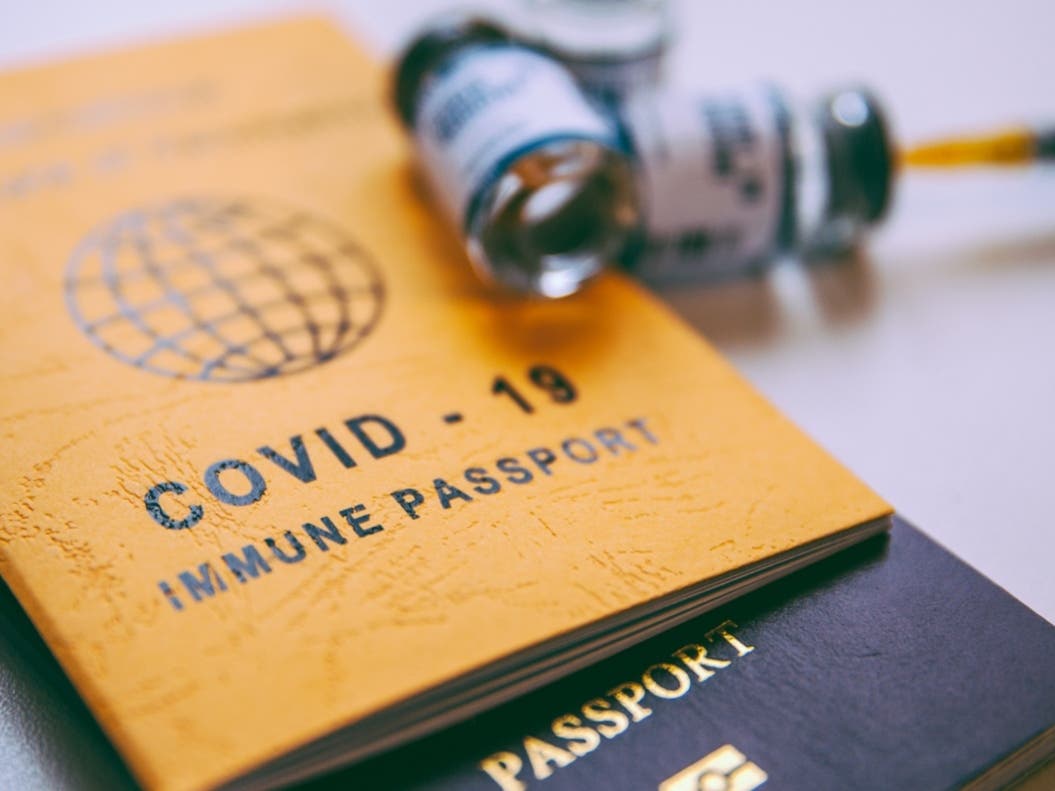
CALIFORNIA — As California's long and embattled road to vaccinating its residents picks up speed, the idea of vaccine passports has entered discussions to return to some semblance of normalcy.
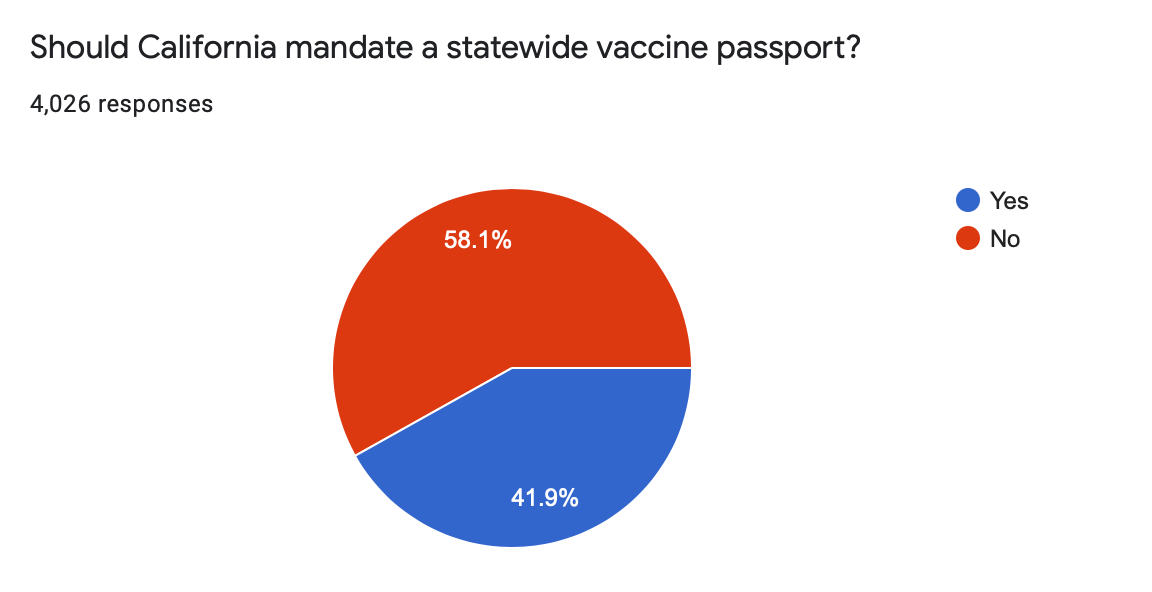
While California leaders haven't announced official plans to officiate such a passport, Patch asked readers last week to weigh in. The survey, which appeared in questionnaire form this week on Patch, is meant not to be a scientific poll but only to give a broad idea of public sentiment.
In the recent non-scientific survey, 58.1 percent said they were against California mandating a statewide vaccine passport. Nearly 42 percent said yes, California should mandate the passport.
Find out what's happening in Los Angelesfor free with the latest updates from Patch.
"We need to get rid of this pandemic," one respondent commented. "Those that don't want a vaccination and that will keep the pandemic going should no longer be allowed to infringe on the rights of those that are vaccinated and want to move on with their life. Vaccination passports would help in this regard."
When asked whether participants had data privacy concerns around the use of a California coronavirus passport, 80.2 percent answered yes and 19.8 percent said no.
Find out what's happening in Los Angelesfor free with the latest updates from Patch.
"[I] do not mind having to show passport but do mind if the information is collected and used for other means or methods," a participant said.
Among the specific concerns named by 1,209 surveyors was privacy of medical information, government overreach and loss of freedom.
"Citizens are not required by law to take the vaccine," one respondent commented. "If a venue wants to know if they have taken it, ask them. People deserve respect and consistency in government."
Some 89.7 percent of respondents said residents should never have to show proof of vaccination and 10.5 percent said they would support a vaccination record card issued by the Centers for Disease Control and Prevention.
Just 1.2 percent were in favor of a federally issued vaccine passport.
An overwhelming 94.4 percent answered no to "are you in favor of any kind of state mandated policy surrounding proof of vaccinations. Just over 3 percent said they would be in favor of this policy.
Some 73.7 percent of respondents said they do not believe employers or businesses should be able to require proof of vaccination while 26.3 percent said they should be able to.
On the subject of school reopenings, 88.5 percent of respondents said they don't believe schools should require students to show proof of coronavirus vaccinations — 11.4 percent said they should.
Some 87 percent also said teachers should not have to show proof of vaccination to work in classrooms while 13 percent said they should.
When asked "Would you feel safer attending an event or eating at a restaurant knowing that others around you have been vaccinated for COVID-19?" 72.4 percent said no, 13.5 percent said maybe and 9.3 percent answered yes.
For the past year, temperature checks and coronavirus testing have become routine for some businesses. Some 66.5 percent of respondents in the survey said they were not in favor of these continued health screenings while 33.5 percent said they were in favor.
More than 88 percent said vaccinations should not be required for air travel — whether it's domestic or international — and 11.8 percent said they should be required.
For those who were in favor of the passport, respondents said settings such as gyms, restaurants, theaters, sporting events and airports were some of the places they named appropriate to show a passport.
"Proof of vaccine has been around for decades and was required for travel in some regions in the past," one respondent commented.
"Vaccine passports should absolutely be required. States that ban them are stupid! I will voluntarily get one if they are offered," another respondent said.
Many also expressed great concern about "choice" and government overreach.
"I myself have been vaccinated, however, I feel that this is crossing a line," one person said.
"Vaccines are optional and should remain that way. It should be a personal choice," a participant said. "However, those that took the vaccine should be able to conduct in normal fashion with no masks."
Some felt very strongly about enforcing the vaccine passport, arguing that it's the only path back to normal life.
"If someone wants the benefits of a non-Covid environment, the price to pay is being vaccinated and showing a passport," one respondent said. "Yes, my stance is harsh, but I want the world to go back to some semblance of normal again."
After the announcement that indoor events would resume in California, health officials said that verification of vaccination or testing could be required for some large venues to host guests. So far, the state hasn't offered further guidance on how that suggestion will be enforced.
For example, a stadium could sell hundreds of tickets for a concert, but attendees may have to provide proof of a recent negative test or a vaccination card.
California's health secretary, Dr. Mark Ghaly, said last week that the state has no plans to develop its own vaccine passport. But the state has been unclear just how businesses will be able to fully open by Gov. Gavin Newsom's target June 15.
The state's announcement detailed that businesses may reopen on June 15 with limited public health restrictions, such as….testing or vaccination verification requirements for large-scale higher-risk events."
READ MORE: Vaccine Passports In CA? Answers To Your Questions
This week, every Californian over the age of 16 will become eligible for a vaccine — a major advancement in the state's sluggish rollout. And although there is currently no requirement to show proof of vaccination anywhere, the state is reopening rapidly.
All but two of California's 58 counties were able to move out of the state's most restrictive, purple tier on the reopening map recently, with 16 more counties moving out of restrictive tiers last week.
As of Wednesday, almost 80 percent of Californians were living under the orange tier, with 18.7 percent living under the red tier — the furthest the state has been able to reopen since the pandemic hit the West Coast.
"It is incumbent upon all of us not to announce, 'Mission accomplished,' ... but to continue that vigilance that got us where we are today," Newsom said. "We are seeing bright light at the end of the tunnel."
SEE ALSO: How To Get The Coronavirus Vaccine In California
California's coronavirus data as of Sunday, April 11
- 3,600,178 total confirmed cases have been reported to date, with 4,954 new cases reported Sunday.
- 1.6% was the 7-day positivity rate as of Sunday.
- 56,363,675+ tests have been conducted in California.
- 59,218 COVID-19 deaths have been reported since the start of the pandemic.
- 22,777,893 vaccine doses have been administered statewide.
Information about variants tracked in the Golden State can be found here.
Read more about coronavirus in California's from Patch:
- CA Vaccine Rollout: How To Book An Appointment At Rite Aid
- 5 CA Variant, Vaccine Questions: What You Need To Know
- Volunteers At CA Vaccine Clinics Could Get Early Access To Shots
- 1 Year With Coronavirus In CA: 'A Moment In Time' Becomes An Eon
- CA Shifts To 3-Foot Desk Spacing In School Reopening Plan
- CA OKs Drumline, Band Events In New COVID-19 Youth Sports Rules
Get more local news delivered straight to your inbox. Sign up for free Patch newsletters and alerts.