
For most, fairy tales are an integral part of one’s childhood. They are the initial stepping-stones to learning important life lessons and the foundation on which morals are taught and learned.
More times than not, these stories are recited to little ones in an effort to help them drift off into a blissful slumber.
Because fairy tales play a major role in the lives of children, not only as a learning tool but also a form of entertainment, they’re the basis for fond and affectionate memories, being passed from parent to child, as is the tradition
Find out what's happening in Mountain Viewfor free with the latest updates from Patch.
When a publisher such as Dynamite Entertainment decides to revive such a timeless story like Alice in Wonderland, readers get a fresh take on a story they’ve known all their lives. In the rare case that you have never heard of Alice in Wonderland, don’t feel left out: This is a great opportunity to get acquainted with a curious fable, enhanced by abstract art.
Originally written by Lewis Carroll in 1865, this story has been adapted by Leah Moore and John Reppion into a graphic form geared toward more mature audiences. Although this adaptation stays true to the original plot and storyline, the contemporary manner in which the characters are drawn and express emotion (through facial features and body language) is something an older reader can appreciate.
Find out what's happening in Mountain Viewfor free with the latest updates from Patch.
One might find it difficult to fail noticing the comical references that are made when the protagonist of the story partakes in substances that help change her perspective on an already skewed realm.
Of course, only a droopy-eyed purple inchworm smoking a hookah could be the vector to supply Alice with bites from the massive mushroom that spurs the change in her headspace.
“Well, my head’s free at last, but what can all this green stuff be?” she said. Indeed.
As Alice continues to traipse through the land at the opposite end of the rabbit hole, she’s continually confronted by jovial, and at times unrestrained characters that pose quizzical notions through facetious conversation and contentious actions. Alice’s journey through the abstract land forms a series of moral lessons taught to her by characters that are at odds with either themselves or with external forces, subsequently illustrating an ethical outcome.
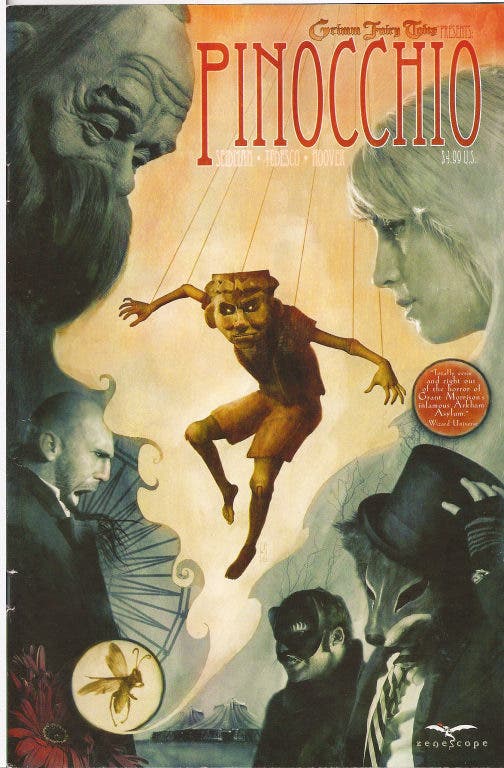
Pinocchio, presented by Grimm Fairy Tales and published by Zenescope, tells the story of a boy carved from wood by his father/maker Gepetto. Pinocchio is then brought to life by a wicked insect late one night.
This take on the classic parable differs from the animated version that made the story famous by Disney in that it veers toward a darker realm. Both Pinocchio and the mal-intentioned insect that would otherwise be known as “Jiminy” were spawned from a cursed tree, destined to “wreak havoc on the weak,” creating a complete void of cheery aspects that one might expect to see in a watered down version of a fairy tale from the twentieth century.
The story begins in a modern day suburb with a boy named Jacob and his father Mark shortly after the boy lost his mother to what appeared to be a brutal robbery turned deadly. The boy’s father discovers a book of fairy tales with the story of Pinocchio after the boy exhibits behavior that worries his father and his teacher, Ms. McCormack. From here, the story begins.
The unique style of art by David Seidman, blends photographs of actual people posing as the characters with drawn and painted elements, lending to the overall creepiness and malevolent composition of this book.
The storyline art by David Hoover of the boy and his father, are drawn up in a style that is customary to comic books, helping illustrate the juxtaposition of the two stories that run parallel to each other.
As Pinocchio becomes aware that he’s different from “real” children, his desire to transform from his wooden state leads him astray, causing him to leave Gepetto’s affectionate embrace. His mission of self-affirmation causes him to cross paths with a number of scandalous villains who, along with his wicked insect cohort, inadvertently help cultivate Pinocchio’s malignant nature.
However, Gepetto’s unyielding love for his makeshift boy causes him to engage in a tragic pursuit, ultimately leading to his own demise.
In the end, the two grisly stories collide with similar outcomes. Pinocchio impaled his father with his spike-like nose induced by incessant fibbing, while Jacob is left by his father to burn in a fire after Mark learns of his son’s inclination of evil doing.
The fairy tales that captivated us as children hold a special place in our hearts and minds. As adults, all that’s needed is a slight tweak to the plot and the design of the story, in order to continue to entertain us.