Health & Fitness
Just Struttin Farm is 'Egg-Ceptional'
Got farm-fresh eggs? Local hen rancher often sells out when she delivers dozens of cartons to Marin Coffee Roasters stand several times a week.



If you're in the mood for fresh laid eggs in Novato, Just Struttin Farm on McClay Road might be your best bet.
Owner and entrepreneur Deann DaSilva, who was born and raised in Novato, launched her business last year using three quarters of an acre on her family's homestead property as the site for 100 free-range laying hens. This year, that number increased to 300 hens and counting, with additional coops added to accommodate her growing brood. The 55-acre property has been in her family since her grandparents purchased the land in 1939. Back then her grandfather raised chickens and pheasants on the farm, selling eggs and apples he grew to local townspeople. Seventy-two years later, Deann feels like she's carrying on the family tradition.
On the day of my visit, I find Deann at the main house in the midst of a crisis. It seems a bobcat has discovered her flock, and has been poaching hens at an alarming rate. Clearly frustrated, she's just finished walking the perimeter of the property looking for signs of entry. Twenty-four chickens have fallen victim to the cat in the past three weeks — an ongoing problem since June. Despite repeated attempts to thwart the predator, her efforts have failed, but she's trying something new.
Find out what's happening in Novatofor free with the latest updates from Patch.
As we walk toward her fenced chicken yard, she points to a mannequin seated in a chair on the hill above the coop. Hopefully, the presence of "Slim" will deter the cat from future killings.
The crisis temporarily averted, Deann turns her attention to showing me her flock. She unlatches the gate to a converted horse corral, and we slip into the dirt yard with about two hundred clucking, strutting, free range hens, and a handful of roosters. She cares for her birds like a mother hen, an understandable attachment since she's raised them all from chicks. Some she even hatches herself by incubating fertilized eggs she purchases from breeders all over the United States. Her flock is "closed", which means she never brings adult birds into the group. This practice decreases the risk of introducing disease.
Find out what's happening in Novatofor free with the latest updates from Patch.
As I survey the big yard around me, Deann points out the various breeds of chickens; more than twenty in all. There are classic commercial varieties like Leghorns and "Sex-Links", as well as less common heritage breeds including Wyandotte, Brahma, Rocks, Americana, Orpington, Buff, Polish, Phoenix, Speckled Sussex, Frizzle, Cochin, Silkie, New Hampshire Red, and D'uccle — all in various color combinations.
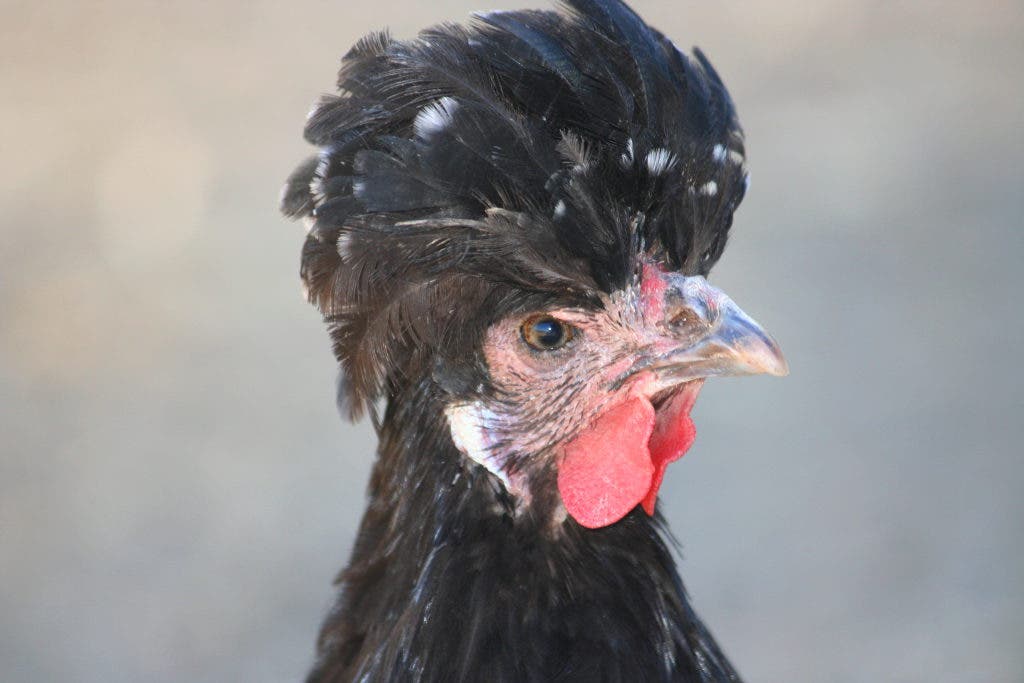
The hens gather eagerly around us as Deann bribes them with some organic cracked corn. She points out a beautiful Silver-Laced Polish who is sporting a wild feathered headdress, and nearby, a Buff Brahma who is flaunting her delicately feathered legs. A passing black Silkie looks as if she's wearing a fur coat rather than feathers. We are approached by a white Leghorn cock she's whimsically named "Steve McQueen" for his good looks. The bird eyes my camera curiously as I snap his photo, then struts away.
Deann singles out another specimen. "That's an Easter-Egger," she laughs. She's referring to the green, blue or pink colored eggs this Americana variety is known for laying. They are prized by her patrons, and she makes an effort to include at least one in every dozen she packs for sale.
Aside from the way they look, I am curious about the difference between commercial and heritage birds. I listen intently as Deann shares that commercial birds are bred for high productivity, laying the bulk of their eggs on the front end of their life cycle. These hens account for the majority of eggs purchased at traditional grocery stores. To stimulate production, many factory farms use artificial lighting cycles in their hen houses, signaling the birds to lay multiple eggs in a 24-hour period. Because of this practice, it is not unusual for a single commercial hen to lay as many as 300 eggs in her first year. On average, factory farms kill their commercial hens at the age of 72 weeks, considering them "spent" in terms of productivity.
Currently, one third of Deann's flock is comprised of commercial breed chickens. Fortunately for them, they will not suffer the typical fate of their factory farm sisters. Deann does not use artificial lighting on her organic farm, allowing her hens to follow their natural laying cycle cued by the rising and setting of the sun. This practice ultimately extends their productive life. When these hens are past their prime, she "re-homes" them or keeps them as pets. "None of my girls are culled," she tells me proudly.
Heritage birds, on the other hand, are pure-bred "boutique" chickens, often displaying beautiful color combinations and unique features. They are bred to lay eggs spaced over their lifetime of five to eight years. Because the goal of most traditional farms is to maximize production, the use of heritage breeds is on the decline and many are in danger of being phased out all together.
"Would you like to see the laying barn?," she asks me. We make our way across the field to the structure, a converted horse barn, and enter in back. I immediately see a long row of nest boxes covered with hinged wood tops. Deann lifts the lid of the first box, and motions me over for a peek. Inside, I observe several hens sitting on hay nests where they deposit their daily egg. They chide us for disturbing their peace with scolding squawks.
Deann reaches into a nest, and comes out holding a lovely bisque-brown colored egg. "Hot off the press", she says, handing me the prize. It's still warm.
Her hens lay roughly 120 to 150 eggs daily, except for the winter months when they experience a dormant cycle. Eggs are collected twice daily and placed into baskets where they are sorted by color and size, then individually washed and packed into cartons. I learn, to my surprise, that store bought eggs are an average of six weeks old when they hit the shelf.
"Fresh eggs are hard to peel when they are boiled," she explains, "so they hold them for several weeks to allow them to age." It's not hard to distinguish her hens' perky, orange-yolked fresh eggs, from the watery, pale yellow specimens in the refrigerator section of the grocery store.
All the chickens at Just Struttin Farm lead a quality life. During the day they wander free-range in their large fenced yards where they forage, dust, and scratch in the dirt as they like. At night they roost in the hen house, locked in at dusk to protect against predators. They free-feed all day long on a diet of Hunt & Behren's brand organic feed, as well as apples, zucchini, and other veggies from the family garden. Deann tells me the flock consumes two to three fifty pound bags of food a day! That's a costly proposition, especially since the price of organic feed increased by 40 percent from last year. "This is an expensive and time-consuming hobby," she cautions. "It's hard to be profitable."
To help increase the bottom line of her business, Deann raises additional laying hens which she sells to other farms and individuals. So far she's sold over 600 hens to the public this year, mostly through advertising on Craigslist. Check out her website at www.juststruttinfarm.com for more information.
Initially, Deann offered her eggs for sale at the farm, using an "honor box" system located at the end of her driveway on McClay Road. Sadly, as of this writing, repeated vandalism of both eggs and the cash box forced her to find a new venue. You can now purchase Just Struttin Farm eggs from her cooler at the at the corner of Center Road and South Novato Boulevard. She offers between 10 to 20 dozen farm-fresh eggs for sale on Tuesdays, Thursdays and Saturdays starting at 8 a.m. They often sell out by 10 a.m. A dozen eggs go for $5. Be sure to arrive early, and bring exact cash. Grab a cup of coffee while you're at it, and leave your empty egg cartons by the egg cooler. Deann will happily recycle them.
Strut on down ... they're "egg-ceptional."