Community Corner
Kehillat Israel's 'Megillah' Tells a Special Story
The Reconstructionist synagogue's holy scroll is written about a woman by a woman in time to celebrate Purim this weekend.


Blessed are you God, spirit of the universe, who makes us holy by having us engage with holy actions. We thank the source of life for bringing us to this moment in time to celebrate a new mitzvah for us as a congregation.
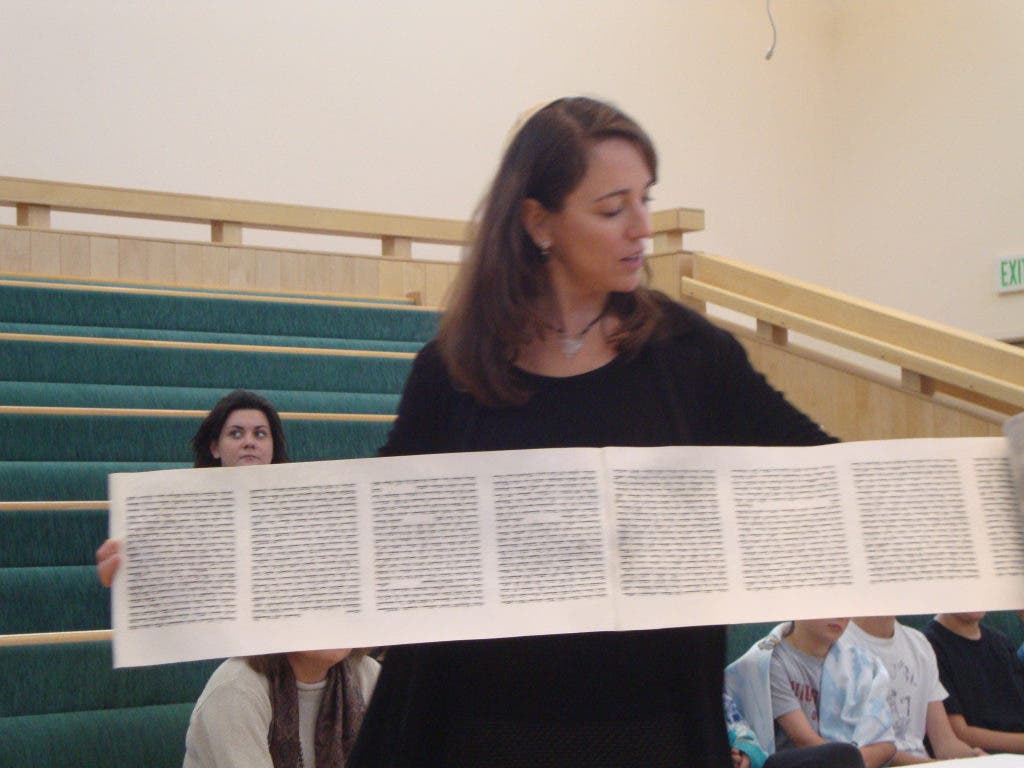
With that Shehecheyanu blessing, Rabbi Amy Bernstein welcomed members of Kehillat Israel to join soferet (scribe) Julie Seltzer in completing a specially commissioned Scroll of Esther for the congregation. The scroll is a part of the Hebrew scripture that is read on the holiday of Purim, which Jews around the world will celebrate at the end of this week.
The scroll project is one of many programs taking place at the temple to commemorate Kehillat Israel’s 60th year in Pacific Palisades. The community was started in 1950 by 10 families and was known as The Jewish Community of Pacific Palisades. Since then the Reconstructionist congregation’s membership has burgeoned to 1,000 families.
Find out what's happening in Pacific Palisadesfor free with the latest updates from Patch.
The scroll was scheduled to be completed in time for it to be read on Purim, which this year begins at sunset Saturday. Seltzer used a hand sharpened turkey feather quill and ink designed for sacred writing to inscribe the text on parchment derived from a kosher animal that was slaughtered for food. It is forbidden to slaughter an animal merely to obtain parchment.
Community members who helped underwrite the cost of the project were invited to hold the quill while Seltzer filled in the last letters of the megillah (scroll). She instructed each participant on the traditional and mystical meanings of the letter they were about to write and led them each in stating, in Hebrew or English, their intention to sanctify this act.
Find out what's happening in Pacific Palisadesfor free with the latest updates from Patch.
The letters, said Rabbi Bernstein, “for the rabbis are the building blocks of creation. The world is created through God’s speech; God speaks the world into existence with Hebrew letters. There’s an incredible love of the language and part of that love is to look at every single letter and its shape, and words that begin with it, the sounds it makes, what it used to look like and to really play with that and to understand Jewish teaching through them.”
Dana Fein wrote a letter in honor of her two daughters-in-law. “I was very honored to have done such a sacred thing,” she said.
“I think it’s very exciting that a woman is doing this for our Jewish tradition. It strengthens it. It was a very moving experience for me.”
Seltzer is one of fewer than a dozen female scribes known to be working worldwide. Jewish tradition has historically not accepted women as writers of sacred texts, but Kehillat Israel, in keeping with its progressive values, specifically sought her out. They had heard she was in San Francisco writing an entire Torah (five books of Moses) at the Contemporary Jewish Museum.
“We thought, It’s the perfect expression of the egalitarian nature of Reconstructionist Judaism,” said Rabbi Steven Carr Reuben, senior rabbi of the congregation. “We knew it would be sort of a spiritual statement about our egalitarianism, in honor of our 60th anniversary and looking forward to the future where really men and women are equal.”
Seltzer has done teachings at the synagogue for the nursery school and religious school and congregation as a whole. On this particular day, she was teaching about the traditions involved with writing a holy scroll, and one historical view that the megillah was actually first written by Esther herself.
“This is an amazing, amazing community,” she said afterward. “I feel so blessed and honored to be part of it even for a brief couple of short visits.”
Bernstein inked in the letter resh, the first initial of her Hebrew name Rachael. It also stands for rosh, or head, and rabba, rabbi.
“And so I was penning a resh as a woman; penning a Torah as a woman in the first place that’s incredible and mind-blowing. And then to be doing a letter that stands for rabbi as a woman rabbi—I live in incredible times and I stand on the shoulders of generations of women who have gone before me who never got to do this. There’s that sense of doing it for them.”